If you regularly dry bedding that’s suitable for tumble drying, a machine with the right capacity and a dedicated bedding programme is a sensible choice. If you often dry mixed loads, look for a suitable mixed-load programme. Then compare energy use, dimensions and maintenance requirements: the German Environment Agency points out that an oversized dryer, often only half full, can use more energy per kilogram of laundry.
Which dryer is right for your household?
Households with lots of bedding
If you regularly have duvet covers and pillowcases that are suitable for tumble drying, consider the size of your usual load alongside the programmes on offer. Bosch lists a bedding programme for the WQB245B40; the German Environment Agency recommends choosing a machine size to suit the amount of laundry you typically dry.
Households with mixed loads
If you want to dry cotton and other tumble-dryer-safe fabrics together, check the programme limits against the care labels. AEG lists MixDry for the TR8T70789; care symbols still determine which fabrics can go in the dryer.
Households mindful of cost and space
If you use your dryer regularly or have limited space, energy figures, dimensions and care instructions can help you weigh up your options. The Verbraucherzentrale explains how to compare energy use per 100 Eco cycles; Siemens lists the dimensions and a noise level of 61 dB(A) for the WQ45B2B40.
What should you look for when buying?
Start by considering the loads you typically dry each week, then check energy use and installation requirements rather than simply opting for the largest stated capacity.
| Buying priority |
What to look for |
Who is it most important for? |
| Bedding and drum capacity |
Check the rated capacity and programme load; look for a bedding programme on the specific model. |
If I regularly dry large duvet covers, I want a drum that can handle them without being unnecessarily large for smaller loads. Around 36% of consumers prioritise bedding. |
| Mixed weekly laundry |
Check which fabrics are suitable and the mixed programme’s load limits against the care labels. |
I dry cotton and other tumble-dryer-safe fabrics, and want to combine suitable items without ignoring their care instructions. Around 29% of consumers prioritise mixed loads. |
| Energy use |
Compare the current EU energy label, kWh per 100 Eco cycles and the size of your typical load. |
If I use my dryer often, I want to estimate energy use for my usual routine, rather than looking at the efficiency class alone. Around 21% of consumers put running costs first. |
| Installation and maintenance |
Check the machine’s dimensions, noise rating and cleaning instructions. |
If space is limited or the dryer will be near a living area, I look at its dimensions and noise rating, and check that the filters are easy to access. Around 14% of consumers prioritise installation and maintenance. |
Avoid common buying mistakes
-
Assuming the largest drum is always the most energy-efficient choice
The German Environment Agency points out that an oversized dryer, often only half full, can use more energy per kilogram of laundry. On the other hand, a smaller drum may mean extra cycles for very large bedding loads.
Compare your usual weekly loads and the size of your bedding before choosing between 8 and 9 kg.
-
Assuming a mixed-load or bedding programme is suitable for every fabric
Programmes are only suitable within their stated conditions. Care symbols tell you whether an item can be tumble dried and which drying setting to use.
Check the care labels, then follow the programme instructions for the specific model.
-
Comparing old and new energy efficiency classes as if they were the same
The EU energy label has used the A to G scale since 1 July 2025. Older ratings such as A+++ use a different labelling system and aren’t directly comparable with the current scale, as the European Commission explains.
Compare current product details and energy use in kWh per 100 Eco cycles on the same basis.
-
Assuming a self-cleaning condenser means the dryer needs no maintenance
A self-cleaning condenser doesn’t remove the need to clean the fluff filter. Miele’s care instructions note that a dirty fluff filter can trigger a cleaning notification.
Read the care instructions for the specific model before buying.
Even with this feature, you’ll still need to allow time to clean the filter and, where necessary, the container.
Brands and models to consider
Bosch
The WQB245B40 is a 9 kg model with a dedicated bedding programme.
- Bosch lists drum reversal during the bedding programme, Auto Dry and a self-cleaning condenser for this model.
- These features don’t prove that it delivers better drying results or that all Bosch dryers offer the same functions.
AEG
The TR8T70789 and TR9W75780 are different 8 kg models, each with its own manufacturer specifications.
- AEG lists MixDry for the TR8T70789 and 3DScan for the separate TR9W75780 model.
- A mixed-load programme or technology feature doesn’t replace checking care labels and the programme’s permitted load.
Beko
The B3T4224SD is an 8 kg model you can compare against your usual load sizes.
- Beko lists energy class C, OptiSense sensor drying and 62 dB(A) for this model.
- The manufacturer’s specifications alone don’t provide an independent comparison with other machines.
Siemens
The WQ45B2B40 is a 9 kg model to consider when comparing installation space and maintenance requirements.
- Siemens lists 61 dB(A), autoDry and a self-cleaning condenser for this model.
- The stated noise level doesn’t tell you how loud the machine will seem in your particular installation space; you’ll also need to keep on top of filter maintenance.
Miele
The TWH780WP is a 9 kg model with a dedicated bedding programme.
- Miele lists intelligent drum reversal in the model specifications.
- Miele notes that the drum may not reverse during the Cottons ECO programme, so check how the specific model and programme work.
Joybuy products for bedding and weekly laundry
This selection includes 8 and 9 kg heat pump tumble dryers. Compare the rated capacity with your usual loads, and check the programmes and care labels for each model.
 No image available
Haier I-Pro 1 HD80-E929E-DE, 8 kg heat pump tumble dryer
The stated capacity is a useful starting point when comparing your usual weekly loads with an 8 kg drum.
8 kg; heat pump tumble dryer; Sensor Drying Technology.
View at Joybuy
 No image available
LG RT80X7B, 8 kg heat pump tumble dryer
For mixed weekly laundry, check the specific programmes against the care labels on your fabrics.
8 kg; Dual Inverter heat pump; AI Dry, TurboDry and SensorDry.
View at Joybuy
 No image available
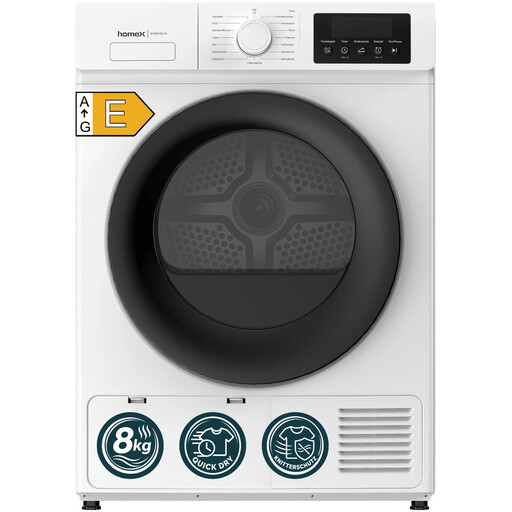
homeX WT8W1E-W, 8 kg heat pump tumble dryer
Compare the number of listed programmes with the fabrics you regularly want to dry.
8 kg; 15 programmes; crease protection. The A++ energy class stated in the product name comes from the previous scale and isn’t directly comparable with the current A to G scale.
View at Joybuy
 No image available
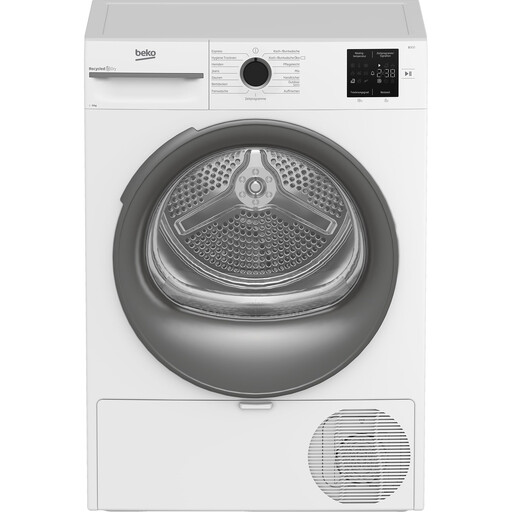
Beko BM3T39210W1, 9 kg heat pump tumble dryer
If you regularly dry bulky bedding, compare the stated capacity with the actual load limit for the programme you plan to use.
9 kg; energy class E; 15 programmes; AquaWave drum.
View at Joybuy
 No image available
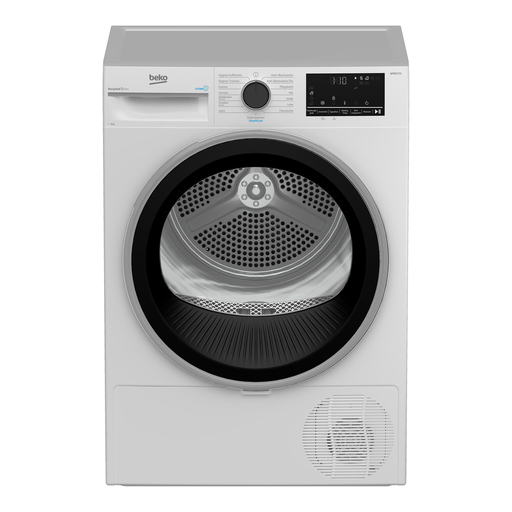
Beko B5TD6821B, 8 kg heat pump tumble dryer
Compare the 8 kg capacity with your usual loads and check that the programmes listed for this model suit your fabrics.
8 kg; 15 programmes; sensor drying; AquaWave drum; Silent programme; energy class B.
View at Joybuy
Frequently asked questions
Can all bedding go in the tumble dryer?
No. Check the care label on each item: a crossed-out tumble dryer symbol means it must not be tumble dried; the dots in the symbol indicate the permitted heat setting. A bedding programme doesn’t override these fabric care instructions.
What does the stated energy use tell me about drying bedding?
The EU energy label gives energy use in kWh per 100 drying cycles using the Eco programme. The Verbraucherzentrale describes this as a way to compare models; it doesn’t predict actual energy use with other programmes or your specific load.
Do I still need to clean anything if the condenser is self-cleaning?
Yes. Follow the instructions for your specific model to clean the fluff filters and condensate container. Miele notes that dirty fluff filters can trigger a cleaning notification; ‘self-cleaning’ doesn’t mean the entire machine is maintenance-free.
Which energy efficiency label should I compare?
The EU energy label has used the A to G scale since 1 July 2025, as the European Commission explains. Older ratings such as A+++ use a different scale and can’t be directly compared with a current rating.


