Families with lots of laundry
If you regularly wash cottons, the stated capacity should suit your usual loads. The Umweltbundesamt notes that an oversized dryer, often used only half full, can use more energy per kilogram of laundry.


For regular family laundry, a freestanding heat pump tumble dryer is an obvious choice if its drum capacity suits your usual loads. The Verbraucherzentrale recommends comparing specific appliances using the figures on the current EU energy label; if you use your dryer frequently, cycle time and condensation efficiency can also make a difference day to day. If you have enough space and time to air-dry your laundry, the Umweltbundesamt says you can avoid the electricity used for tumble drying.
If you regularly wash cottons, the stated capacity should suit your usual loads. The Umweltbundesamt notes that an oversized dryer, often used only half full, can use more energy per kilogram of laundry.
If you use your dryer frequently in winter, you can check the kWh per 100 Eco cycles on the current energy label. The Verbraucherzentrale recommends comparing this figure on a like-for-like label basis and considering the purchase price separately from running costs.
If the appliance will be near rooms you use, condensation efficiency and noise level are important points to compare. The Verbraucherzentrale lists both figures on the energy label.
First, compare the drum capacity with your usual loads. Then check energy use, where you plan to put the dryer and which programmes matter for your day-to-day needs.
| Priority | What to look for when buying | Who is it important to? |
|---|---|---|
| Capacity | Compare your usual dryer-suitable wash loads with the maximum dryer capacity and the appliance dimensions. | If I have several loads of cottons to dry, I want the capacity to suit them as closely as possible, rather than constantly splitting loads or often only partly filling a large drum. Around 31% of consumers would focus mainly on finding a capacity that suits their loads. |
| Electricity use | Compare kWh per 100 Eco drying cycles on the current label; your expected number of cycles and personal electricity tariff will determine your own costs. | If I dry laundry frequently in winter, I want to take energy use over many cycles into account, rather than comparing only the purchase price. Around 25% of consumers would put running electricity costs first. |
| Moisture in the room | Check the condensation efficiency and class on the EU label, as well as the installation guidance in the manual for the specific model. | If the dryer is near rooms I use, I want to consider how much moisture it releases at the intended location. Around 19% of consumers would pay particular attention to this when choosing. |
| Cycle time and noise | Compare the Eco programme duration and noise level in dB(A); only plan to use quick programmes for the loads specified by the manufacturer. | If I need my laundry soon or the appliance is near living spaces, predictable cycle times and a suitable noise level matter in my day-to-day life. Around 13% of consumers would prioritise time or quiet over other buying considerations. |
| Fabric care and maintenance | Check care labels, suitable cotton programmes and drying levels, as well as the cleaning instructions for the specific model. | When I have mixed fabrics, I want to be able to choose suitable programmes and know which components need regular cleaning. Around 12% of consumers would put fabric care and maintenance requirements first. |
Since 1 July 2025, household tumble dryers covered by EU regulations have used an A to G scale. A rating on the former A+++ scale is not a like-for-like basis for comparison.
Check the applicable EU label and product information sheet for the exact model. Compare energy use in kWh per 100 Eco cycles on the same label basis.
The Umweltbundesamt notes that an oversized dryer, often used only half full, can use more energy per kilogram of laundry.
Note the size of your usual wash loads and choose a capacity to suit, rather than simply opting for the largest drum.
The Verbraucherzentrale notes that a washer-dryer often has a lower drying capacity than washing capacity. This can mean you need to run additional drying cycles.
Check the washing and drying capacities separately. If you have the space, include a separate appliance in your comparison too.
Extra drying cycles can take more time; according to the Verbraucherzentrale, washer-dryers use more electricity and water than separate appliances.
Some of the moisture extracted from laundry can be released into the room. Noise level and dimensions may also be crucial for the planned location.
Measure the space you have in mind and check the condensation efficiency, noise level and installation guidance for the specific model before buying.
The Series 8 WQB245B40 heat pump tumble dryer has a 9 kg capacity, making it an option for larger family loads.
According to AEG, the Series 9000 TR9T75680 has an 8 kg capacity.
According to Beko, the B3T3249S is a 9 kg heat pump tumble dryer with sensor-controlled drying.
According to Miele, the TWC640WP in the T1 range is a heat pump tumble dryer with an 8 kg capacity.
These are freestanding heat pump tumble dryers with capacities of 8 or 9 kg, suited to households that regularly dry cotton laundry at home.
 No image available
For loads of up to 8 kg; the product description mentions sensor-controlled drying that stops when the desired dryness is reached.
Heat pump tumble dryer with several programmes.
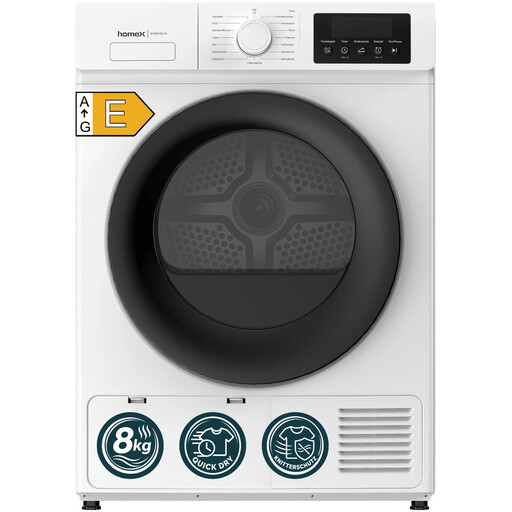 No image available
For loads of up to 8 kg; the programme list includes cottons, wool and delicates.
The description lists 15 programmes, adjustable dryness levels and a remaining-time display. The product name gives the former A++ energy rating; check the current EU label, which uses an A to G scale, instead.
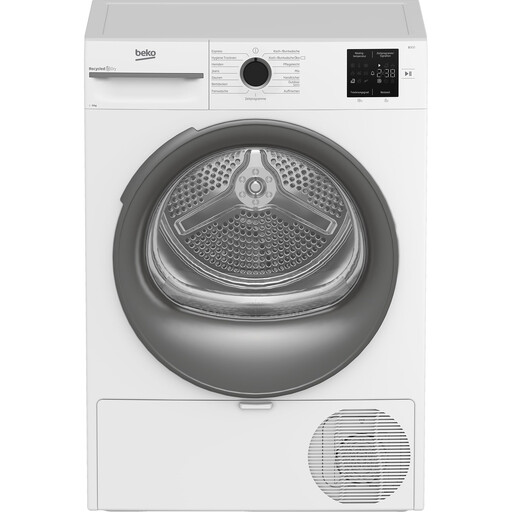 No image available
The stated 9 kg capacity could suit larger family loads if it matches your usual wash loads.
The description lists 15 programmes, including cottons and bed linen. The product name gives energy class E; check this against the current product information sheet.
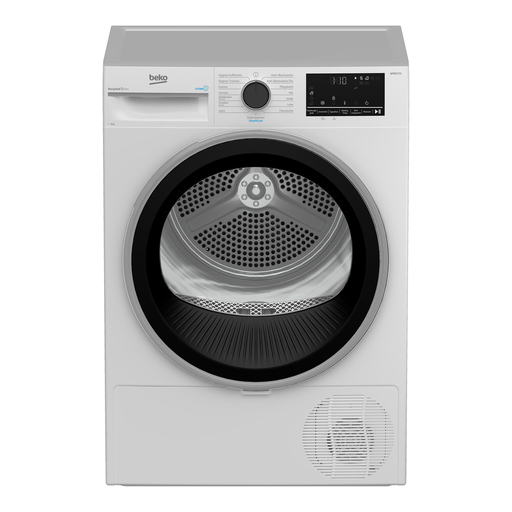 No image available
For loads of up to 8 kg; the description mentions sensor-controlled drying with an automatic programme end.
It lists 15 programmes, including cottons, as well as a Silent programme. The product name gives energy class B; check this against the current product information sheet.
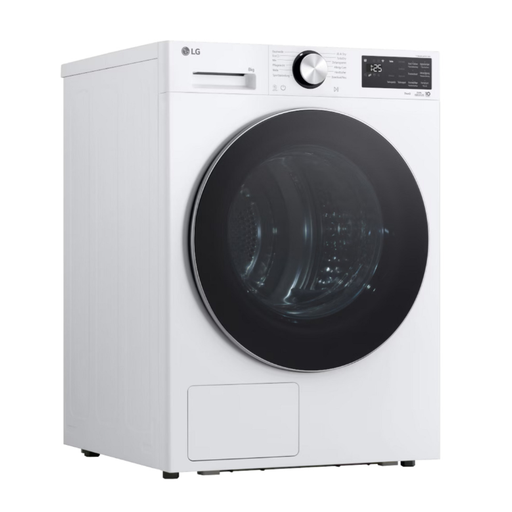 No image available
For loads of up to 8 kg; the description mentions a cottons programme and sensor-controlled drying.
The product description lists 85 kWh per 100 cycles, 91% condensation efficiency and 62 dB(A). Compare energy-use figures on the same current label basis; the product figure is not automatically equivalent to an Eco label figure.
The figure in kWh per 100 drying cycles refers to the Eco programme. According to the Verbraucherzentrale, the comparison is based on cotton laundry with a set initial and final moisture level, so it cannot predict the energy use of an individual load exactly. The label also shows the capacity, Eco programme duration, condensation efficiency and noise level.
Clean the filters and any other components specified for your model, following the manual. The Verbraucherzentrale warns that a build-up of lint and dust due to poor cleaning can pose a fire risk; according to the Umweltbundesamt, dirty filters can also lead to longer cycle times and higher energy use.
No. Since 1 July 2025, household tumble dryers covered by EU regulations have used the new A to G scale. Check the current product information sheet or the label for the specific model; washer-dryer combinations are subject to different labelling rules.
No. If a newly purchased product is faulty, consumers can generally exercise their statutory rights against the seller within two years of receiving it, as explained by the Verbraucherzentrale. A manufacturer's guarantee is an additional voluntary offer with its own terms and conditions; check delivery, installation and any additional services separately in the specific offer.
Take an old appliance to a local collection point or check whether it can be taken back when you buy a new one. The Verbraucherzentrale explains that a retailer's take-back of a large old appliance is subject to legal requirements and the specific take-back arrangements.