For regular full loads of towels, the drum capacity should match the amount of laundry you actually have. Also compare the Eco programme duration and kWh per 100 Eco cycles. The German Environment Agency points out that an oversized dryer, often only partly filled, may use more energy per kilogram of laundry. For smaller loads that need drying quickly, a moisture sensor and suitable load options can be useful. However, the number of minutes quoted for a quick programme does not show that it can dry a full load of thick towels in that time.
Who is this guide for?
Households with a big weekend wash
If several towels that can be tumble dried need to be ready by Monday, you’ll need to weigh up drum size against how often you’d run smaller, partial loads. The German consumer advice centre and the German Environment Agency both identify energy use and filling the dryer appropriately as important factors when buying.
Households short on time
If you need a towel in a hurry, check the maximum load for the programme you want rather than relying on its advertised running time alone. Manufacturers’ claims for quick programmes refer to the stated load size.
Households with limited space
To find a suitable spot, check the appliance dimensions, door opening and how condensate is handled. The German consumer advice centre also notes that washer-dryers can use more electricity and water than separate appliances.
What should you look for when buying?
First, check whether a separate appliance will fit in the space available. Then compare load size, programme duration and energy use with your towel-washing routine. The German Environment Agency points out that an oversized dryer used frequently with half loads may need more energy per kilogram of laundry.
| Buying criterion | What to check before buying | Who is this important to? |
|---|
| Towels dry on time | Check the Eco programme duration and quick-programme load separately; look for a towel programme and moisture sensor. | If the towels need to be dry by the start of the week, I want to know how long it takes to dry exactly the load I have. Around 26% of consumers put getting laundry dry on time first. |
| The right drum capacity | Compare your usual quantity of towels with the stated capacity and the load limits for individual programmes. | If you want to dry a larger weekend load in as few cycles as possible, look for enough capacity without having to put in only small loads during the week. Around 21% of consumers say getting the load size right is their main concern. |
| Electricity consumption | Compare the current energy label and kWh per 100 Eco cycles; estimate your own costs using your electricity tariff and expected usage. | If I use a tumble dryer regularly, I want to compare its stated energy use before buying. Around 21% of consumers give running costs top priority. |
| Fabric care | Check the care symbol on each towel against the temperature setting and programme; set aside any items that are not suitable for tumble drying. | If you want to dry towels in line with their care labels, make sure the programme and permitted temperature are suitable. Around 16% of consumers put fabric care first. |
| Installation and maintenance | Check the dimensions, door opening, condensate tank or drain, and the filter maintenance required. | If space and connections are limited, I want to know in advance whether the appliance will be practical there and how to manage condensate and the filter day to day. Around 16% of consumers prioritise installation and maintenance. |
Tumble dryer buying pitfalls
Assuming a quick programme’s running time applies to a full load of towels
A quick programme may be designed for a smaller amount of laundry. Midea’s stated time of 59 minutes applies specifically to 3 kg; it is not a drying time for a full 10 kg load.
Check the quick programme’s maximum load and fabric suitability. For larger loads, also compare the Eco programme duration and suitable standard programmes.
Comparing older A+++ ratings directly with today’s energy labels
Since 1 July 2025, tumble dryers sold in shops and online have used the A to G scale. The European Commission explains the change; older ratings on the previous scale are not directly comparable with today’s classes.
Compare current product information sheets and kWh per 100 Eco cycles within the same appliance category.
Expecting a washer-dryer to handle full dry loads like a separate tumble dryer
The German consumer advice centre notes that washer-dryers can often dry only half a wash load straight after washing. According to the centre, a combined appliance uses more electricity and water than a separate washing machine and tumble dryer.
Check whether the amount that can be dried straight away suits your towel load, and whether the space saved by a combined appliance is important for your household.
The extra electricity and water use, as well as the possibility of needing another drying cycle, can make day-to-day use more time-consuming.
Brands to consider
Bosch
According to Bosch, the Serie 8 WQB245B40 is a 9 kg heat pump tumble dryer designed for larger loads.
- Bosch lists Auto Dry, a half-load option and a self-cleaning condenser.
- “Extra Short 40′” does not mean a full 9 kg load of towels will dry in 40 minutes.
Siemens
According to the manufacturer, the Siemens iQ500 WQ35G2D00 is an 8 kg heat pump tumble dryer.
- Siemens lists moisture control, a half-load option, a self-cleaning condenser and a 40-minute quick programme.
- The programme duration does not show that a full load of towels will dry in 40 minutes. The product page says a condensate drain hose is not included.
Hisense
For the DH3S802BW3, Hisense lists a heat pump, an 8 kg capacity and a towel programme.
- The manufacturer states 102 kWh per 100 Eco cycles and an Eco programme duration of 126 minutes.
- The advertised running time for the 30-minute programme is no guarantee that it will dry a full load of towels.
Midea
According to Midea, the MD210H100WB-B is a 10 kg tumble dryer with a towel programme.
- Midea lists energy class B and 98 kWh per 100 cycles.
- The stated time of 59 minutes applies to 3 kg of laundry, not a full 10 kg load.
Beko
According to Beko, the B3T3249S is a 9 kg heat pump tumble dryer with sensor drying.
- Beko lists energy class C and a noise level of 63 dBA for this model.
- A test claim cited by the manufacturer from 09/2025 does not tell you how long your towels will take to dry.
Heat pump tumble dryers at Joybuy
The models below are heat pump tumble dryers for laundry suitable for tumble drying. Compare their capacities and the programme information relevant to your towel load.
 No image available
Haier I-Pro 1 HD80-E929E-DE heat pump tumble dryer, 8 kg
The 8 kg capacity and sensor drying are worth considering if load size and varying levels of residual moisture matter to you.
- 8 kg capacity
- Sensor drying
- Multiple drying programmes
 No image available
Midea MD110H70B-E heat pump tumble dryer, 7 kg
For smaller loads, the stated capacity and separately specified quick-programme load may help you decide.
- 7 kg capacity
- 15 programmes
- Sensor drying
- Quick Dry 35′
 No image available
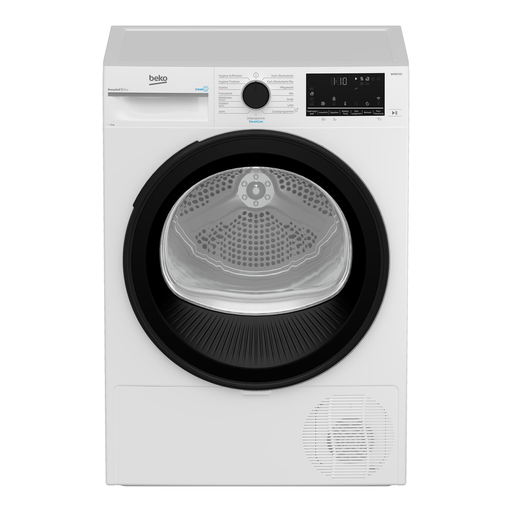
Beko B7TDT8820A heat pump tumble dryer, 8 kg
The 8 kg capacity and sensor drying are relevant for households looking to account for their usual towel load and varying quantities of laundry.
- 8 kg capacity
- Sensor drying
- 15 drying programmes
- Delay start up to 24 hours
 No image available
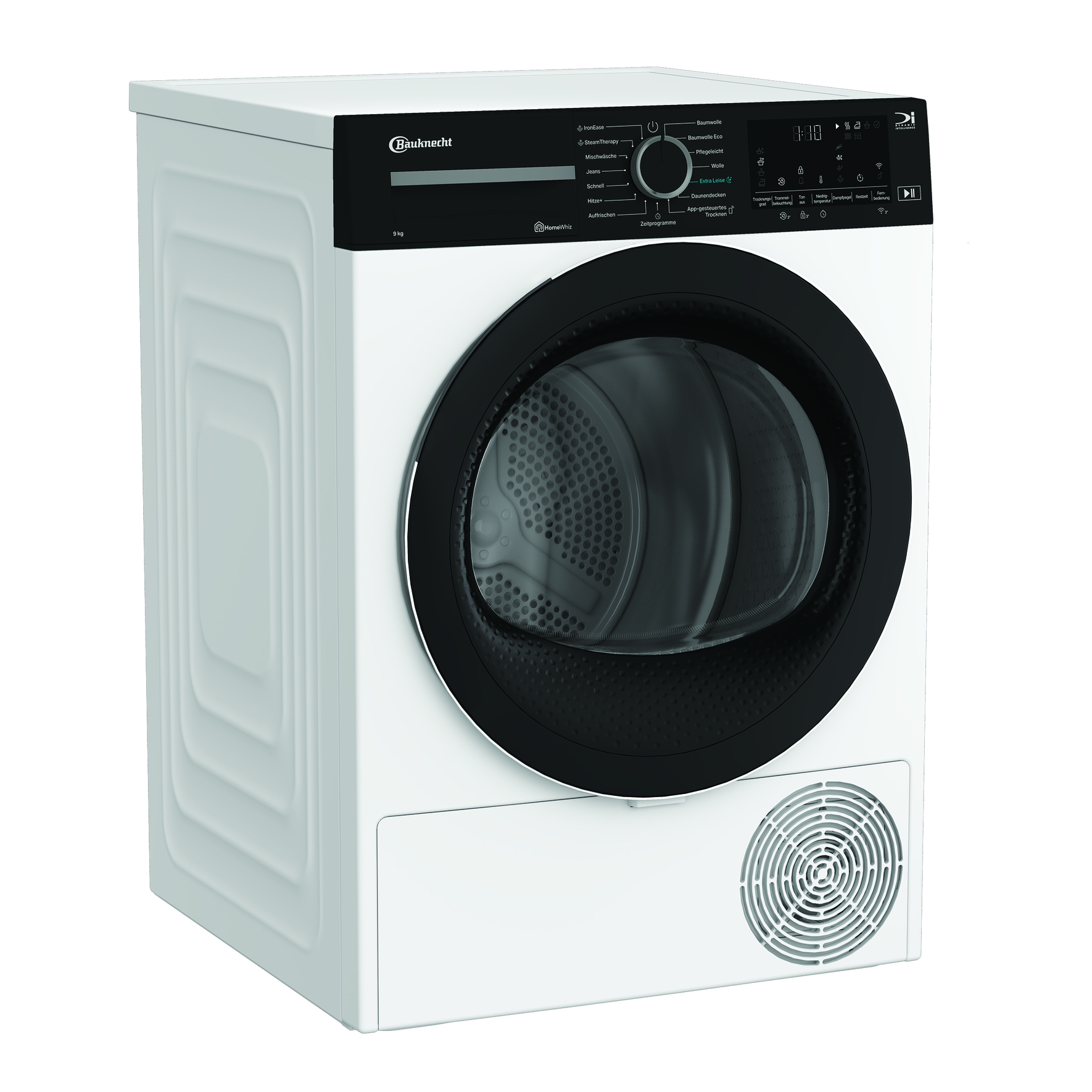
Bauknecht BD 9C WBS heat pump tumble dryer, 9 kg
If you dry larger loads, check whether the stated duration of the cotton programme at full capacity fits your schedule.
- 9 kg capacity
- Energy class C
- 195 minutes for the standard cotton programme at full capacity
- Adaptive Dry
 No image available
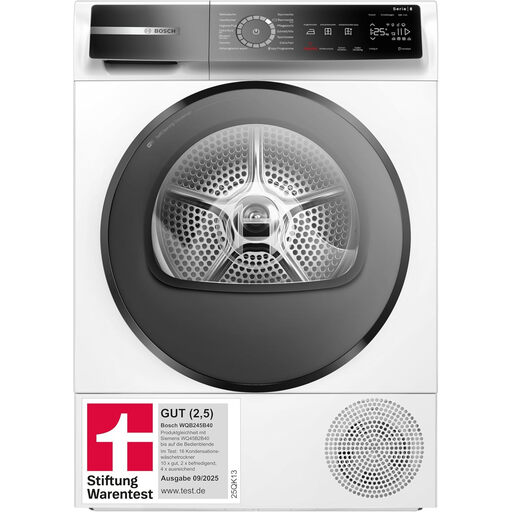
Bosch WQB245B40 Serie 8 heat pump tumble dryer, 9 kg
A towel programme and half-load option may be useful for different quantities of laundry. Compare the Eco programme duration with the time you have available.
- 9 kg capacity
- Towel programme
- Eco programme duration of 3 hours 15 minutes at full capacity
- 110 kWh per 100 cycles
- AutoDry and half-load option
- Self-cleaning condenser
Frequently asked questions
Can I count on a 40-minute programme to dry a full load of towels?
Not based on the programme name alone. Check the maximum load for the programme on the specific model; quick-programme and Eco durations are different measures.
What should I check before drying towels for the first time?
Check the care label on each towel. The dots in the tumble-drying symbol indicate the permitted temperature setting; a crossed-out tumble-drying symbol means the item should not be machine dried.
How do I compare the electricity consumption of different tumble dryers?
Use the kWh per 100 Eco cycles shown on the current energy label as your basis for comparison. To estimate your own costs, you’ll also need your electricity tariff and the number of cycles you expect to run. Other programmes may use more or less energy than the Eco figure.
Which energy label applies to tumble dryers in Germany?
Since 1 July 2025, tumble dryers sold in shops and online have used the A to G scale. The European Commission explains the labelling; the previous A+++ to D scale should not be compared directly with the new one.
How can I keep everyday care and use straightforward?
Follow the care labels and choose a suitable programme. Before buying, check the manual for the specific model to see how to handle the lint filter and condensate tank, and whether a drain connection is provided.


