People who often dry small loads
If you often wash just a few items, you won’t want to wait until you have a full drum. Check that the programmes are suitable for small loads and that the moisture control suits the amount of laundry you do.


If you regularly dry small loads and have room for a separate appliance, look for heat pump tumble dryers with dimensions that suit your space and features specifically designed for partial loads. The Verbraucherzentrale considers heat pump dryers more energy-efficient than conventional condenser dryers. If there’s no room for a separate appliance, a washer-dryer may be an option, but weigh the space-saving benefit against its higher electricity and water consumption.
If you often wash just a few items, you won’t want to wait until you have a full drum. Check that the programmes are suitable for small loads and that the moisture control suits the amount of laundry you do.
In a small flat, the appliance’s actual dimensions, access to the installation space and door opening all matter. If a separate appliance won’t fit, a washer-dryer could be an alternative.
If you use your dryer frequently or plan to place it near your living area, compare energy use and noise using equivalent label information. The energy rating alone won’t tell you everything about drying small loads.
A good fit if: you dry laundry regularly and can make room for a separate appliance with suitable dimensions. Check that it’s specifically suitable for partial loads.
The trade-off: A large stated capacity alone doesn’t mean a dryer is well suited to small loads or uses less energy when drying them.
A good fit if: a specific model, once measured, fits your available space better and you’re prepared to factor in its energy use.
The trade-off: The Verbraucherzentrale considers heat pump dryers more energy-efficient than conventional condenser dryers. Even so, compare the information for the specific models you’re considering.
A good fit if: there’s no room for a separate tumble dryer or a practical place to hang your laundry, and you need a washing machine anyway.
The trade-off: The Verbraucherzentrale highlights higher electricity and water consumption than separate appliances, as well as a lower drying capacity than washing capacity.
A good fit if: you have a suitable space to dry your laundry or access to a shared tumble dryer, and don’t need your clothes to be dry straight away.
The trade-off: Air-drying saves electricity, but takes up space while your laundry dries. How practical it is depends on your living situation.
First, check that the appliance will actually fit in the space you have and can handle small loads effectively. Then you can compare energy use, noise and fabric care.
| Priority | What to check when buying | Who is it important to? |
|---|---|---|
| Small loads | Check the permitted load for the programme you need, as well as the moisture sensor or any specifically stated partial-load option. | If I often dry just a few items, I don’t want to wait for a full drum; around 33% of consumers put suitability for small loads first. |
| Space | Compare the height, width and depth of the appliance, the door opening and access to the installation space with the dimensions of the specific model. | When space is tight, I want to know whether the appliance and access will really fit in my home; around 27% of consumers prioritise the space available. |
| Energy use | Compare kWh per 100 Eco cycles and capacity. Don’t assume the label figures are the same as the energy used for a specific small load. | If I dry laundry often, I want to be able to estimate the ongoing electricity costs; around 20% of consumers put energy use first. |
| Noise and moisture | Check the noise level in dB(A) and condensation efficiency as separate figures on the current energy label. | If the dryer is near my living area, I want to consider its noise and condensation performance in that location; around 13% of consumers prioritise the impact on their living space. |
| Delicate fabrics | Check the care label and confirm that the specific programme is approved for the fabric in question. | If I dry delicate individual items, I want to find a suitable programme; around 7% of consumers put fabric care first. |
Capacity doesn’t tell you how deep a tumble dryer is or how much electricity it will use for your laundry. Two Beko models, each with a 7 kg capacity, differ in both their technology and depth.
Compare the dimensions and current energy-use information for the full model name.
Label information is based on set conditions for the Eco programme. It isn’t a measurement for every load or programme.
Use the energy label to compare models, then check partial-load features and the conditions for each programme separately.
A washer-dryer may be able to dry less laundry than it can wash. Compare the washing and drying capacities separately.
If a wash load exceeds the drying capacity, you may need to run additional drying cycles. The Verbraucherzentrale also highlights higher electricity and water consumption than with separate appliances.
For comparing specific 7 kg models with different technologies and appliance depths.
For checking an 8 kg heat pump model with a specifically stated partial-load option.
For comparing specific models with load sensors and programmes for delicate fabrics.
For checking a separate 8 kg heat pump tumble dryer with connectivity and drainage options.
This selection features separate heat pump tumble dryers. For small loads, check the partial-load features listed and the actual installation dimensions of each model.
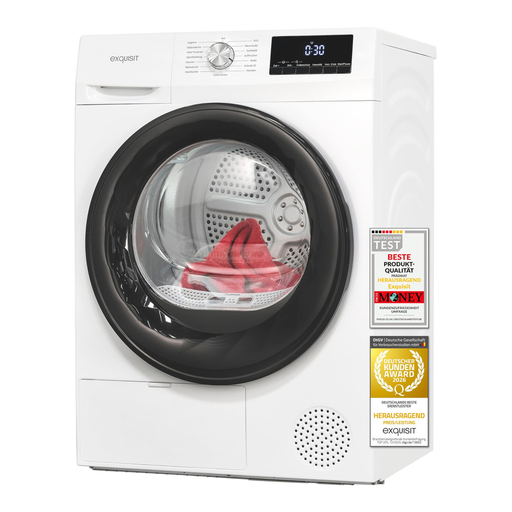 No image available
Could be worth considering if a 7 kg appliance with a depth of 54 cm fits your available space; this doesn’t mean it’s particularly suitable for small loads.
Features listed include 15 programmes, a Quick 30' programme, anti-crease function, remaining-time display and a 4–24-hour delay start.
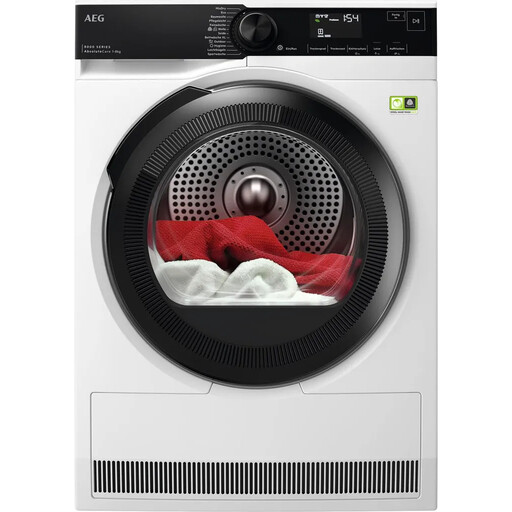 No image available
The product description lists ProSense load sensing for varying load sizes. Also check whether the specific programme suits your small load.
Figures listed include 85 kWh per 100 cycles, 63 dB and a depth of 657 mm. The description also lists programmes for wool and silk.
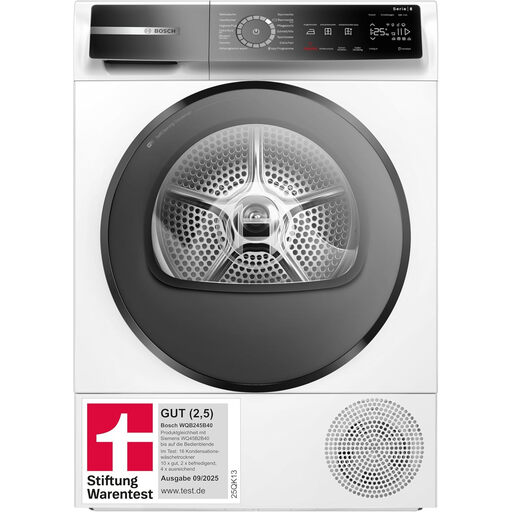 No image available
The description lists Half Load for smaller loads and AutoDry. Check the permitted load for the programme you plan to use.
Figures listed include 110 kWh per 100 cycles, energy efficiency class C on the A to G scale, 61 dB(A) and a depth of 613 mm. The condenser is described as self-cleaning.
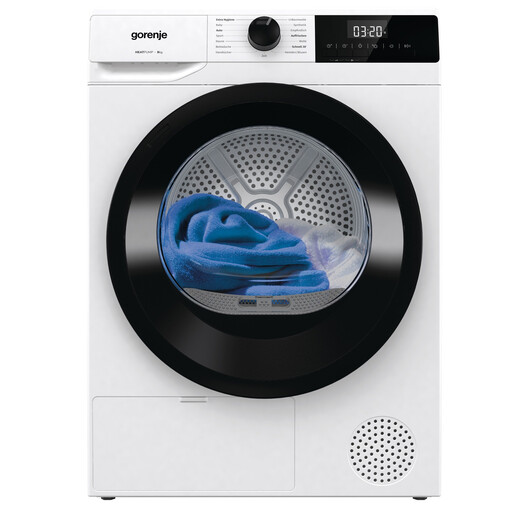 No image available
According to the description, AutoDry with a moisture sensor ends the cycle when the selected dryness level is reached. Check that the appliance’s depth of 550 mm suits your installation space.
Figures listed include 119 kWh per 100 cycles and 64 dB. The product information gives a condensation efficiency of 85% at full load and also lists AutoDrain.
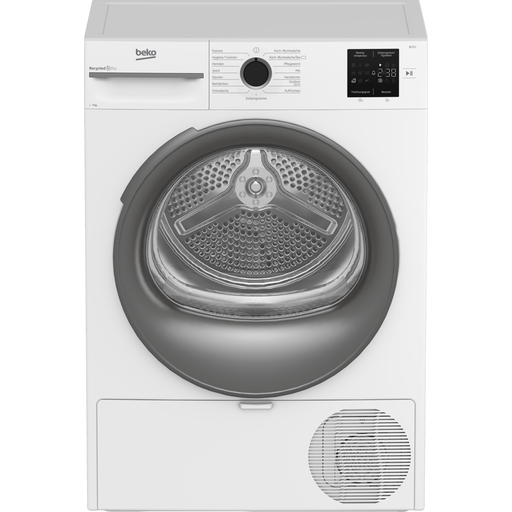 No image available
Sensor drying may be worth considering if you’re looking for a 7 kg appliance with a depth of 54,5 cm.
Features listed include energy efficiency class E on the A to G scale and sensor drying.
The label shows comparison figures under set conditions, but it doesn’t measure the energy used for your specific small load. These figures include kWh per 100 Eco cycles, rated capacity, programme duration, noise and condensation efficiency. The A to G scale has applied to household tumble dryers since 1 July 2025; the European Commission explains the change.
Measure the space and access using the dimensions of the exact model. Before installing it, also check the installation and safety instructions; the clearance required depends on the appliance.
First, check the care label and the programme you selected. For the relevant appliances, Beko recommends cleaning the lint filter after every drying cycle; check any other filters according to your model’s instructions.
Under statutory consumer rights, the seller is generally responsible, not the manufacturer. In August 2026, the Verbraucherzentrale explained that the goods must be free from defects when handed over, with a two-year period applying; any additional guarantee offered is separate.
No. Electrical waste is collected separately. The Umweltbundesamt lists local collection points and returning the appliance to a retailer when buying a new one as disposal options.