Listeners with an existing audio system
You want to listen to live LPs through your existing amplifier or active speakers. Check that the phono or line output matches the input.


For live albums in your hobby room, your turntable should suit the input on your audio system. Check whether you use a phono or line input, then choose between fully automatic operation, manual operation or an automatic tonearm lift at the end of a record. Fully automatic models make starting and returning the tonearm easier, while manual models offer more adjustment options. Set your turntable on a level surface, away from your speakers. Choose the speed, a compatible replacement stylus and any extra connections, such as Bluetooth or USB, based on your collection and what you actually need.
You want to listen to live LPs through your existing amplifier or active speakers. Check that the phono or line output matches the input.
You want to start a side of a record easily and do as little as possible with the tonearm when it finishes. Check whether the model starts and returns the tonearm automatically, or simply lifts it at the end.
You want to choose speeds and replacement styli to suit your collection, or connect your turntable differently in the future. Depending on the model, extra adjustment options may mean more set-up is required.
| What matters | What to check before buying | Who is this important for? |
|---|---|---|
| Connecting to your audio system | Check the inputs on your amplifier or active speakers, the phono/line switch and any cables you’ll need. Bluetooth is only useful if you want to use a compatible receiver. | If I want to keep using my existing audio system, the signal path needs to match the input. Around 36 % of consumers make compatibility with existing equipment a priority. |
| Listening to full album sides | Check automatic start, tonearm lift at the end and return separately. | If I want to listen to a live album without lots of manual steps, it matters which operations are actually automatic. Around 29 % of consumers prioritise easy operation for a side of a record. |
| Setting up in your hobby room | Allow for a level surface and check the model’s external dimensions against the space available. Audio-Technica points out that speaker vibrations can affect tracking. | If there are speakers in the same room, I need a suitable spot for the turntable that doesn’t block access to my audio system. Around 21 % of consumers focus primarily on placement. |
| Records and replacement styli | Check the speed and the stylus that’s compatible with the specific cartridge; remove dust according to the care instructions. | If I listen to different records, I want to match the speed and stylus to my collection. Around 14 % of consumers put record formats and care first. |
A phono preamp prepares the signal for a suitable input, but it doesn’t replace an amplifier or speakers. Check which equipment and inputs you already have.
Depending on your existing set-up, you may need suitable speakers and connection cables.
First, compare the inputs on your equipment with the turntable’s phono or line output.
An automatic lift raises the tonearm at the end of a record. Automatic start and tonearm return are separate functions, as the model details from Sony, Denon and Technics show.
Check the product description to see separately whether the turntable starts, lifts the tonearm and returns it.
Audio-Technica points out that speaker vibrations can affect the stylus and cause it to skip.
Choose a level surface and leave some space between the turntable and your speakers.
If your current spot isn’t suitable, you may need to rearrange the room.
The 78 rpm specification alone doesn’t tell you whether the supplied stylus is suitable for every record that plays at that speed. A replaceable stylus must also be compatible with the specific cartridge.
Check the speed, record material and the stylus designed for it separately. Ortofon also recommends gently removing dust before playing a record.
Some records may require an additional compatible stylus.
The models mentioned mainly differ in their operation, connections and adjustment options.
The PS-LX310BT combines automatic operation with several connection options.
According to Denon, the DP-300F combines fully automatic operation with a tonearm that can also be used manually.
The SL-1500C combines manual operation with an automatic tonearm lift at the end of a record.
Dual describes the CS 329 as a fully automatic turntable that comes pre-assembled.
The range includes models with built-in speakers and turntables with RCA outputs. Depending on the model, you’ll also find fully automatic operation, Bluetooth or USB recording. Check each product to see which connections and features suit your audio system and listening habits.
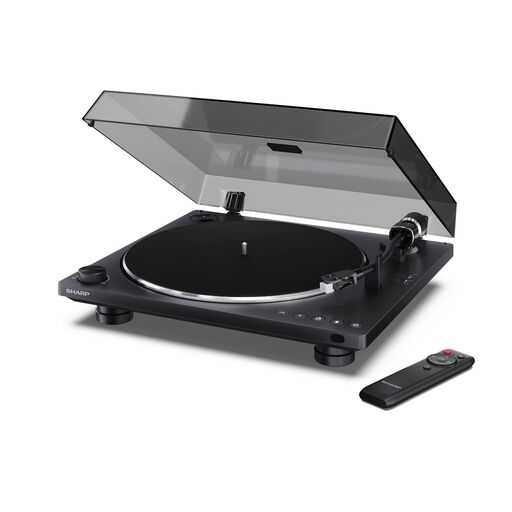 No image available
If you want an easy way to play album sides and record your vinyl, this model combines fully automatic operation with USB-C recording. Bluetooth requires compatible speakers or headphones.
Features an Audio-Technica cartridge, dust cover and RCA outputs with phono and line settings.
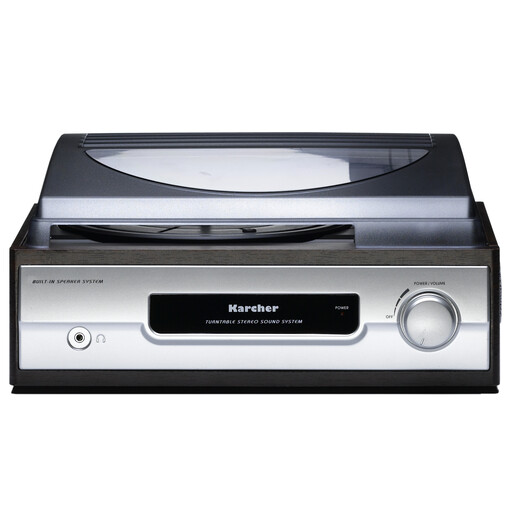 No image available
If you want to listen in your hobby room without separate speakers, this model has built-in stereo speakers. The RCA line output lets you connect it to a device with a compatible input.
33/45 rpm, auto-stop, headphone socket and RCA LINE OUT.
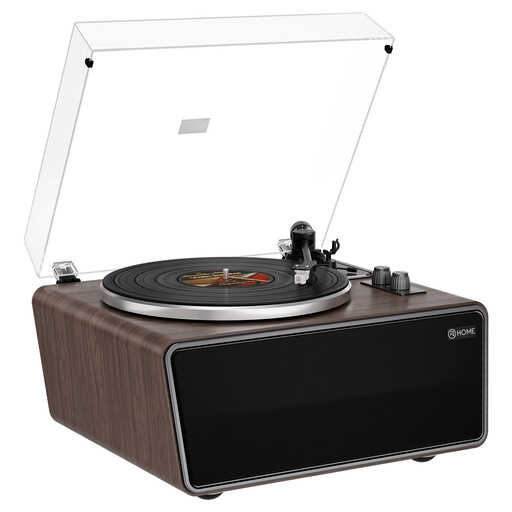 No image available
If you want to listen to live albums without separate speakers, the product description lists four built-in speakers and connections for external speakers.
33⅓ and 45 rpm, Bluetooth, USB recording, phono and line RCA outputs, plus an AT-3600L (MM) cartridge with a diamond stylus and adjustable counterweight.
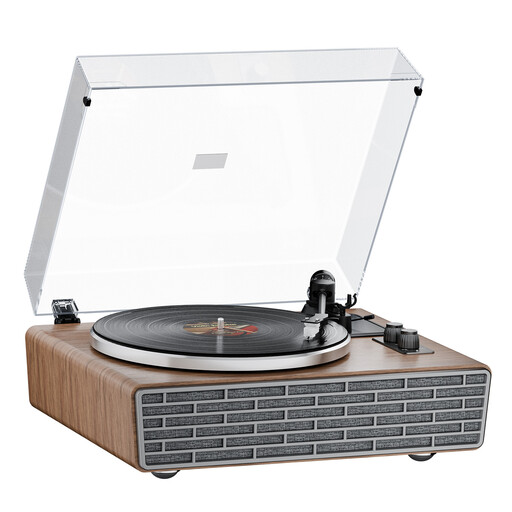 No image available
If you want the option of using either the built-in speakers or an external audio system in your hobby room, the description lists both connection options.
33⅓ and 45 rpm, Bluetooth, AUX, separate phono and line outputs, belt drive and dust cover.
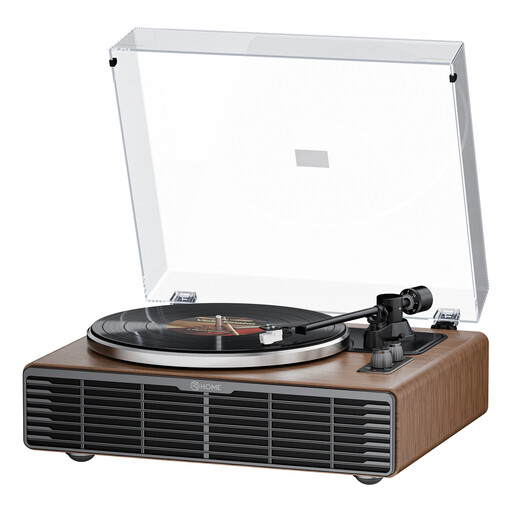 No image available
If you want to listen in your hobby room without separate speakers to begin with, then connect an audio system later, the description lists built-in speakers and RCA outputs.
33⅓ and 45 rpm, Bluetooth, belt drive, AT3600L cartridge, phono/line RCA outputs and transparent dust cover.
Yes, as long as the turntable’s output matches the speakers’ input. For a line or AUX input, for example, you can use the switchable phono preamp on the Audio-Technica AT-LP60X. Check the connection type and cable required for the specific device, too. A phono preamp doesn’t replace speakers.
Choose a level surface and don’t place it right next to your speakers. Audio-Technica points out that speaker vibrations can affect the stylus and cause it to skip.
Ortofon recommends removing dust from the record with a fine anti-static brush or cloth before playing it, and not using solvents on the stylus. Also follow the care instructions for your specific cartridge.
Follow the rules that apply where you live and in your building. For neighbour noise caused by people’s behaviour, the German Environment Agency refers to state law, local regulations and, where applicable, building rules.