What should you check before buying?
First, check the signal path from the turntable and phono stage through to your amplifier and speakers. Then plan where to put the turntable and decide how much automation you want for long album sides. Audio-Technica Europe explains that passive speakers need an amplifier; Cambridge Audio advises against connecting a phono output to a phono input when a phono stage is already in use.
| Consideration |
What to check before buying |
Who is this important to? |
| Connections and signal path |
Check your system’s inputs and match the phono/line setting; find out whether passive speakers need an amplifier. |
If I want to use my existing speakers, the signal path needs to match my amplifier and its inputs. Around 36% of consumers put the right connection first. |
| Placement in the living room |
Measure the space needed for the turntable and dust cover; plan for a stable, level surface away from the speakers. |
In a large living room, I need suitable spots for the turntable and speakers, and want to take possible vibrations into account. Placement is a key consideration for around 29% of consumers. |
| Playing long album sides |
Check separately whether the exact model has automatic start, end-of-record lift and return. |
When I listen to long live sides, I want to know what I’ll need to do at the start and end. Around 21% of consumers prioritise ease of use for long album sides. |
| Cartridge and adjustability |
Check whether the cartridge or stylus can be replaced and what tonearm adjustments are required. |
I want to be able to change the cartridge or adjust the setup later, so I check what the specific model allows. Around 14% of consumers put adjustability first. |
Turntables for different listening habits
This selection includes fully automatic turntables, as well as models and compact systems with built-in speakers or connections for an existing hi-fi system. Check that each product’s signal path is right for your amplifier and speakers. Built-in speakers alone don’t tell you how well the sound will carry across a large room.
 No image available
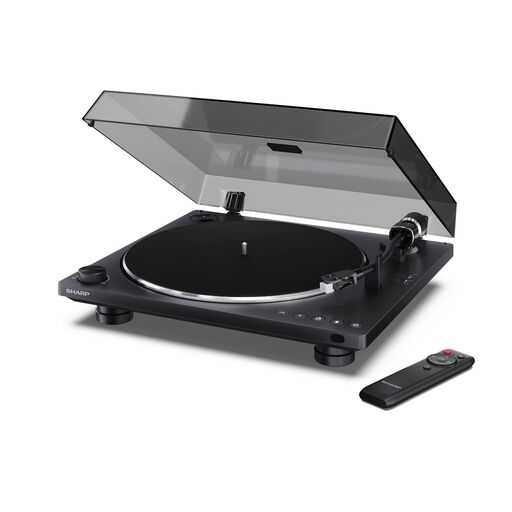
SHARP RP-TT95
The product title lists fully automatic operation for long album sides. Connection options include RCA outputs and a built-in preamp with PHONO and LINE settings.
The title also lists Bluetooth 5.4, USB-C recording and an Audio-Technica cartridge. According to the product description, Bluetooth is for compatible speakers or headphones.
View at Joybuy
 No image available
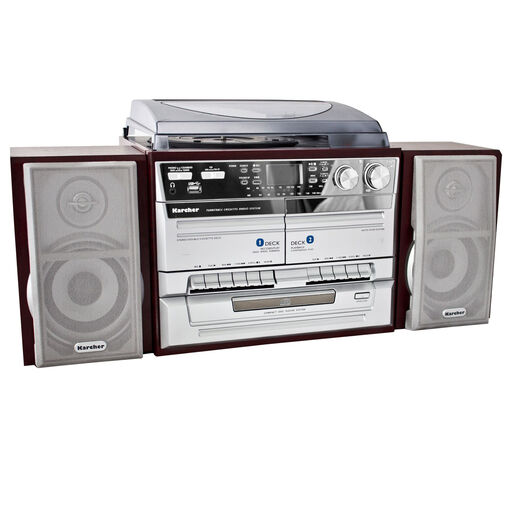
Karcher KA 320 compact system with turntable
If you want to play more than just vinyl, this system combines a turntable with a CD player, cassette player and radio.
The product description lists built-in stereo speakers and an RCA line-out for connecting external audio equipment. USB, an SD card reader and 33/45 rpm are also listed.
View at Joybuy
 No image available
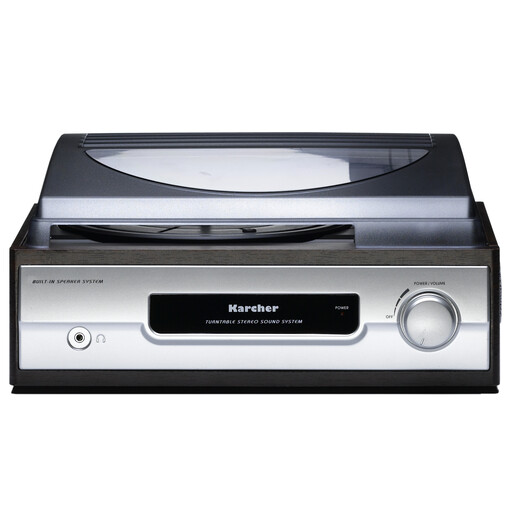
Karcher KA 8050 turntable
The product description lists built-in stereo speakers for listening directly through the unit, with an RCA line-out for connecting to an external sound system.
Features include 33/45 rpm, an auto-stop function, a headphone socket and a line-out. According to the description, auto-stop stops the platter at the end of a record.
View at Joybuy
 No image available
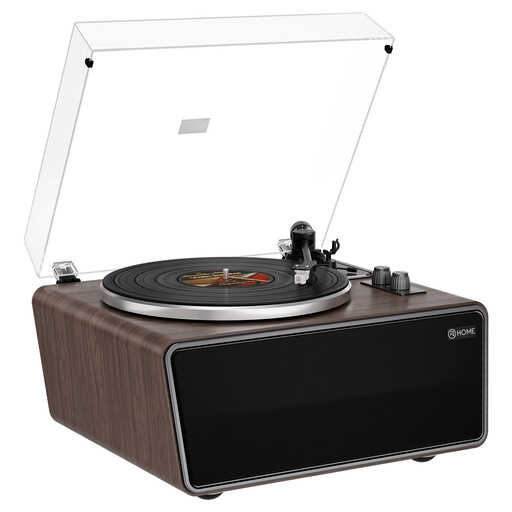
XJ-HOME XJ-H01 all-in-one turntable
If you want to listen to records directly through the unit, the description lists a built-in four-speaker system. Phono and line RCA outputs are provided for connecting to an external system.
Other listed features include a counterweight, Bluetooth, USB recording and an AT-3600L MM cartridge.
View at Joybuy
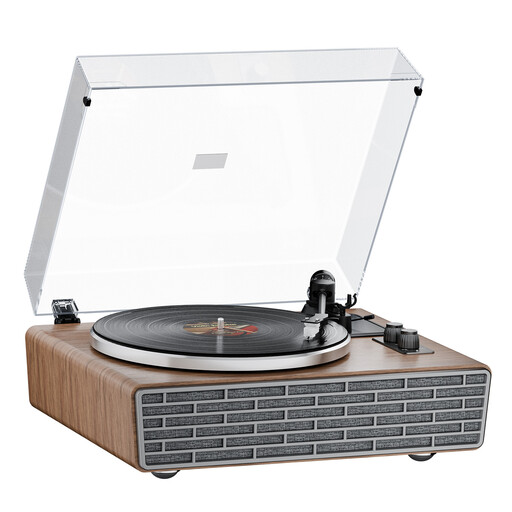 No image available
XJ-HOME XJ-H02 retro turntable
The product description lists four built-in speakers and separate RCA outputs for PHONO and LINE, so you can match the connection to your existing system.
Features include belt drive, 33⅓/45 rpm, an AT-3600L cartridge, Bluetooth and an AUX input.
View at Joybuy
Frequently asked questions about turntables in the living room
Do I need a special turntable for a large living room?
Not just because of the size of the room. First, check the signal path to your amplifier or active speakers, then plan the speaker positions around your listening area. Passive speakers need an amplifier, as Audio-Technica Europe explains.
When do I need a separate phono preamp?
You need a separate phono preamp if the turntable outputs a phono signal and neither the turntable nor the rest of your system has a suitable preamp. For the Debut Carbon EVO, Pro-Ject Audio Systems recommends an amplifier with a phono input or an external preamp. If the turntable has a switchable built-in preamp, make sure its setting matches the input.
What should I bear in mind when setting up the tonearm?
On adjustable models, set the counterweight, tracking force and anti-skating according to the instructions and the cartridge you’re using. Audio-Technica Europe notes that incorrect settings can cause distortion; follow the manufacturer’s instructions for models with fixed settings.
What are my rights when buying a turntable online in Germany?
For a standard online purchase by a consumer, the withdrawal period is generally 14 days. Statutory exceptions and any conditions on return postage should also be taken into account. This is separate from the statutory guarantee for faulty goods: Your Europe, the European Union’s consumer portal, states that goods bought in the EU are covered for at least two years from the date you receive them.
How should I dispose of an old, broken turntable?
Electrical waste shouldn’t go in your household rubbish. The German Environment Agency lists recycling centres and suitable retail take-back points as disposal options; check which return options are available locally.


