Listeners with second-hand records
You want to take the condition of second-hand records into account and choose a suitable replaceable stylus. Ortofon recommends gently removing dust before playing records, using a fine anti-static brush or cloth.


For second-hand records in an open-plan home, place your turntable on a level surface, as far as possible from speakers that cause vibrations, and make sure it’s compatible with your system’s connections. A fully automatic model is worth considering if you’d rather not operate the tonearm yourself; if you want to adjust settings such as anti-skating yourself, choose a manual model with the right features. Whichever type you choose, using a suitable replacement stylus and handling your records with care are important.
You want to take the condition of second-hand records into account and choose a suitable replaceable stylus. Ortofon recommends gently removing dust before playing records, using a fine anti-static brush or cloth.
You need a level surface and want to keep your turntable as far as possible from speakers that cause vibrations. Audio-Technica gives this placement advice for the AT-LP70XBT.
You want to check whether your amplifier has a phono input, or whether you can connect a turntable with a switchable phono preamp to a line input.
| What matters when buying | What to look for | Who is this particularly important to? |
|---|---|---|
| Record care and stylus | Check which replacement stylus is compatible with the specific model and how to care for your records and stylus. | When listening to second-hand records, I want to remove dust carefully and find a suitable replacement stylus if needed. Around 33% of consumers are likely to make care and stylus choice their top buying priority. |
| Placement in an open-plan living space | Plan for a flat, level surface away from speakers that cause vibrations. | I need to be able to position the turntable so it sits level and isn’t right next to speakers that cause vibrations. Around 27% of consumers are likely to prioritise finding a suitable spot above all else. |
| Connecting to your system | Check whether your system has a phono or line input, and whether the preamp on the specific model can be switched on or off. | If I want to keep using my existing system, I need to know which inputs it has and what connections the turntable offers. Around 20% of consumers are likely to prioritise connection compatibility above all else. |
| Automatic or manual operation | Compare how each model works and which adjustment options are actually available. | If I don’t want to operate the tonearm myself every time, fully automatic operation matters to me; if I want to make adjustments myself, a manual model may be suitable. Around 20% of consumers are likely to make the type of operation their top priority. |
A wireless audio connection doesn’t change Audio-Technica’s placement advice for the AT-LP70XBT: the turntable should sit level and be kept away from speakers that cause vibrations.
Check the placement and the receiving device separately.
A phono preamp lets you connect to certain inputs, but it doesn’t replace speakers. The right connection depends on your system’s inputs and the settings available on the specific turntable.
Before buying, make a note of your system’s inputs and check which other components you’ll need for playback.
Depending on the equipment you already have, you may still need active speakers or an amplifier and speakers.
Technics describes the SL-1500CS as a technically modified version of the SL-1500C. Don’t assume that details about one model also apply to the other.
Check the full model name and compare the features that matter to you.
The AT-LP70XBT focuses on fully automatic operation, Bluetooth and a switchable phono preamp; the AT-LP60X is also a fully automatic model.
The CS 329 is a pre-assembled, fully automatic turntable; the CS 518 is operated manually.
The DP-300F is a belt-drive, fully automatic turntable with a switchable phono preamp.
The SL-1500C is a direct-drive model; the SL-1500CS is a separate model version announced later.
This selection includes a fully automatic turntable with Bluetooth, as well as all-in-one systems with built-in speakers. Check that the connections suit your system, and plan where to place the turntable independently of how it transmits audio.
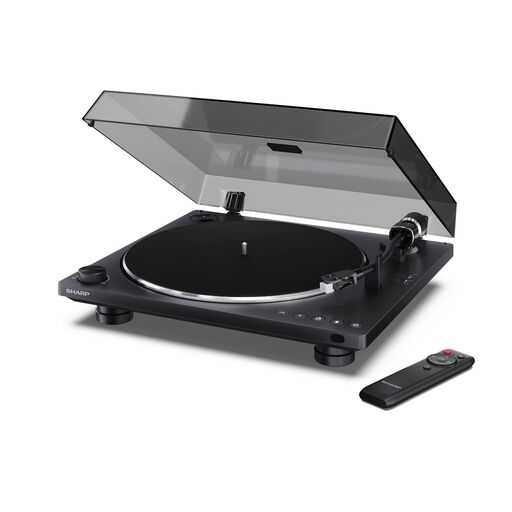 No image available
Fully automatic operation may suit you if you’d rather not operate the tonearm yourself every time you start or finish playing a record.
The product details list Bluetooth 5.4, a built-in preamp, an Audio-Technica stylus and a USB-C recording function. Check that the receiving devices you want to use are compatible with Bluetooth.
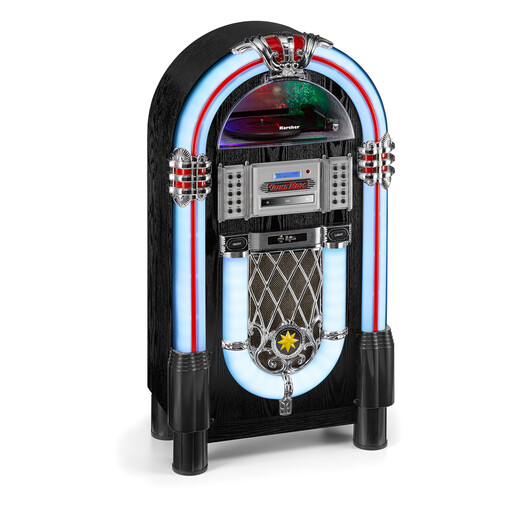 No image available
This all-in-one system may suit you if you’re looking for a turntable and speakers in a single unit.
The product description lists two built-in stereo speakers and record playback at 33, 45 and 78 U/min. It also lists CD playback, radio and Bluetooth.
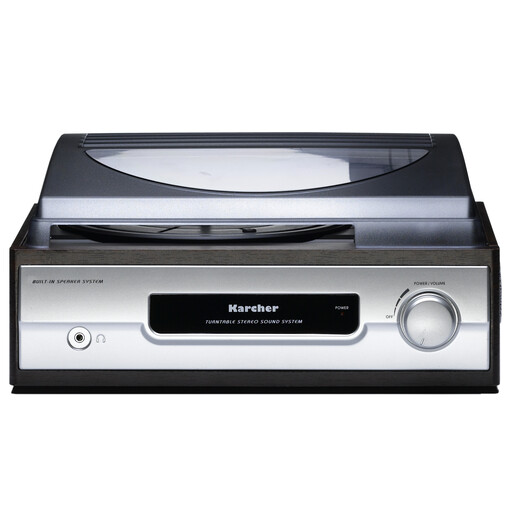 No image available
This model may suit you if you want to use built-in speakers or connect the turntable to an external system via a line output.
The details list 33 and 45 U/min, built-in speakers, auto-stop, a headphone socket and line-out.
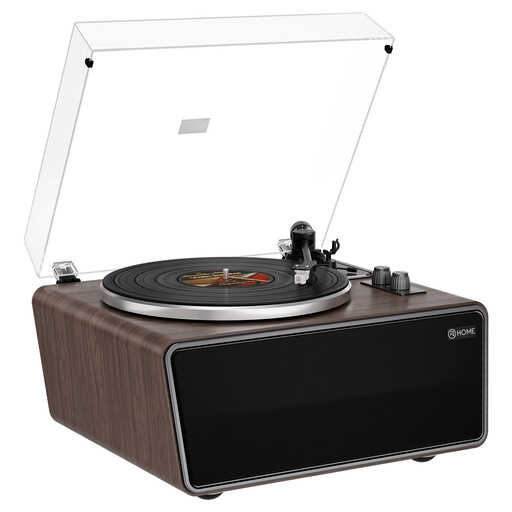 No image available
The built-in speakers let you play records without separate speakers; still, check that the location suits your living space.
The product details list four built-in speakers, 33⅓ and 45 U/min, a phono preamp and phono/line outputs. An AT-3600L-MM cartridge is also listed.
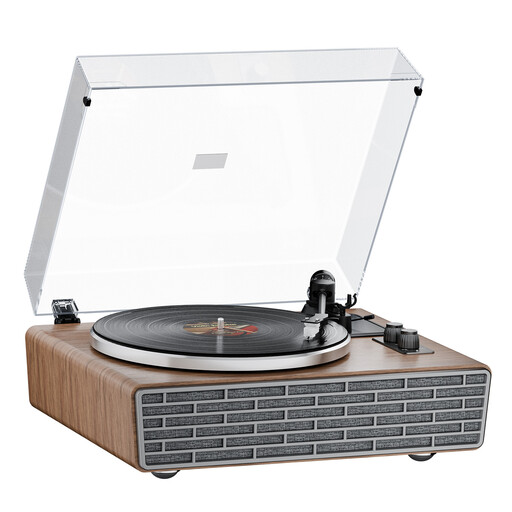 No image available
This model may suit you if you want to use built-in speakers or connect to external devices.
The details list four built-in speakers, belt drive, 33⅓ and 45 U/min, and a dust cover. RCA connections with phono and line outputs, as well as Bluetooth, are also listed.
For the AT-LP70XBT, Audio-Technica recommends selecting LINE when connecting to AUX, line inputs or active speakers. For a phono input, check the instructions for the specific device; don’t choose the switch setting based only on the shape of the plug.
For the AT-LP70XBT, Audio-Technica recommends a flat, level surface away from speakers that cause vibrations. Plan for a suitable spot rather than choosing a location based only on the available shelf width.
Ortofon recommends gently removing dust from records before playing them, using a fine anti-static brush or cloth. Clean the stylus with the recommended fibre brush, moving it in the specified direction, and also follow the instructions for your cartridge.
No. In Germany, the Verbraucherzentrale distinguishes between statutory consumer rights against the seller and a voluntary guarantee with its own terms and conditions. When arranging a replacement stylus or repair, check which right or service applies to your situation.
According to the Verbraucherzentrale, consumers who buy online generally have a 14-day right of withdrawal after receiving the goods. Exceptions and the specific contract should be taken into account; you must notify the other party to the contract that you wish to withdraw.