First, check which formats and condition your second-hand records are in, and what inputs your hi-fi system or speakers offer. You can then choose between convenient full automation and a turntable with more adjustable settings. Whatever the model, make sure you have a level surface with some space between it and the speakers. Audio-Technica’s set-up guidance does not show that a particular drive system or damping can compensate for an unsuitable position.
Who should consider these options?
Listeners with limited space
Even if your speakers are close to a wall, you’ll still need a separate, level surface for your turntable. Audio-Technica advises against placing its AT-LP120XUSB on or close to speakers; this doesn’t establish a universal minimum distance in centimetres.
Collectors of second-hand records
Check whether your collection includes LPs, singles or 78 rpm records. For shellac records, the correct speed isn’t enough on its own: Audio-Technica also points out that you need a stylus suited to the record material.
Owners of existing speakers
If you want to connect your turntable to your existing hi-fi system or active speakers, compare their inputs with the outputs on the specific model. Audio-Technica explains the difference between phono and line signals. Whether you also need an amplifier depends in part on whether your speakers are active or passive.
What should you look for when buying?
Start by checking your available space, record formats and signal path. You’ll then be better placed to decide which controls and adjustment options suit your collection.
| What matters when buying |
What to check |
Who it matters to |
| Position and distance from speakers |
Allow for a level surface separate from the speakers; position the turntable there and consider where the cables will go. Audio-Technica recommends this set-up for the AT-LP120XUSB. |
I need a separate, level surface and don’t want to place my turntable on the same surface as my speakers. Around 31% of consumers are likely to prioritise where the turntable will go. |
| Record format and compatible stylus |
Check whether your records need 33⅓, 45 or 78 rpm. With 78 rpm records, the material and stylus must also be compatible, as Audio-Technica explains. |
If my second-hand records include different speeds or shellac, I want to check which stylus is suitable before buying. Around 25% of consumers are likely to prioritise record format. |
| Connecting to your existing hi-fi system |
Check whether you have a phono or line input, and whether your speakers are active or passive. A phono preamp doesn’t replace an amplifier for passive speakers; Audio-Technica highlights this when explaining the signal path. |
I want to connect my existing speakers without confusing phono and line inputs or overlooking the amplification I need. Around 25% of consumers are likely to want to check the connections first. |
| Controls and adjustability |
Compare automatic start, lift at the end of a record and return separately. Denon describes the DP-300F as fully automatic; Technics describes an automatic end-of-record lift on the SL-1500C. |
If I want to keep handling to a minimum or adjust the tonearm and stylus carefully, I’ll look at the specific features on offer rather than relying on the word “automatic”. Around 19% of consumers are likely to prioritise ease of use. |
Common misconceptions
-
Damping means you can place the turntable right next to a speaker
The information about damping on the Dual CS 429 and Audio-Technica’s set-up guidance for the AT-LP120XUSB relate to different models. They don’t prove that placing a turntable right next to speakers is always trouble-free.
First, find a level surface separate from the speakers. Consider the feet or damping features afterwards.
You may need a separate surface for your turntable.
-
A 78 rpm setting makes any shellac record ready to play
The speed alone doesn’t tell you whether the stylus is suitable for the record material. Audio-Technica distinguishes between suitable styli for shellac and those for 78 rpm vinyl.
Identify the material and speed of your records, then check that they’re compatible with the specific cartridge’s stylus.
Shellac records may need a suitable stylus, which you’ll need to check separately.
-
A phono preamp is all you need for passive speakers
A phono preamp prepares the signal for the rest of the audio chain, but it doesn’t power passive speakers by itself.
Before buying, follow the signal path from the turntable to the speakers and check that you have a suitable amplifier.
Passive speakers may need an additional amplifier.
-
End-of-record lift, return and full automation all mean the same thing
The Technics SL-1500C is described as having an automatic end-of-record lift, while Denon describes the DP-300F as fully automatic. These terms refer to different operations.
Check separately whether starting, lowering the stylus, lifting it at the end of a record and returning the tonearm are automatic.
Brands to consider
Audio-Technica
The AT-LP120XUSB and AT-LP3XBT differ in several ways, including their controls and stated playback speeds.
- According to the manufacturer, the AT-LP120XUSB has manual controls, supports 33⅓, 45 and 78 rpm, and uses replaceable VM95-series styli.
- A 78 rpm setting alone doesn’t make the AT-LP120XUSB suitable for shellac; you’ll need a compatible stylus.
- The manufacturer describes the AT-LP3XBT as a fully automatic alternative that supports 33⅓ and 45 rpm.
Denon
The DP-300F is an option if you’re looking for full automation and a switchable phono preamp.
- Denon lists adjustable balance and anti-skating for this model.
- Full automation doesn’t answer the question of where to place the turntable, nor does it confirm shellac compatibility.
Sony
According to Sony, the PS-LX310BT is designed for automatic playback through compatible Bluetooth devices or a suitable wired connection.
- Sony lists phono and line outputs, as well as 33⅓ and 45 rpm, for this model.
- Sony doesn’t list a removable cartridge head or USB output for the PS-LX310BT.
Dual
According to the manufacturer, the CS 429 combines full automation with an adjustable tonearm and a damped sub-chassis.
- Dual lists 33, 45 and 78 rpm, as well as phono and high-level connections, for this model.
- The manufacturer’s information about damping doesn’t prove that the turntable can be placed right next to speakers.
Technics
According to the manufacturer, the SL-1500C combines direct drive, built-in phono equalisation and an automatic tonearm lift.
- The manufacturer’s website describes an automatic end-of-record lift.
- An end-of-record lift isn’t the same as full automation with automatic cueing and tonearm return.
Joybuy products
The models below offer different controls and connection options, and some have built-in speakers. Check whether the speed and signal path of the specific model suit your records and existing speakers.
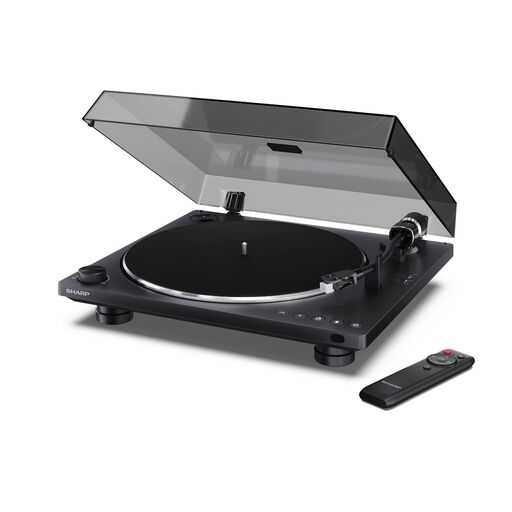 Image unavailable
SHARP RP-TT95
An option if you’re looking for full automation and several ways to connect compatible playback devices.
Bluetooth 5.4, USB-C recording and an Audio-Technica cartridge are listed in the product title. The description mentions RCA outputs and a built-in preamp that can be switched between PHONO and LINE.
View at Joybuy
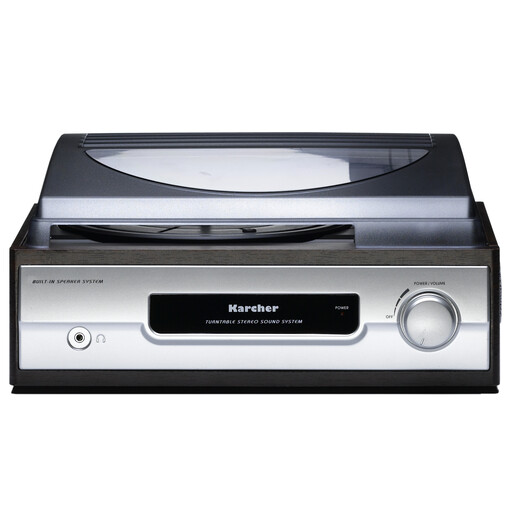 Image unavailable
Karcher KA 8050
Worth considering if your records play at 33 or 45 rpm and built-in speakers could work for your set-up.
Features listed include 33/45 rpm, an automatic stop function, built-in stereo speakers, a headphone socket and line-out.
View at Joybuy
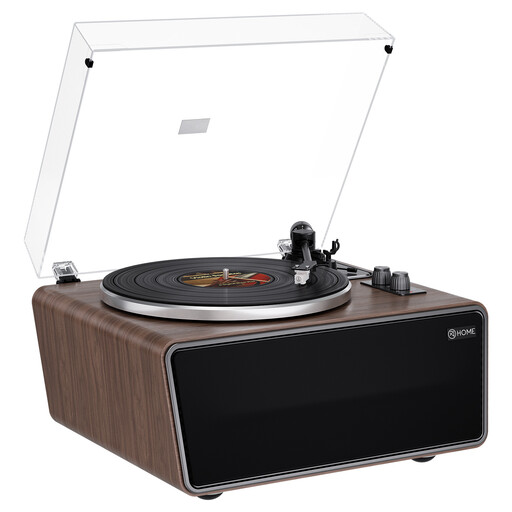 Image unavailable
XJ-HOME XJ-H01
A good fit if you’re considering built-in speakers and connections for external devices.
The description lists four built-in speakers, 33⅓/45 rpm, PHONO and LINE outputs, and an adjustable counterweight. The product title specifies an AT-3600L cartridge.
View at Joybuy
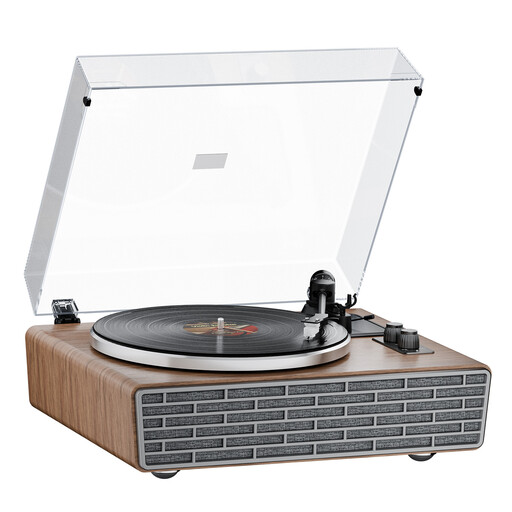 Image unavailable
XJ-HOME XJ-H02
An interesting option if you play 33⅓ or 45 rpm records and want to choose between wireless connectivity and wired connections.
The description lists belt drive, Bluetooth, an AUX input, PHONO and LINE outputs, four built-in speakers and a dust cover. An AT-3600L cartridge is also specified.
View at Joybuy
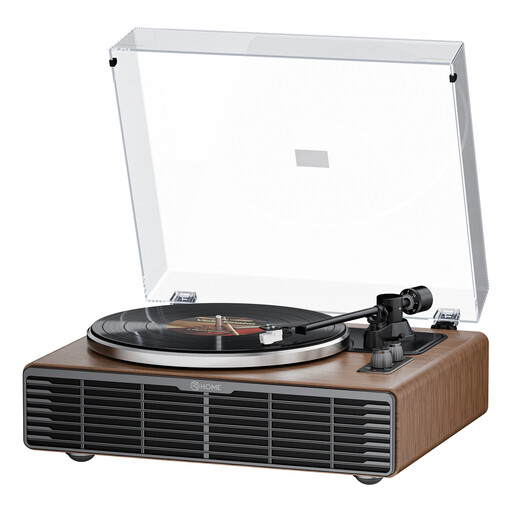 Image unavailable
XJ-HOME XJ-H03
An option if built-in speakers and outputs for external playback devices matter to you.
The description lists belt drive, 33⅓/45 rpm, four built-in speakers, Bluetooth, an AUX input and RCA phono/line outputs. It also specifies an AT3600L cartridge and a dust cover.
View at Joybuy
Frequently asked questions
Is 78 rpm enough to play old shellac records?
No, the stylus must also suit the record material. Audio-Technica distinguishes between styli for shellac and those for 78 rpm vinyl, so check the specific cartridge and the records in your collection.
Can I connect passive speakers directly to a phono or line output?
No, passive speakers need suitable amplification. Also check whether your signal path needs a phono preamp, or whether one is already built into the turntable or hi-fi system.
How should I position the turntable and care for the stylus?
Place the turntable on a level surface, not on or close to the speakers. Audio-Technica points out that dust can collect on the stylus; follow the instructions for your stylus and cleaning product when cleaning it carefully.
What extra connections or components might my set-up need?
Check whether your set-up needs a suitable replacement stylus, a phono preamp or, for passive speakers, an amplifier. The components you need will depend on your records, turntable and existing equipment.
What should I look for in terms of electrical product safety and eventual disposal in Germany?
For electrical and electronic equipment, Germany’s Federal Network Agency checks matters including CE marking, manufacturer details and instructions in German. This doesn’t confirm that an individual product listing is compliant. According to the German Environment Agency, electrical waste must be collected separately and not disposed of with household rubbish.


