Jazz single collectors
If you want to play the singles you already own, check their stated speed and whether you need an adapter for the centre hole.


First, check the speed stated on your singles and whether you need an adapter for their centre holes. If several people will be using the turntable, a fully automatic model can make it easier to operate. Also check that its connections are compatible with your sound system, and find a level surface away from vibrating speakers. Whether music played in a shared space counts as a public performance depends on how it is used, not on the purchase of the equipment.
If you want to play the singles you already own, check their stated speed and whether you need an adapter for the centre hole.
If several people will be using the turntable, easy-to-understand controls and a position away from speaker vibrations are important things to consider. Audio-Technica recommends placing the AT-LP70XBT on a level surface, away from speakers that could cause vibrations.
Before buying, check whether your system has a phono or line input, and which stylus can be replaced on the model you choose.
Start with your singles and existing sound system. Then decide whether simple automatic operation or more manual control is the priority for people using the space.
| Buying priority | What to look for | Who is it important to? |
|---|---|---|
| Playing singles correctly | Check the speed stated on the records, whether the turntable supports 45 U/min and whether you need a suitable centre-hole adapter. | If I want to play the singles I already own at the right speed, I check their labels and centre holes. This is a priority for around 28% of consumers. |
| Easy operation | Check whether the turntable starts and returns automatically, rather than simply lifting the tonearm at the end of a record. | When several people use the turntable, I want starting and finishing playback to be easy. Around 22% of consumers prioritise straightforward operation. |
| Connecting to your sound system | Check your system’s inputs and the turntable’s phono or line output. For the Pro-Ject T1 EVO, make sure you check the exact version. | If I want to connect the turntable to my existing system, I need to know which connection will work. Around 22% of consumers have this priority. |
| Finding the right position | Allow for a level surface, space between the turntable and vibrating speakers, and enough room to open the dust cover. | In a shared space, I need a suitable position where speakers are unlikely to transfer vibrations. Around 17% of consumers pay particular attention to positioning. |
| Stylus replacement and care | Check which stylus can be replaced on the exact model and follow the relevant cleaning instructions. | When several people play records, I want to know how to care for the stylus and singles, and which parts can be replaced. Around 11% of consumers prioritise care and replacement options. |
On the Technics SL-1500C, the auto-lift function raises the tonearm at the end of a record. It does not mean the turntable starts automatically.
If people taking turns need to start playback at the touch of a button, check the start and end functions separately in the specifications for the exact model.
The standard, Phono and BT versions of the Pro-Ject T1 EVO have different features. With the Denon DP-300F, the connection method depends on whether its built-in preamplifier is switched on.
Check the exact version against the inputs on your system. Denon says its built-in phono preamplifier can be used with an AUX input and switched off when connecting to a compatible phono input.
According to Audio-Technica, the AT-LP70XBT is a fully automatic model for 33⅓ and 45 U/min, with Bluetooth and a switchable phono preamplifier.
Sony describes the PS-LX310BT as a fully automatic model with 33⅓ and 45 U/min, and phono and line outputs.
The DP-300F is a fully automatic belt-drive option with a switchable phono preamplifier and 33⅓/45 U/min.
The standard, Phono and BT versions of the T1 EVO have different features.
The CS 518 is a manual option with 33/45/78 U/min, a removable headshell and a switchable MM phono preamplifier.
According to Technics, the SL-1500C combines direct drive, a built-in phono equaliser and automatic tonearm lift.
The models below are suited to playing singles at 33⅓ or 45 U/min. Some also have built-in speakers or connections for an existing sound system.
 No image available
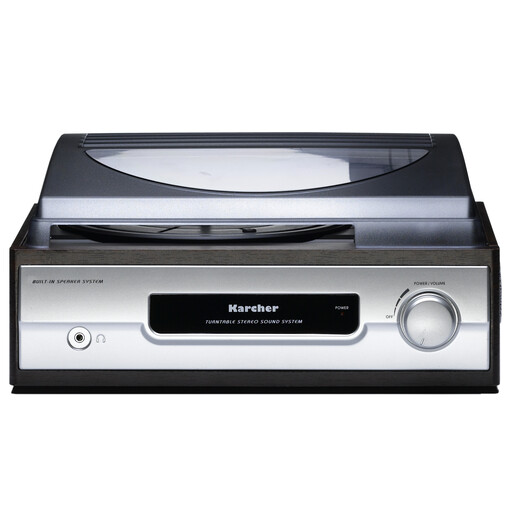
An option for singles if built-in speakers or a line output to connect to your existing sound system suit your needs.
Supports 33 and 45 U/min; according to the product description, an adapter is included. The title also mentions auto-stop, a headphone socket and a line output.
 No image available
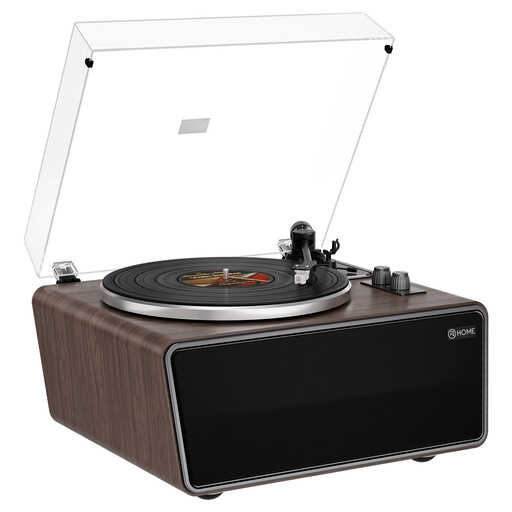
The built-in speakers let you play records without a separate speaker system. The phono and line outputs are listed for connecting other audio equipment.
The description lists 33⅓/45 U/min, playback of 7-inch records, a phono preamplifier and an AT-3600L cartridge.
 No image available
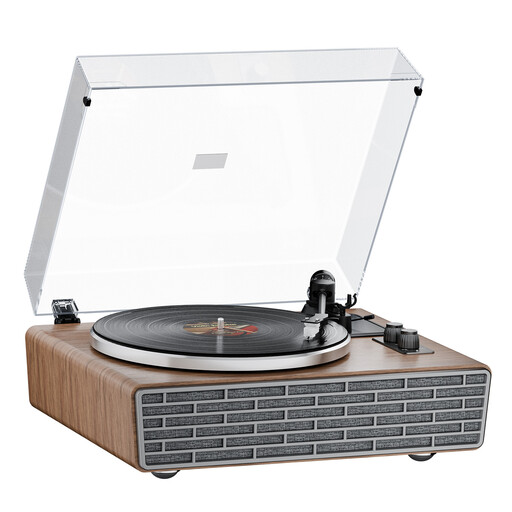
The built-in speakers let you play records without a separate speaker system. Bluetooth and the listed phono and line outputs offer additional connection options.
The title lists a belt drive and dust cover; the description lists 33⅓/45 U/min and an Audio-Technica cartridge.
 No image available
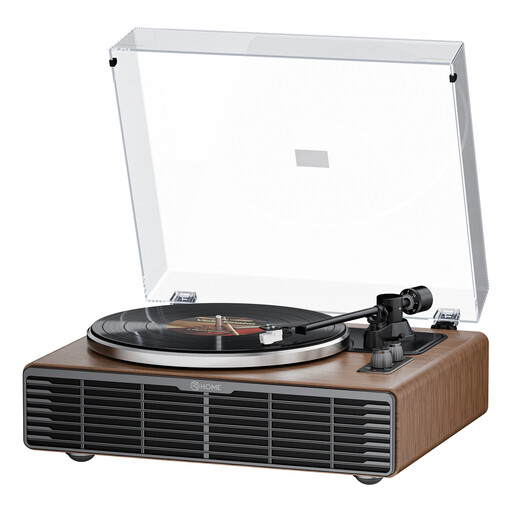
The built-in speakers let you play records without a separate speaker system. The RCA phono/line output offers a connection option for external audio equipment.
The description lists 33⅓/45 U/min and an AT3600L cartridge. The title lists a belt drive and a transparent dust cover.
Check the speed stated on the specific record and the size of its centre hole, rather than assuming either from the format alone. Audio-Technica lists 33⅓ and 45 U/min for the AT-LP70XBT, along with a supplied 45 U/min adapter. Sony lists the same speeds and an adapter for the PS-LX310BT.
That depends on your system’s inputs and amplification. For the Denon DP-300F, Denon says to switch on the built-in phono preamplifier when using an AUX input and switch it off when using a compatible phono input. Check the connections and settings on the specific equipment you choose.
Audio-Technica recommends placing the AT-LP70XBT on a level surface away from vibrating speakers. You can remove dust and fluff with suitable brushes for records and styli; follow the instructions for your particular device.
If a product is faulty, your statutory rights are against the seller; these are separate from any voluntary guarantee. The German Environment Agency advises that discarded electrical equipment must not be put in household waste in Germany. It should be collected separately or returned.
You cannot decide this based on the equipment or the name of the room alone. Under § 15 UrhG, whether a performance is public depends in part on whether the music is intended for several people who do not have the personal relationships described there. GEMA explains that public music performances must be registered. So check how the music will be used and who will be listening, rather than assuming a blanket rule applies to every shared space.