Listeners with existing speakers
If you want to use an existing hi-fi system or active speakers, first check whether you need a phono or line-level signal. Audio-Technica and Dual outline the relevant connection options for their models.


First, choose a turntable whose signal path suits your speakers or hi-fi system, then check the space available and how easy it is to use. A switchable phono preamp can make it easier to connect to different inputs; Bluetooth is only useful if you have a compatible receiving device. Full automation makes it easier to start playback and return the tonearm, while the dust cover, placement and any extra equipment all add to the space needed for the complete set-up.
If you want to use an existing hi-fi system or active speakers, first check whether you need a phono or line-level signal. Audio-Technica and Dual outline the relevant connection options for their models.
In a small living room, you’ll need to find space for the turntable, dust cover and speakers. Audio-Technica recommends placing the AT-LP70XBT on a level surface away from speakers.
If you’d rather not start or return the tonearm yourself, look for a fully automatic model. Manufacturers describe these features on models including the AT-LP70XBT and Dual CS 329.
First, check how the turntable will connect to your existing speakers, then consider the space you have, ease of use and maintenance.
| Buying priority | What to check | Who is it important to? |
|---|---|---|
| Connections | Check the inputs you have and whether there’s a phono/line switch; if you want to use Bluetooth, make sure you have a compatible receiver. | If I want to use my existing hi-fi system or wireless speakers, the signal path needs to be compatible. Around 33% of consumers cite connectivity as their main priority. |
| Space | Check your furniture dimensions and allow room to open the dust cover; choose a level spot away from speakers that vibrate. | If you need to fit a turntable, dust cover and speakers into a small space, remember to allow room to open the cover. Around 27% of consumers prioritise the space needed. |
| Ease of use | Check how the specific model handles starting, stopping and returning the tonearm; find out whether it’s manual or fully automatic. | If I want to keep handling to a minimum when playing a record, automation is key. Around 20% of consumers prioritise ease of use. |
| Maintenance | Check which replacement stylus fits the exact cartridge system and how many parts can be replaced. | If you want to keep your turntable for longer and replace worn parts with suitable alternatives, compare the replacement options for each model. Maintenance is the top priority for around 20% of consumers. |
Having a suitable output alone won’t let you play records through speakers. The key is whether the input on your existing device accepts a phono or line-level signal.
Check the whole signal path from the turntable to the speakers, including the amplification you’ll need.
Depending on the connections, you may also need suitable active speakers, an amplifier or a phono preamp.
The dust cover and cables need extra room. Placing the turntable right next to speakers can also transfer vibrations to it.
Measure your furniture and allow room to open the dust cover. Choose a level spot away from speakers that vibrate.
Bluetooth turntables send audio to a separate receiving device; the feature doesn’t mean that speakers are built into the turntable.
Check whether your playback device can receive Bluetooth audio. If you prefer a wired connection, compare the analogue connections instead.
For Bluetooth playback, you may need a compatible Bluetooth speaker or headphones.
The AT-LP70XBT combines full automation with a switchable phono preamp and a Bluetooth transmitter.
The PS-LX3BT features full automation, a Bluetooth transmitter and a switchable phono/line output.
The E1 Phono in the E1 range is a manual model with a switchable phono preamp; the E1 BT adds Bluetooth.
The CS 329 is a pre-assembled, fully automatic model with connections for phono and line-level inputs.
The LBT-188 is a manually started Bluetooth model with RCA and USB connections.
The following Joybuy products include models with built-in speakers as well as turntables for use with external speakers. Compare each model’s connections with your hi-fi system and check how much space it needs, including room for the dust cover.
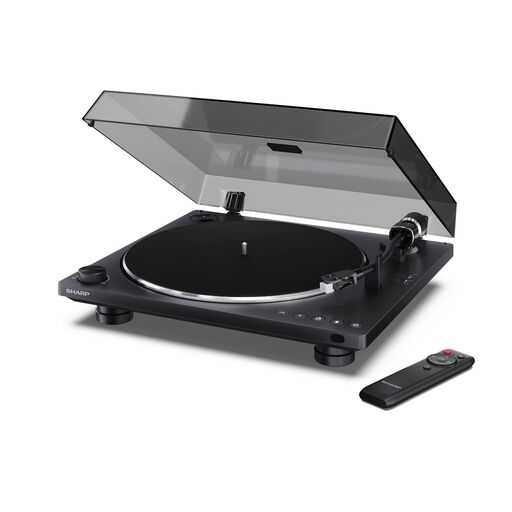 No image available
Full automation is a good option if you want to handle the tonearm as little as possible when playing a record; you’ll need a compatible receiving device for Bluetooth playback.
Bluetooth 5.4, USB-C recording function and RCA outputs.
Includes an AT-3600L cartridge and dust cover.
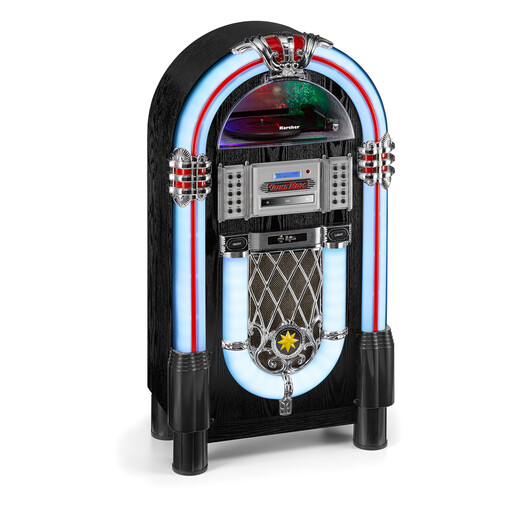 No image available
The built-in stereo speakers let you play records without a separate set of speakers; before buying, check that the jukebox will fit in the space you have.
Turntable, CD player, DAB+/FM radio, USB and SD playback, plus Bluetooth audio streaming.
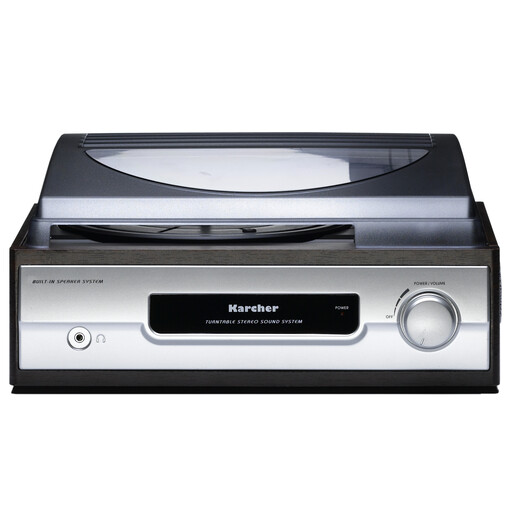 No image available
The built-in speakers are handy if you don’t want to buy a separate set; the dimensions make it easier to check whether it’ll fit on a small piece of furniture.
Dimensions: 32 × 28 × 14 cm.
33/45 rpm, automatic stop function, headphone socket and line output.
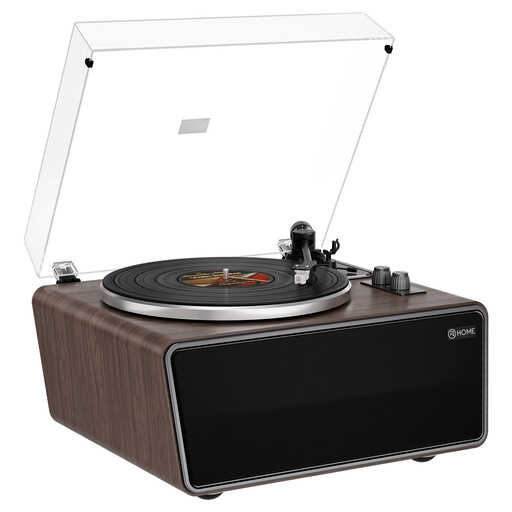 No image available
The built-in speakers let you play vinyl without a separate set of speakers; the additional connections give you more ways to connect other audio devices.
Four built-in speakers, phono preamp and AT-3600L cartridge.
33⅓/45 rpm, belt drive, phono/line RCA outputs, AUX, Bluetooth and USB recording.
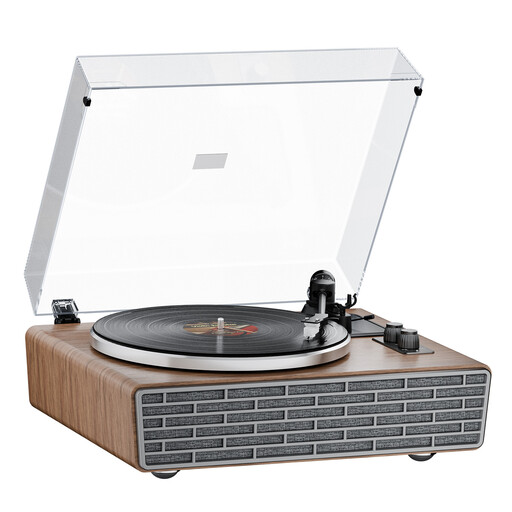 No image available
The built-in speakers offer playback without a separate set of speakers; the listed RCA and AUX connections are useful for connecting other devices.
Four built-in speakers, transparent dust cover and belt drive.
33⅓/45 rpm, AT cartridge, RCA phono/line outputs and AUX input.
For the AT-LP70XBT, Audio-Technica says to set the switch to LINE when connecting to active speakers. Check that your speaker has a compatible analogue input; use the other switch position for a phono input.
Audio-Technica recommends placing the AT-LP70XBT on a level, flat surface away from speaker vibrations. Also allow for the depth of the turntable and enough room to open the dust cover.
Not necessarily: Audio-Technica describes a mechanical noise from the stylus that may be audible near the turntable, particularly at low volume. If you hear other noises, check the specific set-up and operating instructions for your device.
Your statutory rights are against the seller and are separate from any voluntary guarantee. The Verbraucherzentrale generally allows two years for goods to be free from defects at the time of delivery; online purchases can usually be cancelled within 14 days, subject to the relevant conditions.
The Bundesnetzagentur lists CE marking, manufacturer details and German-language instructions among the aspects it checks when monitoring products and radio equipment on the market. According to the Umweltbundesamt, unwanted electrical equipment must not go in household rubbish; it must be collected separately.