First, check whether your soundtracks are LPs, singles or genuine 78 U/min shellac records, and what inputs your equipment has. These determine the speed, stylus and connection you need. A fully automatic model can make things easier to use, while a manual turntable may require more setup. In a loft, you’ll also need a level surface for your turntable, with some space between it and the speakers.
Who is this selection for?
Listeners with vintage soundtrack records
If you own LPs or singles, check before you buy whether your collection also includes genuine 78 U/min shellac records. Manufacturer information from Audio-Technica and Ortofon can help you assess the required speed and stylus separately.
Listeners with an existing hi-fi system
If you want to keep using your active speakers or amplifier, the turntable’s output must match the relevant input. Connection information from Audio-Technica, Denon and Pro-Ject shows why it’s worth checking the phono and line signal paths before you buy.
Loft dwellers with an open-plan listening area
If you’re setting up your turntable in an open-plan living area, you’ll need a level surface with some space between it and the speakers. Audio-Technica highlights the potential effects of vibration and sound pressure.
What should you look for when buying?
Start by comparing record formats and signal paths. Then find a suitable spot for your turntable and decide how much of the setup and maintenance you’re happy to take on. Ortofon describes a suitable, larger stylus profile for shellac records, while information from Sony, Audio-Technica and Pro-Ject can help you check the speed and connections.
| Consideration |
What to check before buying |
Who is it important to? |
| Record format and stylus |
Record type and required speed; for shellac records, also check that the stylus is suitable for the specific cartridge combination. |
If I need to find out whether my vintage soundtracks are even compatible with the turntable, this is my top priority. Around 26 % of consumers prioritise record format and the right stylus. |
| Connection to your hi-fi system |
Phono or line output and the matching input on your amplifier or active speakers; you may also need a separate phono stage. |
If I want to keep using my existing speakers or amplifier, the signal path needs to be right. Around 26 % of consumers put connection to their hi-fi system first. |
| Where to place it in a loft |
A level surface with some space between it and the speakers; if space is limited, check the turntable’s dimensions with the dust cover open too. |
If my living area is open-plan, I need a spot with room for the turntable and dust cover, away from the speakers. Around 21 % of consumers prioritise placement. |
| Ease of use |
Check whether the turntable starts and returns the tonearm automatically; with manual models, consider how much setup you’re comfortable with. |
If I want to handle the tonearm as little as possible when starting and finishing a record, the specific automatic functions matter to me. Around 16 % of consumers focus mainly on ease of use. |
| Maintenance and replacement parts |
Check whether you can replace just the stylus or the cartridge too, and which replacement parts are available for the specific model. |
If future maintenance and replacing compatible parts matter to me, I check exact compatibility rather than just looking for a replaceable stylus. Around 11 % of consumers prioritise maintenance and replacement parts. |
Avoiding buying pitfalls
-
Assuming 78 U/min means a turntable is suitable for shellac
The speed alone doesn’t tell you whether the stylus is suitable for a shellac record. Ortofon recommends a suitable, larger stylus profile.
First, identify the record type and speed. Then check specifically whether the stylus is compatible with the record and cartridge combination; you may need to change the stylus or cartridge.
-
Treating a phono output like a line output
A phono signal needs a suitable phono stage. The setup instructions for the Pro-Ject Debut Carbon EVO specify a phono stage in the amplifier or a separate device.
Match the turntable’s output to your system’s input, and plan for a separate phono stage if neither the turntable nor the amplifier provides the required signal path.
-
Assuming an automatic tonearm lift means the turntable is fully automatic
A lift at the end of a record doesn’t automatically tell you whether the tonearm starts playback or returns on its own. The manufacturer describes the Technics SL-1500C as lifting the tonearm at the end of a record.
Check start, stop and return as separate functions before deciding how much manual handling you’re happy with.
-
Confusing a replaceable stylus with a replaceable cartridge
The stylus on the Audio-Technica AT-LP70XBT is replaceable with a VM95-series stylus, while the cartridge is integrated into the tonearm.
Check which component you might want to replace in future, and whether the specific model allows you to do so.
Key brands at a glance
Audio-Technica
The AT-LP70XBT and AT-LP120XUSB differ in their operation, speeds and connection options.
- Audio-Technica says the AT-LP70XBT takes replaceable VM95-series styli; it also has Bluetooth and a switchable phono stage.
- The AT-LP70XBT’s cartridge is integrated into the tonearm. The AT-LP120XUSB is specified for 78 U/min; you’ll also need to check that the stylus is suitable for shellac records.
Sony
Sony describes the PS-LX310BT as designed for automatic playback via phono, line or Bluetooth.
- Sony’s specifications list automatic start and return.
- The specified speeds are 33⅓ and 45 U/min; a replaceable cartridge headshell isn’t listed for this model.
Pro-Ject
According to its setup instructions, the Debut Carbon EVO needs a phono stage in the amplifier or a separate device. The connection for the T1 EVO depends on the version you choose.
- Pro-Ject says the T1 EVO Phono version has a switchable phono preamplifier.
- The Standard, Phono and BT versions have different connections, so check the exact model variant.
Dual
Dual describes the CS 329 as a pre-assembled, fully automatic turntable for 33 and 45 U/min, with connections for phono and line-level inputs.
- Dual lists replacement parts for the CS 329.
- Dual specifies fixed factory settings and dimensions with the dust cover open. Bear both in mind if you want to adjust the settings or place the turntable on a shelf with limited space.
Denon
Denon combines fully automatic playback at 33⅓ and 45 U/min on the DP-300F with a built-in phono stage that can be switched off.
- Denon says the DP-300F can connect to a standard AUX input when its phono stage is switched on; the manufacturer also lists automatic start and return.
- Playback at 78 U/min isn’t specified for this model.
Turntables at Joybuy
These models offer different ways to play records and connect to your equipment, from automatic operation with a switchable phono stage to models with built-in speakers.
 No image available
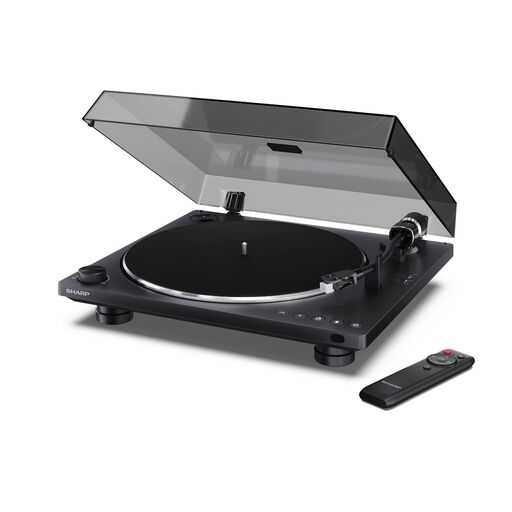
SHARP RP-TT95 turntable with Bluetooth 5.4
Fully automatic operation and a built-in preamplifier, switchable between PHONO and LINE, make it a good fit for a system with an input that matches your chosen signal path.
With an Audio-Technica cartridge, USB-C recording and a dust cover.
View at Joybuy
 No image available
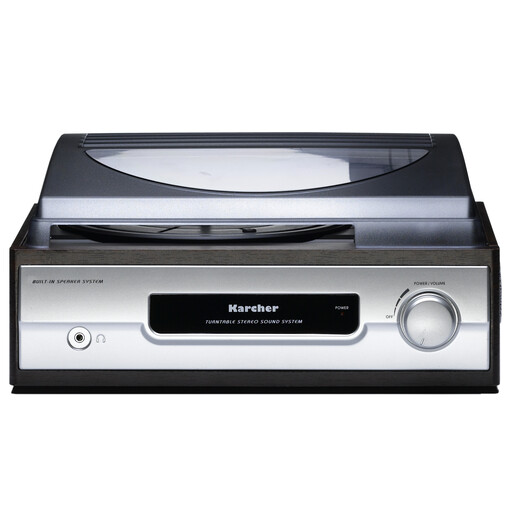
Karcher KA 8050 retro turntable
The built-in stereo speakers let you play records without separate speakers; a LINE output is also specified.
For 33 and 45 U/min, with an auto-stop function and headphone socket. The specified dimensions are 32 × 28 × 14 cm.
View at Joybuy
 No image available
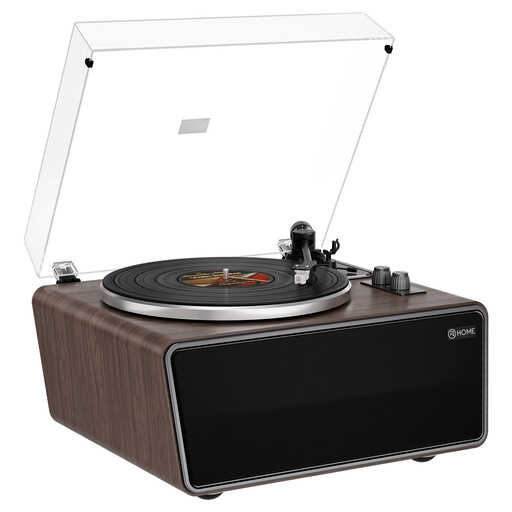
XJ-HOME XJ-H01 all-in-one turntable
Four built-in speakers make it a good choice if you want to listen without separate speakers; the built-in phono preamplifier offers phono and line RCA outputs.
For 33⅓ and 45 U/min, with an AT-3600L (MM) cartridge and USB recording.
View at Joybuy
 No image available
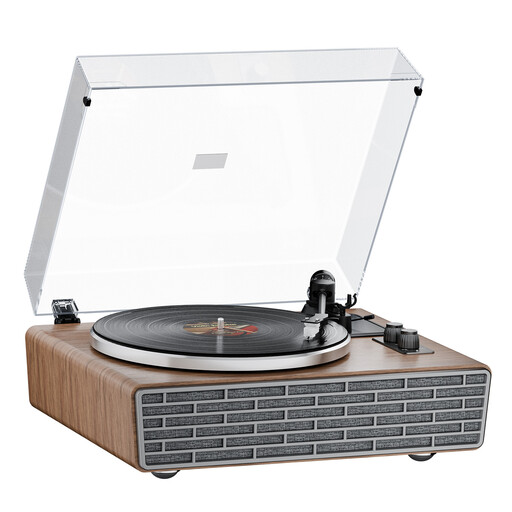
XJ-HOME XJ-H02 retro turntable
Four built-in speakers let you play records without separate speakers. For connecting to a compatible hi-fi system, dual RCA outputs with phono and line options are specified.
With Bluetooth, an AT-3600L cartridge, a dust cover and playback at 33⅓ and 45 U/min.
View at Joybuy
 No image available
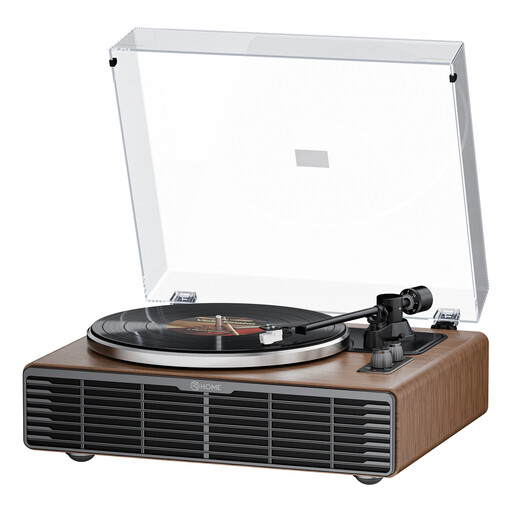
XJ-HOME XJ-H03 walnut turntable
Four built-in speakers are designed for listening without separate speakers; phono and line RCA outputs give you connection options for compatible external devices.
With Bluetooth, an AT3600L cartridge, a clear dust cover and playback at 33⅓ and 45 U/min.
View at Joybuy
Frequently asked questions
Can I connect a turntable directly to active speakers?
Yes, if the turntable outputs a line-level signal and the active speakers have a suitable input. If it has a phono-only output, you’ll need a suitable phono stage first. Check the connections on both devices.
Is a 78 U/min turntable suitable for shellac records?
No, the speed alone doesn’t guarantee that the stylus is suitable. Also check that the stylus matches the shellac record and the cartridge combination; Ortofon describes a suitable, larger stylus profile for this purpose.
Where should I place and how should I clean a turntable in a loft?
Place it on a level surface, not on or immediately next to speakers. Dirt on the stylus can affect playback, so follow the instructions for your specific device and stylus when cleaning.
How can I tell whether a turntable is truly fully automatic?
Check separately whether the model starts playback automatically and returns the tonearm at the end. An automatic lift or an end-of-record function alone doesn’t mean playback starts automatically.
Who is responsible if a product is faulty after purchase?
When you buy as a consumer in Germany, you have statutory rights against the seller if the product is faulty. The Verbraucherzentrale generally states a period of two years; this is separate from any voluntary guarantee.


