For listeners with a variety of jazz singles
First, check the speed of your records and, if they have a large centre hole, whether you need an adapter. For vintage shellac records, make sure the speed and a suitable SP stylus are both right.


First, check the speed of your jazz singles and, if they have a large centre hole, whether you need an adapter. Shellac records also need a suitable stylus. Next, make sure the turntable’s phono, line or Bluetooth connection is compatible with your existing audio setup. Full automation can make frequent side changes easier, while a manual turntable requires more hands-on operation. You’ll also need a level surface, away from speakers that cause vibrations.
First, check the speed of your records and, if they have a large centre hole, whether you need an adapter. For vintage shellac records, make sure the speed and a suitable SP stylus are both right.
Check the turntable’s output against the inputs on your speakers or amplifier. Depending on the model, you may have phono, line or Bluetooth connections.
If you play several short sides in a row, consider whether automatic tonearm start and return matter more to you than manual operation.
For jazz singles in your listening room, start by checking the record format and connection. Then consider ease of use and where you’ll put the turntable.
A good fit if: you often change short singles and want to handle the tonearm as little as possible.
Worth noting: connections and replacement options vary by model. Sony says the cartridge head on the Sony PS-LX310BT is not replaceable.
A good fit if: you want to operate the tonearm yourself and listen via a wired connection. According to the manufacturer, the Pro-Ject E1 Phono switches between 33 and 45 U/min and comes with an adapter for 7-Zoll singles.
Worth noting: you’ll need to do more by hand for each short side. Also check that the signal path is compatible with your audio setup.
A good fit if: you also want to record to a computer or play 78 U/min shellac records. According to the manufacturer, the Audio-Technica AT-LP120XUSB has USB and three speeds.
Worth noting: USB and 78 U/min aren’t needed for standard 45 U/min vinyl singles. Shellac records also require a suitable SP stylus.
| Buying priority | What to check | Who it matters most to |
|---|---|---|
| Format and speed | Check the speed and centre hole of each record. For shellac, also make sure you have a suitable SP stylus. | If I play a variety of jazz singles, I check the speed and centre hole first, as well as the stylus for shellac. Format compatibility is the top buying priority for around 36% of consumers. |
| Connection to your audio setup | Match the inputs on your amplifier or active speakers to the phono, line or Bluetooth output on the specific model. | If I want to keep using my existing speakers or amplifier, the right signal path is essential. For around 29% of consumers, connecting to their audio setup is the main priority. |
| Ease of use when changing sides | Check whether the model is fully automatic, only stops automatically or requires manual operation. | If I often switch between short sides, I want to know whether the turntable starts and returns automatically. Ease of use is the top priority for around 21% of consumers. |
| Placement and stylus care | Choose a level surface away from speakers that cause vibrations, and check which replacement styli are suitable for the exact model. | If my speakers are in my listening room and I plan to use the turntable regularly, I consider where to put it and how to care for the stylus. This is a priority for around 14% of consumers. |
Having an additional speed alone doesn’t make a turntable suitable for 78 U/min shellac records. The stylus needs to be right for them too.
Check the material and speed of your records before buying. If you want to play shellac, make sure the turntable has a suitable SP stylus.
The models mentioned here differ in how they handle phono and line connections. An incompatible signal path may require extra equipment or a different type of connection.
Compare your audio setup’s inputs with the outputs and switch settings on the exact turntable model.
Audio-Technica says the AT-LP70XBT has replaceable VM95-series styli, but the cartridge is integrated into the tonearm.
If you’re considering upgrades later on, check which component can be replaced on the specific model.
The AT-LP70XBT and AT-LP120XUSB cater to different preferences for operation and connectivity.
The PS-LX310BT is a fully automatic option with Bluetooth and phono and line outputs.
The E1 Phono is a manual, wired option with a switchable phono preamp.
According to Denon, the DP-300F is a fully automatic, wired turntable with a switchable phono preamp.
According to Dual, the CS 329 is a fully automatic option with a phono or high-level input.
The turntables below are specified for records labelled 33⅓ and 45 U/min. Depending on the model, they have built-in speakers or connections for an existing audio setup.
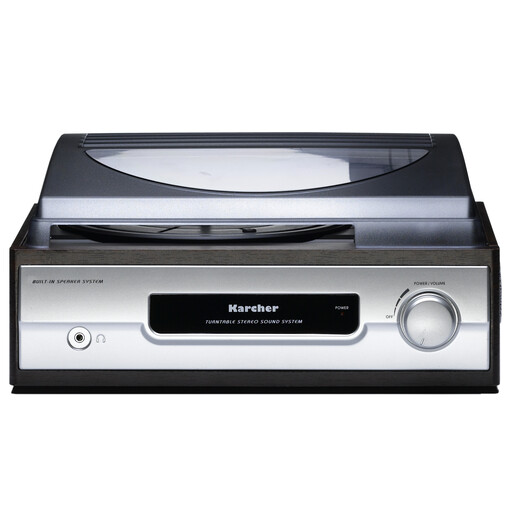 No image available
For singles at 33/45 U/min, with the choice of using the built-in speakers or connecting to an audio system or headphones.
33/45 U/min and a 45 U/min adapter. Built-in stereo speakers, headphone socket and RCA line output; the product name also specifies an auto-stop function.
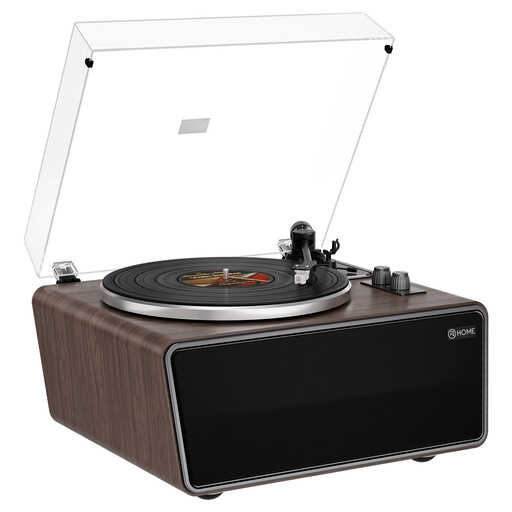 No image available
For records labelled 33⅓ and 45 U/min, with built-in speakers and extra connection options.
Four built-in speakers, phono/line outputs, Bluetooth and a USB recording function. The product name also specifies an AT-3600L (MM) cartridge stylus.
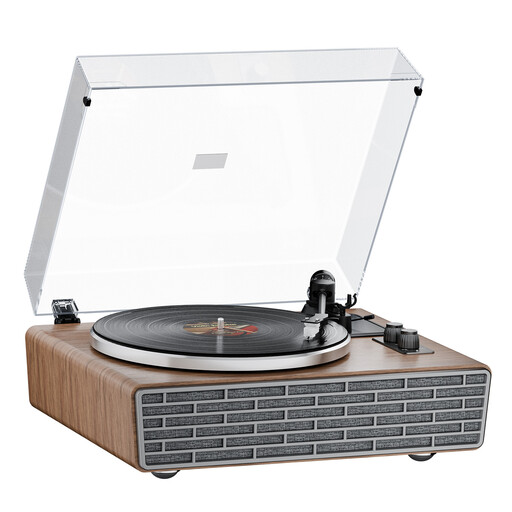 No image available
For singles at 33⅓ or 45 U/min, with the choice of using the built-in speakers or connecting to an existing audio setup.
Bluetooth and four built-in speakers. Phono and line outputs are listed; the product name also specifies a belt drive and a transparent dust cover.
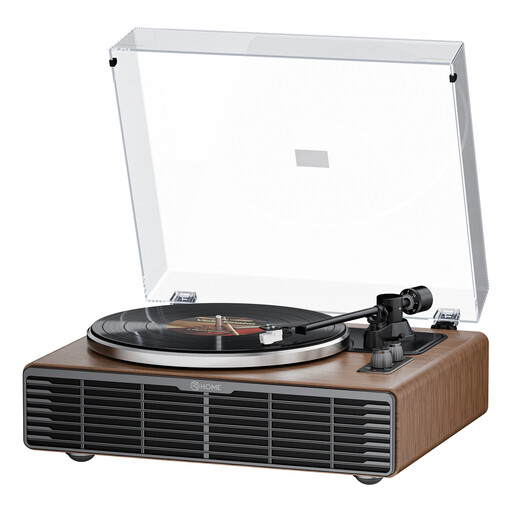 No image available
For records labelled 33⅓ and 45 U/min, with the choice of using the built-in speakers or connecting external speakers or an amplifier.
Four built-in speakers, Bluetooth and RCA phono/line outputs. The product name specifies a belt drive and an AT3600L cartridge.
No. It depends on the centre hole of the particular record. If it has a large centre hole, check whether you need a suitable adapter; Pro-Ject and Sony list an adapter for their respective models. Set the speed according to the record’s label, rather than relying on the ‘single’ format alone.
Audio-Technica recommends placing the AT-LP70XBT on a level surface, away from speakers that cause vibrations. Dust can collect on the stylus, according to the manufacturer. Follow the instructions for cleaning it and avoid putting sideways pressure on the cantilever.
The statutory warranty generally applies against the seller and, for the new goods described here, lasts for two years. It is separate from any voluntary manufacturer’s guarantee. The Verbraucherzentrale also explains that, from 31 July 2026, the period is extended by twelve months if you choose a repair rather than a replacement for a fault reported within the warranty period. The requirements in each case depend on the specific purchase.
GEMA says no licence is needed for a private party. Public events may need to be registered. Calling a room a ‘listening room’ doesn’t by itself determine whether the music is being played privately or in public.
According to the German Federal Ministry for the Environment, waste electrical equipment must not go in household rubbish; take it to an authorised collection point instead. Retailer take-back depends on the statutory requirements. The amendment to the ElektroG, which came into force on 1 January 2026, changed, among other things, the information retailers must provide about return points.