Before you buy, check which speeds and stylus types your spoken-word records need, and how the turntable will connect to your system. You’ll also need a level surface away from your speakers. Fully automatic operation can make things easier, but it’s no substitute for the right stylus or a suitable position.
Who should consider these options?
Listeners with limited space
If your speakers are close to the wall, you’ll need a level, separate surface for your turntable. Audio-Technica recommends placing the AT-LP70XBT on a level surface away from speakers, which can cause vibrations. ELAC notes that positioning certain speakers close to a wall can affect their sound.
Collectors of older spoken-word records
Check your records’ material and speed before choosing a turntable. For historical 78 rpm records, you’ll also need to check whether a suitable stylus is compatible with the cartridge. Audio-Technica offers a dedicated SP stylus for its VM95 series.
Listeners with an existing system
If you want to keep using your active speakers or amplifier, the output, input and phono preamp need to be compatible. Audio-Technica explains that passive speakers also require an amplifier.
What matters when buying?
When playing spoken-word records in a room with speakers close to the wall, your main decisions will depend on where you can place the turntable, the record formats you have, how you’ll connect it and how hands-on you want to be.
| Buying priority |
What to check |
Who is this important to? |
| Separate position |
A level surface with enough room for the turntable and its open dust cover; follow the speaker’s positioning guidance. |
When space is tight, being able to position my turntable separately from speakers close to the wall is what matters most. Around 33 % of consumers put finding a suitable place for it first. |
| Speed and stylus |
Match the record material to the required speed; for historical 78 rpm records, check for a suitable SP stylus and compatibility with the cartridge. |
If my collection includes older records, I want to check the material, speed and stylus together, rather than relying on a 78 rpm setting alone. Around 27 % of consumers put compatibility with their record formats first. |
| Connecting to your system |
Check whether you have active or passive speakers, a phono or line input, and an existing preamp; passive speakers need an amplifier. |
If I want to keep using my existing speakers or amplifier, the signal path from the turntable to the input needs to work. Around 20 % of consumers make system connectivity their top buying priority. |
| Ease of use |
Check automatic start, tonearm movement and return separately; these features vary by model. |
For longer spoken-word recordings, I want to have as little to do as possible when starting playback and at the end of a record side. Around 20 % of consumers put ease of use first. |
Common buying mistakes
-
Assuming damping feet mean you can place the turntable right next to a speaker
Claims about damped components don’t prove that the whole system will work without interference in your chosen spot. Vibrations from speakers can affect tracking.
First, find a level surface away from your speakers, and also follow the positioning guidance for your specific speakers.
You may need a separate surface or have to rearrange your equipment.
-
Assuming a 78 rpm setting means it can play shellac records
Speed and stylus type are two different requirements. A supplied stylus isn’t automatically suitable for historical shellac records just because the turntable supports 78 rpm.
Check the record material, required speed and suitability of the specific stylus for the cartridge together.
Depending on your collection, you may need a separate, suitable stylus or cartridge.
-
Assuming phono and line connections are interchangeable
A phono output needs a phono preamp before it can connect to a standard line input. Using two phono preamps can distort the sound; passive speakers also need an amplifier.
Before you buy, map out the signal path from the turntable through any required preamp or amplifier to your speakers.
Depending on your existing system, you may need an external phono preamp or an amplifier for passive speakers.
Relevant brands and model ranges
Audio-Technica
According to Audio-Technica, the AT-LP120XUSB is a manual model with three speeds and VM95 stylus compatibility.
- The manufacturer specifies 33⅓, 45 and 78 rpm, a switchable phono preamp and interchangeable VM95 styli.
- The supplied AT-VM95E is not the separately available SP stylus. You’ll need to start playback and operate the tonearm yourself, and plan for a suitable position separately.
Sony
According to Sony, the PS-LX310BT is designed for listeners with 33⅓ and 45 rpm vinyl who want automatic operation and the choice of wired or Bluetooth output.
- Sony lists phono and line outputs, as well as automatic functions.
- The specifications don’t list 78 rpm playback or a replaceable cartridge headshell. Bluetooth requires a compatible receiving device.
Denon
According to Denon, the DP-300F is a fully automatic model for 33⅓ and 45 rpm with a switchable phono preamp.
- Denon describes the one-touch start and automatic tonearm return at the end of playback.
- The listed speeds don’t include 78 rpm. Set the preamp to suit the input you’re using.
Dual
According to Dual, the CS 429 combines fully automatic operation with three listed speeds and an adjustable tonearm.
- Dual lists 33, 45 and 78 rpm, damping elements and a removable headshell.
- These specifications don’t prove that it will work without interference right next to speakers, or that the supplied Ortofon 2M Red stylus is suitable for shellac records.
Pro-Ject
According to Pro-Ject, the E1 Phono is a manual model for 33 and 45 rpm with an integrated phono preamp.
- Pro-Ject lists a switchable preamp and tonearm settings adjusted at the factory.
- The model specifications don’t include 78 rpm. The manufacturer’s claims about low resonance don’t prove that a specific position near your speakers will be suitable.
Turntables at Joybuy
This selection includes fully automatic and manual turntables, as well as models with built-in speakers. If you want to position your turntable separately from speakers close to the wall, bear in mind that built-in speakers can’t be positioned independently of the turntable.
 No image available
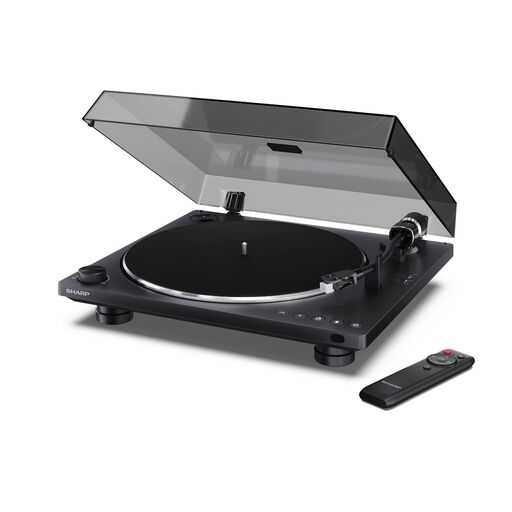
SHARP RP-TT95 Fully Automatic Turntable
A good fit if you’re looking for a model described as fully automatic, with additional recording or connectivity options.
Bluetooth 5.4, USB-C recording, an Audio-Technica cartridge and a dust cover are listed in the product name. Before buying, check that the connections are compatible with your system.
View at Joybuy
 No image available
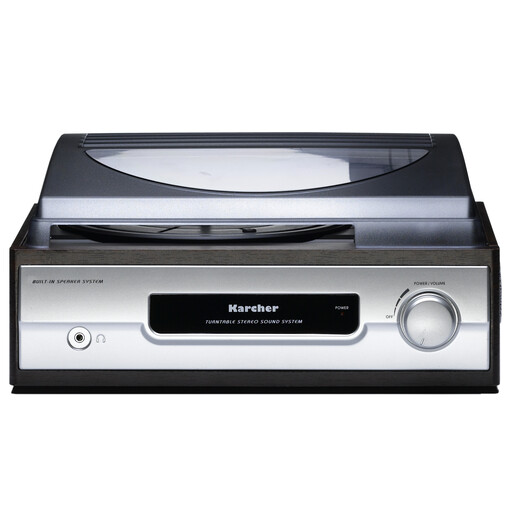
Karcher KA 8050 Retro Turntable
The built-in stereo speakers are part of the unit and can’t be positioned separately from the turntable. This may not suit every setup where you want to place your speakers separately.
The product name lists 33/45 rpm, auto-stop, a headphone socket and line output. Check that the line output matches your system’s input.
View at Joybuy
 No image available
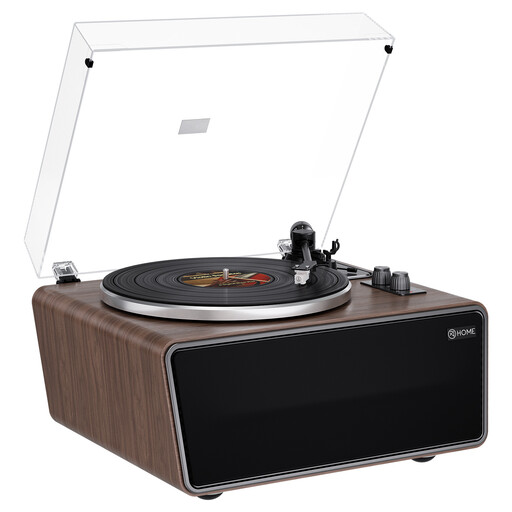
XJ-HOME XJ-H01 All-in-One Turntable
This all-in-one model has built-in speakers that can’t be positioned independently of the turntable. Bear this in mind if your speakers need to stay by the wall while the turntable sits elsewhere.
The product name lists a phono preamp and an AT-3600L (MM) cartridge. Check that the connection you plan to use is compatible with your existing system.
View at Joybuy
 No image available
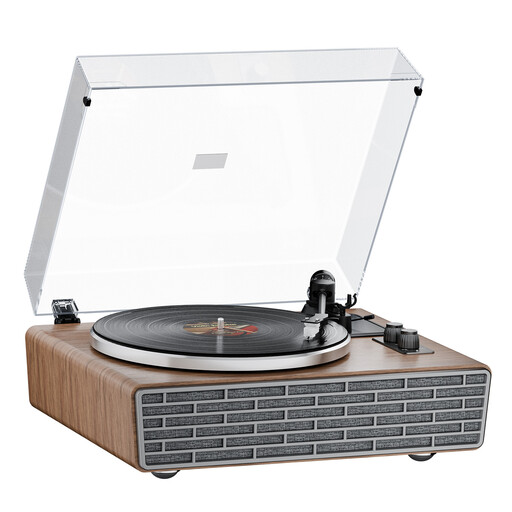
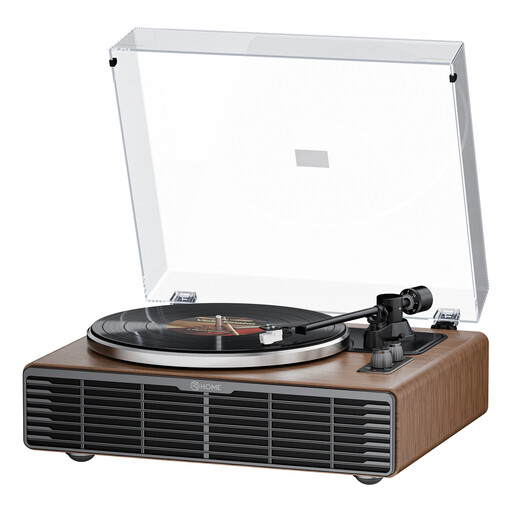
XJ-HOME XJ-H02 Retro Turntable
The four built-in speakers are part of the unit and can’t be positioned separately from the turntable. Check that this design works with the space you have available.
The product name lists Bluetooth, belt drive, an AT cartridge and a transparent dust cover. Before buying, check that the connections described will work with your setup.
View at Joybuy
 No image available
XJ-HOME XJ-H03 Bluetooth Turntable
The four built-in speakers can’t be positioned independently of the turntable. This matters if you want to keep the turntable and speakers in separate locations.
The product name lists belt drive, an AT3600L cartridge, RCA phono/line output and a clear dust cover. Check that the phono or line output matches your system’s input.
View at Joybuy
Frequently asked questions
Can I place the turntable right next to speakers close to the wall?
If possible, give your turntable its own level surface. Audio-Technica recommends this for the AT-LP70XBT to help avoid possible vibrations from speakers; this doesn’t establish a universal minimum distance for all equipment. ELAC also notes that placing certain speakers close to a wall can affect the bass.
Is 78 rpm enough for historical shellac spoken-word records?
No. The speed alone doesn’t prove that a turntable is suitable for historical shellac records. Check the record material and make sure you have an SP stylus that’s compatible with the cartridge. Audio-Technica offers a dedicated 3-mil VM95 SP stylus for this purpose.
Why is the sound very quiet or distorted through my active speakers?
First, check the signal path and the instructions for your specific model: a phono output needs a phono preamp before it can connect to a line input. If the built-in preamp is set to line output, don’t also connect it to a phono input.
Which features should I check for maintenance and future repairs?
Check which replacement stylus is compatible with your specific cartridge, and follow the instructions when positioning and setting up the turntable. A replaceable stylus, a removable cartridge headshell and an adjustable tonearm are different features. For example, Sony doesn’t list a removable cartridge headshell for the PS-LX310BT.


