
Lieferung heute & morgen

Qualitätsgarantie

Willkommens-Angebote freischalten: KOSTENLOSE Lieferung | Bis zu 80 % RABATT | Kostenlose 30-Tage-JoyPlus-Testphase
App herunterladen
A dynamic TV backlight that adapts to the colours of your on-screen content can significantly enhance your viewing and gaming experience. Instead of a harsh edge between the screen and the wall, it creates a soft, immersive transition that reduces eye strain and intensifies the atmosphere. However, the market for retrofit systems is crowded and confusing. Many products promise more than they can deliver. This guide will help you identify the crucial features and avoid common pitfalls.
Before you invest, you should be aware of the typical weaknesses that often only become apparent after the purchase, leading to disappointment.
To avoid the problems mentioned above, you should check three technical aspects before buying. These are the primary determinants of the quality and functionality of your new smart TV lighting.
The method the system uses to capture screen colours is fundamental.
This point is non-negotiable for a convincing result.
Good smart TV lighting is distinguished by its intuitive controls. A well-designed app is crucial for the initial setup, camera calibration, and fine-tuning of brightness and colour saturation. Also, check if the system is compatible with voice assistants like Google Assistant or Amazon Alexa to conveniently turn the lighting on and off or switch modes with a voice command. This is an important feature for a modern home cinema accessory.
Based on the criteria above, we have identified several products that offer a suitable solution for different users and requirements.
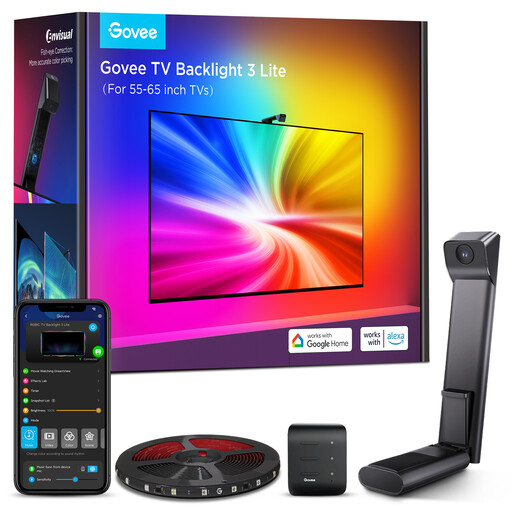
Why This Fits Their Persona: This kit is an ideal solution for users looking for a complete, out-of-the-box system for common TV sizes without needing a deep dive into the technical details. It offers a balanced ratio of features and cost.
Thanks to the Govee Envisual camera technology, it bypasses the incompatibility trap of HDMI boxes and works with all content. The RGBICW technology ensures precise, segmented colour representation.
Extensive customisation options via the Govee Home App; compatibility with Google Home and Amazon Alexa for voice control.
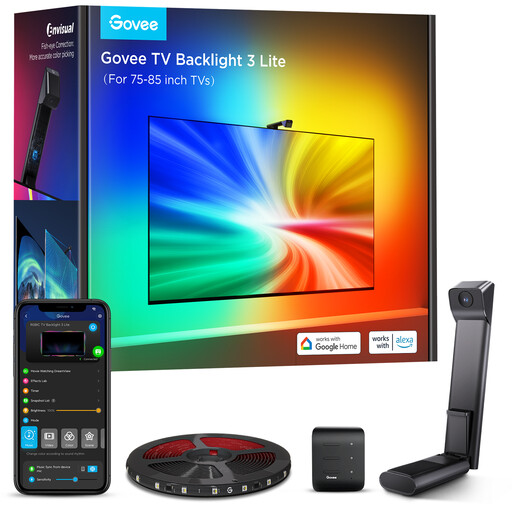
Why This Fits Their Persona: Those who have invested in a large television need lighting that scales proportionally and covers the entire area. This kit is specifically designed for screens from 75 to 85 inches.
The improved fisheye camera accurately captures colours even in the corners of large screens. The camera's mounting design is optimised for modern, ultra-thin TVs, avoiding installation issues.
Optimised colour capture for large screens; sufficient LED strip length for gapless coverage.
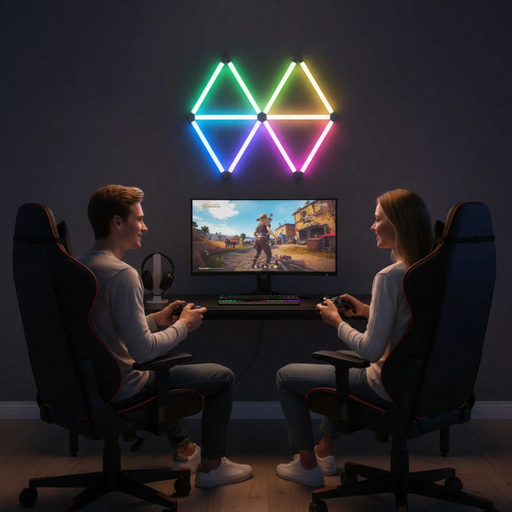
Why This Fits Their Persona: For users who want to create comprehensive gaming room lighting that extends beyond the TV's border. These modular lights can be arranged in any pattern on the wall.
This system focuses not on video sync, but on music sync. It bypasses the latency issues of image recognition and instead offers reactive lighting that responds to the rhythm of music or game audio.
High degree of creative freedom thanks to its modular design; music sync mode for parties or intense gaming sessions.
We have compiled a complete, up-to-date list of products that fully meet these strict selection criteria and relevant safety standards.
Yes, as long as you choose a camera-based system. Since the camera films the screen, it doesn't matter which app or service is providing the content. Systems based on an external HDMI sync box, however, cannot process content from native smart TV apps.
Modern camera systems, like those using Govee Envisual technology, employ wide-angle lenses and advanced algorithms to achieve high colour accuracy. Careful calibration via the companion app is crucial for the final result. Ambient light or strong reflections on the screen can affect precision but can usually be minimised by adjusting the room's lighting.
A conventional RGB strip can only display a single colour across its entire length at any given time. An RGBIC strip, on the other hand, has integrated circuits (IC) that allow different segments of the strip to light up in different colours independently. This technology is the fundamental requirement for dynamic and believable synchronisation with on-screen content.