
Lieferung heute & morgen

Qualitätsgarantie

Willkommens-Angebote freischalten: KOSTENLOSE Lieferung | Bis zu 80 % RABATT | Kostenlose 30-Tage-JoyPlus-Testphase
App herunterladen
The idea is alluring: a dynamic backlight that projects the colours from your TV screen onto the wall in real time, making the viewing experience more immersive. Anyone looking to retrofit this feature, known as Ambilight, faces a vast selection of products. However, not every system delivers on its promises. Many users invest in solutions that cause more frustration than fascination. This guide highlights the most common pitfalls and explains which technical features truly matter.
Before deciding on a system, you should be aware of the typical weaknesses found in cheap or poorly designed products. These often lead to an unsatisfying result and render the investment worthless.
To avoid the problems mentioned above, buyers should pay attention to three technical specifications. These are the primary determinants of the system's quality and performance.
The method the system uses to capture screen colours is fundamental. The most common and flexible solution is a TV backlight with a camera. A small camera is placed on the top or bottom edge of the TV and films the screen. A good camera accurately captures the colours at the edges and relays the information to the control unit. Advanced systems like the Govee Envisual T2 even use a dual-camera structure to further increase accuracy, especially for large TVs in the 55-65 inch range. HDMI sync boxes are an alternative, but they only pass through the signal from external sources (e.g., game console, Blu-ray player), not the content from smart TV apps.
The type of LED strip is critical for the quality of the display.
A high-quality system should integrate seamlessly into a modern smart home. Look for stable app control via 2.4 GHz Wi-Fi and compatibility with common voice assistants like Alexa or Google Assistant. The app should not only facilitate calibration but also offer various modes (Movie, Music, Scene) and detailed customisation options for brightness and saturation.
Based on the criteria mentioned, we have identified products suitable for different requirements and budgets.
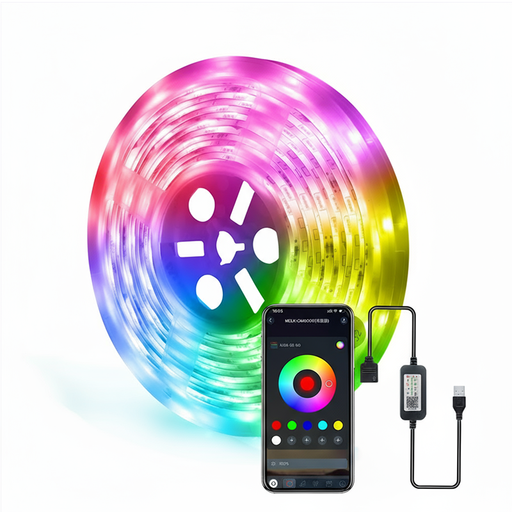
Why This Fits Their Persona: Ideal for users who want to try out the concept of mood lighting without a large investment. The simple USB power supply and app control offer an accessible entry point into the world of smart lighting.
This system bypasses the pitfall of complicated installation. It is powered directly via a USB port on the TV and controlled by an app, ensuring stable and simple operation without additional hardware.
Offers app control and a music sync mode, which is not a given in this price range. The USB power supply eliminates the need for a separate power adapter.
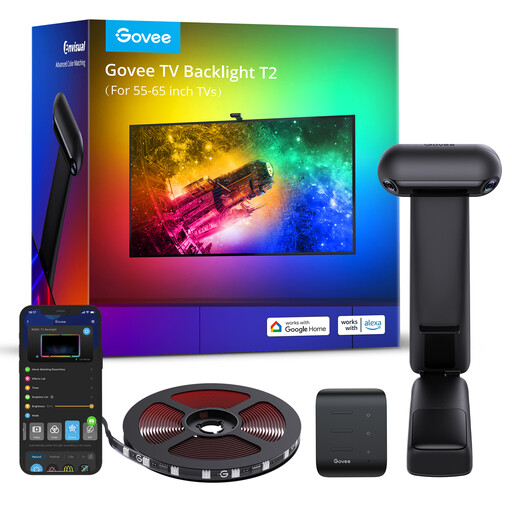
Why This Fits Their Persona: For users seeking a high-quality, responsive, and colour-accurate solution that closely mimics the original Ambilight experience. Perfect for immersive movie nights and latency-free gaming.
Directly addresses the core problems of colour inaccuracy and latency. The dual-camera technology ensures precise colour capture on all four edges, while the RGBIC technology enables smooth, lag-free transitions.
Outstanding colour accuracy thanks to the dual camera. Segmented control of the LEDs for dynamic and multi-colour effects. Comprehensive control via the Govee Home App.
We have compiled a complete, up-to-date list of products that fully meet these strict selection criteria and German safety regulations.
A camera attached to the TV continuously captures the colours displayed at the edge of the screen. This colour information is sent to a small control unit (control box). The control unit processes the data in real time and commands the connected LED strips to reproduce the corresponding colours on the wall behind the TV.
No, cutting RGBIC LED strips like the one on the Govee T2 is not possible and would permanently damage the product. The integrated circuits that enable segment-by-segment control are distributed along the entire length of the strip. For this reason, it is important to buy the correct version for your TV size, for example, the Govee T2 55-65 inch model for corresponding screen diagonals.
The additional power consumption from an LED backlight is typically very low. Modern LED technology is extremely energy-efficient. A typical system consumes only a few watts, depending on brightness and settings. The impact on your annual electricity bill is therefore minimal and hardly noticeable.