
Lieferung heute & morgen

Qualitätsgarantie

Willkommens-Angebote freischalten: KOSTENLOSE Lieferung | Bis zu 80 % RABATT | Kostenlose 30-Tage-JoyPlus-Testphase
App herunterladen
A TV cabinet for TVs up to 65 inches needs to do more than support the television. It should suit the available space, the width of the TV and the entertainment equipment you already own. Its design also determines whether cables can be routed neatly and whether there is enough room for a receiver, games console or speakers.
Many products look similar at first glance. However, some common buying mistakes can lead to unnecessary costs.
“Suitable for TVs up to 65 inches” describes the intended compatibility, but it does not automatically mean that every type of set-up will work without problems. The key factors are:
Depending on the frame and stand, a 65-inch TV may require a different amount of surface space. Measure the television and the intended location before ordering a TV stand. A TV unit should extend slightly beyond the feet on either side, or accommodate them fully within its surface area.
A modern lowboard with a glossy front or LED lighting can look appealing. For everyday use, however, cable management, ventilation and accessible ports are also important. Closed compartments without sufficient air circulation may be unsuitable for equipment that generates heat.
If you are considering a TV cabinet with LED lighting, also check how the lighting is connected, whether a remote control is included and whether the desired colour control is actually part of the product specification. 16-colour lighting does not automatically mean that every function synchronises with the TV.
A TV cabinet with lots of compartments can still be impractical if the internal dimensions do not suit your existing equipment. Look out for:
For a TV unit in the living room, bedroom or home office, the room layout is a key factor. A 150 cm TV cabinet is suitable for many medium-sized living areas, while wider models offer more space for decorations or additional equipment.
The depth should suit both the TV and the connected devices. A TV lowboard that is too shallow may cause the feet to protrude or cables to bend sharply. Also check whether doors and drawers can be opened fully at the intended location.
TV furniture is often made from MDF, chipboard or melamine-coated panels, along with metal or glass components. The material specification alone is not a complete indication of quality. Other relevant factors include:
High-gloss surfaces can make fingerprints more noticeable. Matt or wood-effect finishes are often easier to care for in everyday use. Always clean TV furniture according to the manufacturer’s instructions and do not use abrasive products.
The stated maximum load capacity must be suitable for the weight of the TV. Also take a soundbar, decorations and other equipment into account. The Parrot Uncle model has a stated maximum load capacity of 54 kg, while the black TV cabinet with wood-effect finish supports 50 kg. These limits must not be exceeded.
Clear assembly instructions and labelled components can make construction easier. Allow yourself plenty of room and place the finished unit on a level surface. For taller or heavily loaded cabinets, additional anti-tip protection may be advisable, provided it is suitable for both the furniture and the wall.
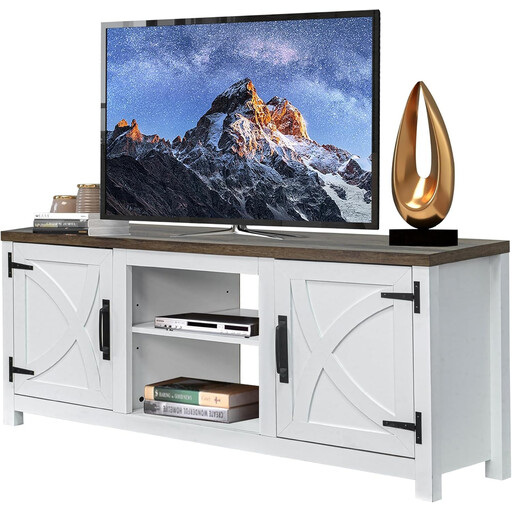
Why this product suits this profile: Measuring 147.3 cm wide, this TV unit combines open compartments with enclosed storage and is suitable for TVs up to 65 inches. The adjustable shelf makes it easy to accommodate accessories of different heights.
The combination of two open compartments and two enclosed areas makes the storage layout easy to understand. An adjustable shelf reduces the risk of equipment not fitting because of fixed compartment heights.
MDF construction, a maximum load capacity of 54 kg and labelled components with illustrated instructions, according to the product details.
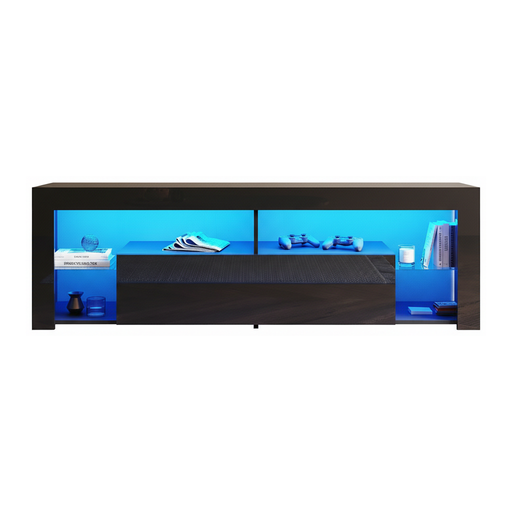
Why this product suits this profile: This TV unit is designed for TVs up to 65 inches and combines a high-gloss surface with open glass shelves, a drawer and 16-colour LED lighting.
The product description specifies dimensions of 160 x 35 x 50.5 cm, along with a layout consisting of a drawer and open glass compartments. This makes it easier to compare the available storage with your own equipment before buying.
MFC and MDF with a black high-gloss finish, plus 16-colour LED lighting, according to the product details.
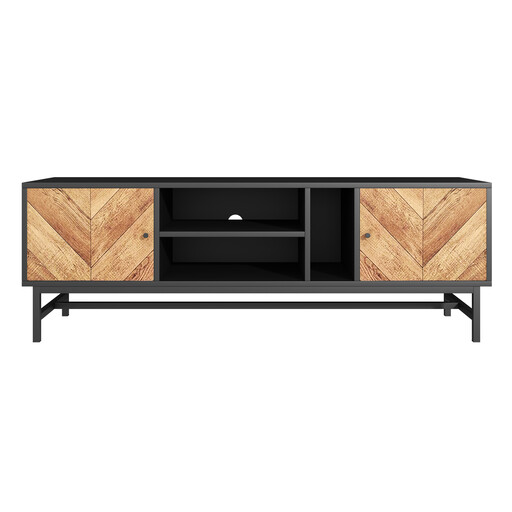
Why this product suits this profile: Measuring 150 x 38 x 55 cm, this TV unit is designed for households with several media devices and accessories, featuring two enclosed cabinets, horizontal shelves and a vertical compartment.
The clearly described compartment layout makes it easier to plan space for consoles, books and decorations. The stated load capacity of 50 kg provides a specific reference point for your set-up.
150 cm width, chipboard cabinet, iron legs with an additional crossbar and two enclosed areas, according to the product description.
We have put together a complete, regularly updated list of products that fully meet these strict selection criteria and the safety regulations applicable in the EU.
The right width depends on the TV’s actual width and the position of its feet. A 150 cm or 160 cm TV cabinet often provides additional space at the sides, but it does not replace taking your own measurements. The TV should stand securely and must not extend beyond the surface.
Compare the TV’s weight with the stated maximum load capacity of the TV unit. Also include the soundbar, receiver, games console and decorations in your calculations. A load limit of 50 or 54 kg should not be interpreted as a recommendation to use the full capacity if the manufacturer does not specify any further distribution.
Running costs depend on the LED unit’s power consumption, how long it is used each day and your electricity tariff. Check the technical details for the LED system. Switch the lighting off when it is not needed and avoid leaving it permanently on standby unless this is necessary.