Watching during the day in front of tall windows
You watch short films in natural daylight, so direct reflections from windows and visibility in dark scenes are your first things to check.


If tall windows reflect directly onto the screen during the day, start by checking the specific model’s reflection handling and how it performs in ambient light. For a room that stays bright, a bright Mini LED/LCD TV is often the better choice. If you can control the light and prioritise dark film scenes, OLED is also worth considering. According to RTINGS.com, a matte or glossy finish alone doesn’t determine how well a TV handles direct reflections and raised black levels.
You watch short films in natural daylight, so direct reflections from windows and visibility in dark scenes are your first things to check.
You can use curtains or change the TV’s position, and want to focus on comparing film contrast and detail in dark scenes.
You want to match the screen size to your viewing distance and available space, and take electricity use into account before choosing.
A good fit if: Your windows let in a lot of light and it isn’t practical to darken the room day to day.
The trade-off: How dark scenes and bright details against a dark background look depends on the specific model. Peak brightness alone tells you little about window reflections.
A good fit if: Film contrast matters and you can limit direct reflections through the TV’s position or by using curtains.
The trade-off: According to RTINGS.com, Mini LED is often the more reliable choice in very bright rooms. With OLED, you should also consider how you use the TV if you regularly display static images.
A good fit if: Size and cost are your priorities, and you can adjust the lighting or TV’s position.
The trade-off: The term LED alone doesn’t guarantee good reflection handling or enough contrast for dark film scenes.
| What matters | What to check before buying | Who it matters most to |
|---|---|---|
| Direct reflections from windows | Compare reflection tests for the exact model, taking into account where you plan to put the TV and your seat. | If I can see the window reflected on the screen, I want to avoid distracting mirror images. Around 36% of consumers put direct reflections first. |
| Brightness in diffuse daylight | Check tests in ambient light and the brightness of typical film scenes; don’t compare HDR peak figures in isolation. | I want films to remain visible during the day, even without a direct reflection of a window. Around 29% of consumers prioritise daylight brightness. |
| Film contrast and dark detail | Look at picture tests under suitable lighting. For Mini LED, also consider how bright elements look against a dark background. | If dark film scenes matter most, I want to assess contrast and detail under my usual lighting. Around 21% of consumers put film contrast first. |
| Size, positioning and energy use | Measure your viewing distance and available space, then compare mounting information and the energy label for the exact variant. | If space and running costs determine my choice, I want to compare TVs that suit my room. Around 14% of consumers prioritise size, positioning and ongoing costs. |
Direct light reflections and black levels raised by ambient light are two different aspects of reflection handling, as RTINGS.com explains.
Check both test results for the exact model and take the position of your windows into account.
An HDR peak figure and performance in direct window light describe different characteristics.
Also compare tests in bright ambient light, and consider how Mini LED handles dark film scenes.
Verbraucherzentrale points out that larger TVs generally use more electricity.
Measure your viewing distance and available space, and compare the energy labels for the models you’re considering.
The BRAVIA-9-II range is one option for bright rooms; Sony Germany lists it as an RGB LED TV.
The OLED evo G6 range is worth considering if you want to compare film contrast with a model range that the manufacturer specifically describes as designed to reduce reflections.
The Q7D Pro range is a Mini LED option for comparing daylight picture quality, local dimming and features across specific models.
The OLED S90F is another OLED range to consider when comparing film contrast and daylight performance across specific models.
The One PUS9000 is worth considering if you’re interested in the effect Ambilight has on the room as well as the film itself.
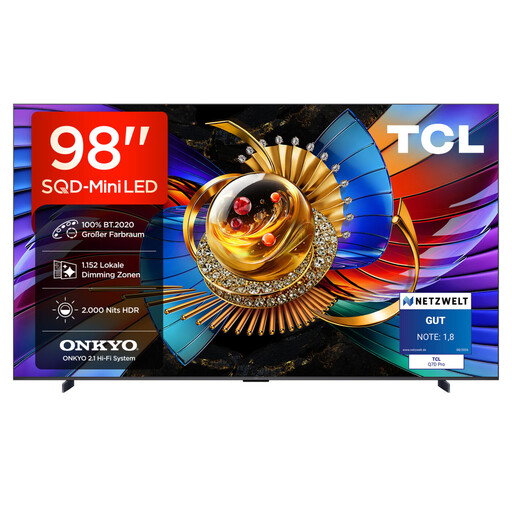
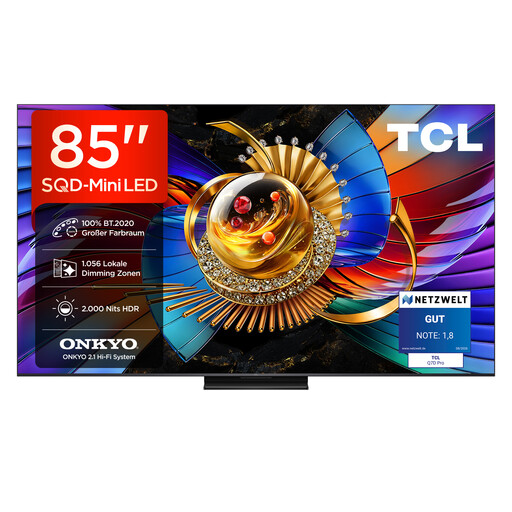
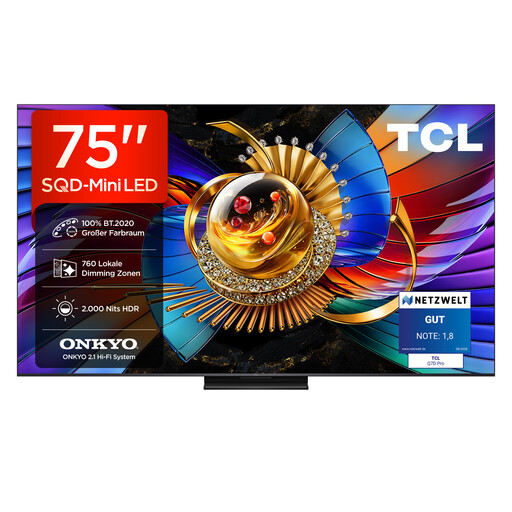
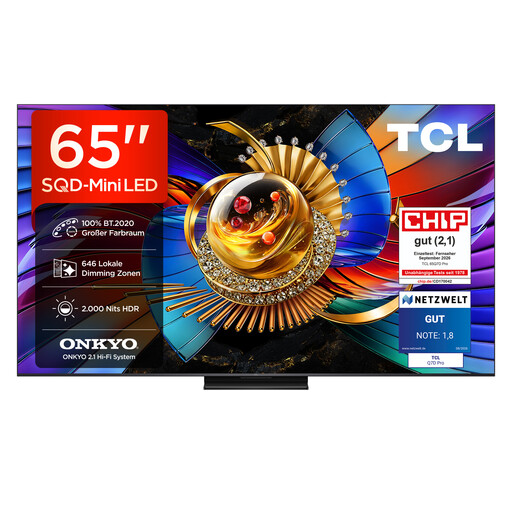
This selection includes TCL Q7D Pro Mini LED TVs in a range of screen sizes, so you can compare them for daylight viewing and potential window reflections.
 No image available
The 98-inch version is worth considering if you’re comparing large screens and have enough space for it.
Features listed in the product name: Anti-Reflection, 1,152 local dimming zones, 2,000 nits HDR, 144 Hz, Dolby Vision IQ and Dolby Atmos.
The 98-inch screen requires plenty of space where you plan to install it.
 No image available
This version is a good option if you want to compare a large Mini LED screen with explicitly listed Anti-Reflection technology.
Features listed in the product name: 1,056 local dimming zones, 2,000 nits HDR, 144 Hz, Dolby Vision IQ and Dolby Atmos.
 No image available
The 75-inch version gives you another screen size to compare with your viewing distance and available space.
Features listed in the product name: Anti-Reflection, 760 local dimming zones, 2,000 nits HDR, 144 Hz, Dolby Vision IQ and Dolby Atmos.
 No image available
The 65-inch version is a good fit if this screen size suits your viewing distance and where you plan to put the TV.
Features listed in the product name: Anti-Reflection, 646 local dimming zones, 2,000 nits HDR, 144 Hz, Dolby Vision IQ and Dolby Atmos.
 No image available
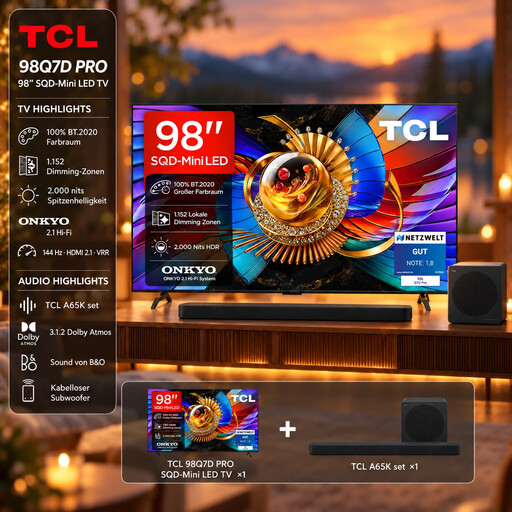
This set is worth considering if you want to compare the 98-inch TV with the A65K soundbar named in the product title.
Features listed in the product name: Anti-Reflection, 1,152 local dimming zones, 2,000 nits HDR, 144 Hz, Dolby Vision IQ and Dolby Atmos.
The 98-inch screen requires plenty of space where you plan to install it.
No. A matte finish alone doesn’t answer the question. RTINGS.com distinguishes between direct reflections and black levels raised by ambient light when assessing reflection handling. Check both for the specific model and the position of your windows.
First decide where you want the screen to go. Then check the mounting and screw specifications for the exact model, as well as the wall’s load-bearing capacity. Sony recommends having a retailer or licensed contractor install the TV for safety reasons; this isn’t a general legal requirement.
Compare the EU energy label and energy consumption figures for the exact models on the same basis. Verbraucherzentrale points out that larger TVs generally use more electricity. Actual costs also depend on how long you use the TV for and your electricity tariff.
If possible, check the TV in similar daylight and from the position where you plan to sit. If a window reflection is distracting, try changing the TV’s position or controlling the light first. Assess direct reflections separately from dark areas of the picture that appear raised by ambient light.
You’ll need an internet connection to use internet-based smart TV features. Check that the apps you want are available on the specific model and that it has the connections you need for your setup.