
Lieferung heute & morgen

Qualitätsgarantie

Willkommens-Angebote freischalten: KOSTENLOSE Lieferung | Bis zu 80 % RABATT | Kostenlose 30-Tage-JoyPlus-Testphase
App herunterladen
The right TV furniture needs to do more than support your television. It should suit your screen size, room layout and existing accessories. It also needs to keep cables, games consoles, receivers and remote controls neatly organised. If you choose based only on colour or a low price, you could easily overlook important details.
The “up to 65 inches” measurement refers to the diagonal screen size, not the actual width of the television. Depending on the frame and model, a 65-inch TV may be around 145 cm wide. So a 120 cm-wide TV unit could be too short, even if the manufacturer specifies a particular screen size.
Before you buy, check:
A TV cabinet with doors and drawers offers storage, but closed compartments can make it harder to use remote controls or let heat escape from electronic devices. Open shelves are more practical for receivers and consoles, but you’ll need to keep the cables organised.
Check the internal dimensions of the compartments, the position of the back panel and whether there are cable openings. A decorative front alone doesn’t tell you how practical a cabinet will be for everyday use.
A TV wall mount must be suitable for the VESA size, the weight of your television and the type of wall. Mounting it on plasterboard without suitable supporting framework may not be appropriate. The screws supplied with a TV wall mount also won’t necessarily suit every type of wall.
Before ordering, check:
A TV stand or TV cabinet should be wider than your television, or at least fit its stand securely. A slightly wider surface can make it more stable in everyday use and leave room for speakers or decorations. The height affects your viewing angle, so consider your seating, eye level and the centre of the screen together.
With low furniture such as a modern lowboard, also check that the remote control works from where you sit and that the connections remain accessible.
For furniture made from chipboard, MDF or coated wood-based materials, the edges, back panel and fixings are all important. A steel frame can add support to the structure, but it doesn’t replace correct assembly.
The load capacity needs to be suitable for the weight of your television and any additional devices. For example, the 5five Chevrons TV Stand has a maximum load capacity of 55 kg, measures 120 × 40 × 45 cm and has steel legs. It is made partly from chipboard and MDF, and is supplied for self-assembly. Check these specifications against the weight of your television and your equipment.
A TV unit with storage can combine doors, drawers and open compartments. LED lighting is a design feature that requires extra wiring and access to a power supply. Check whether you can route cables neatly behind the unit and whether the lighting can be switched on and off separately.
For self-assembly, you’ll need clear instructions, enough space and, in some cases, a second person. According to the product details, two people are needed to assemble the 5five model, and assembly takes around 45 minutes.

Why it suits this profile: Its compact dimensions make it a good fit for smaller living spaces, while the doors and drawer provide practical storage.
The stated 55 kg load capacity and precise external dimensions make it easier to check whether it’s suitable for your television and accessories.
120 × 40 × 45 cm, two doors, one drawer, steel legs and a soft-close mechanism, according to the product details.
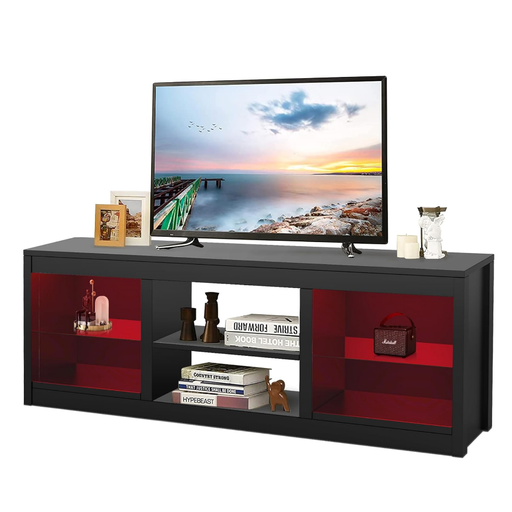
Why it suits this profile: This black TV unit combines a wide surface with several compartments and is specified as suitable for televisions up to 65 inches.
Its 167.6 cm width and stated compatibility make it easier to compare with a large screen.
167.6 × 41.7 × 55.5 cm, black finish and several cabinets or storage areas, according to the product description.

Why it suits this profile: The high-gloss black finish, open glass shelves and 16-colour LED lighting make a striking design statement.
Open compartments make media devices easy to reach, while the precise dimensions of 131.3 × 47.6 × 14.4 cm make it easier to plan your space.
MFC and MDF, LED lighting, a drawer, open glass shelves and suitability for televisions up to 65 inches, according to the product details.
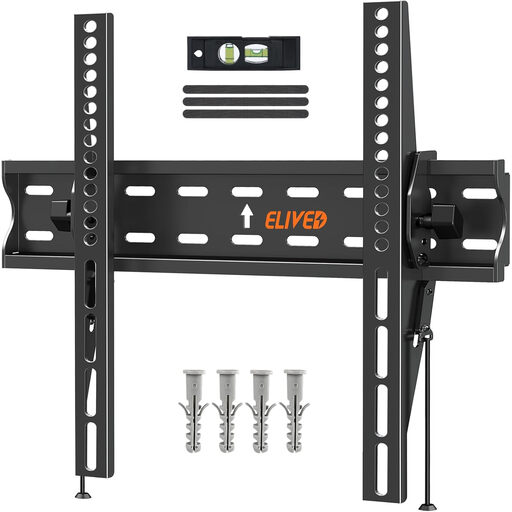
Why it suits this profile: Wall mounting saves floor space and is suitable for 26- to 60-inch televisions with a compatible VESA size.
The specifications of 75 × 75 to 400 × 400 mm VESA, a 45 kg load capacity and the requirement to mount it to timber studs or solid walls make it easier to check that it’s safe for your setup.
38 mm wall clearance, tilts by up to -8°, steel construction and quick-release design, according to the product description.
We’ve put together a comprehensive, regularly updated list of products that meet these strict selection criteria and the safety regulations in force across the EU.
First, measure the actual width of the television, including the frame. The lowboard should be at least as wide as the stand. For a balanced look, you may want the unit to extend beyond the TV on either side. Remember to allow room for speakers, decorations and cables too.
Its lifespan depends on the materials, load, assembly and care. Avoid standing moisture, direct heat sources and regularly exceeding the load limit. Clean coated wood-based materials with a dry or slightly damp cloth.
The running costs depend on the power consumption, how many hours a day you use the lighting and your electricity tariff. Use this simple calculation: Wattage ÷ 1,000 × hours of use × electricity price per kilowatt-hour. Also check whether the lighting switches off completely or goes into standby mode.