
Lieferung heute & morgen

Qualitätsgarantie

Willkommens-Angebote freischalten: KOSTENLOSE Lieferung | Bis zu 80 % RABATT | Kostenlose 30-Tage-JoyPlus-Testphase
App herunterladen
A TV lowboard should safely support your television, keep cables and devices organised, and blend harmoniously into your living room. In practice, however, some typical purchasing decisions can lead to unnecessary costs: a piece of furniture may look spacious in product photos, even though its compartments are too small for a games console. Similarly, a suitable screen size does not automatically mean that the surface is wide or sturdy enough.
The specification “for TVs up to 65 inches” primarily describes the intended screen size. It is also important to check the actual width of the television, including its stand. A TV lowboard measuring 147 cm wide will often provide enough space, but you should still compare the dimensions of your own device and the desired overhang at the sides beforehand.
Open compartments are suitable for devices controlled by remote control or wirelessly. Doors and drawers, on the other hand, keep books, cables, remotes and accessories out of sight. Before buying, shoppers should check the internal dimensions, the number of shelves and the cable-management options. A TV unit with storage is only practical if your existing devices actually fit inside.
Descriptions such as “sturdy”, “modern” or “high quality” reveal little about the actual construction. More meaningful details include material, dimensions, maximum load capacity and the type of assembly required. Even an elegant, low TV unit needs a level surface and should not be loaded beyond its stated weight capacity.
For a television up to 65 inches, furniture measuring around 147 to 180 cm wide is often suitable. The right choice depends on the TV model, its stand and the layout of the room. Measure:
A taller TV unit may be suitable for a bedroom or a seating area with a higher seating position. Lower models measuring around 42 to 50 cm high often have a more understated appearance and position the screen differently.
The maximum load capacity must be suitable for both the weight of the television and the devices placed on the unit. Some available models specify 50 kg, while the 147 cm Parrot-Uncle model states 54 kg. These figures should not be interpreted as a general recommendation for every TV unit; the relevant product specification always takes precedence.
Commonly used materials include:
You should also check that the screws are properly fitted, the feet provide a sufficiently wide base and the unit is assembled according to the instructions. For taller or heavily loaded furniture, an additional anti-tip device may be advisable, provided one is intended for the particular model.
A TV cabinet with doors and drawers is suitable for households that need different types of storage space. Open compartments make it easier to access receivers, games consoles and streaming devices. Closed sections reduce visible clutter. There should be enough room behind or inside the TV unit for cables. Ventilation openings must not be blocked on devices that generate heat during operation.
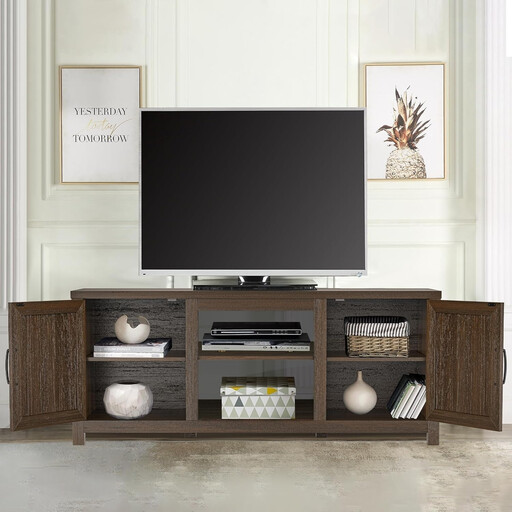
Why this product suits this profile: Measuring 147.3 cm wide, this TV unit offers two open compartments and two closed doors. According to the product information, it is designed for televisions up to 65 inches. This makes it possible to organise a compact media setup in the living room or bedroom.
The product data specifies the external dimensions, a maximum load capacity of 54 kg and the storage layout. Shoppers can compare these details with the weight of their television, the available floor space and the size of their devices.
MDF engineered wood, two open compartments, two doors and adjustable shelves according to the description; assembly with illustrated instructions.
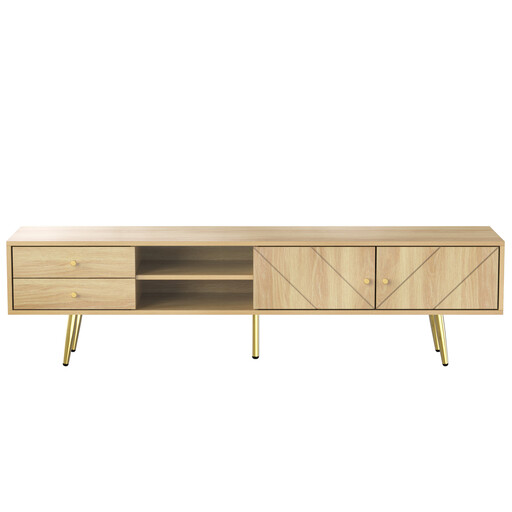
Why this product suits this profile: The combination of a wood-effect finish, gold-coloured legs, two drawers, two doors and open compartments appeals to shoppers looking for a well-organised TV unit with a clear layout.
The product data specifies dimensions of 160 × 36 × 42 cm, a maximum load capacity of 50 kg and the individual storage areas. This makes it possible to assess its suitability accurately before buying.
Two drawers, two doors, two open compartments, MDF and chipboard, plus a stated product weight of 23.4 kg.
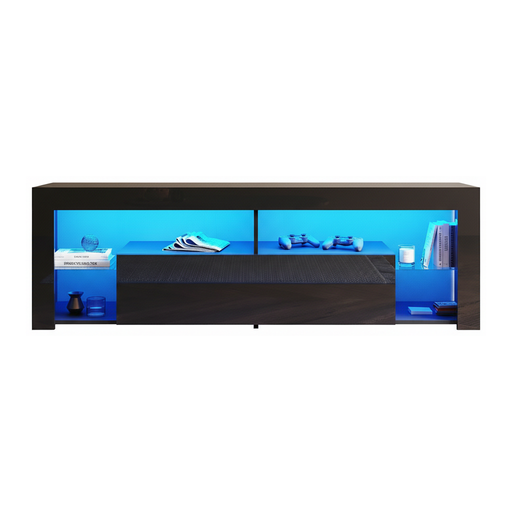
Why this product suits this profile: This modern TV unit is designed for users who want to combine open glass compartments, a drawer and multi-coloured LED lighting in their media area. According to the product name, it is designed for televisions up to 65 inches.
The features are clearly specified: a high-gloss finish, one drawer, open glass shelves and LED lighting with 16 colours. This makes it easier to decide whether the additional functions are genuinely needed.
MFC and MDF, black high-gloss finish, open glass compartments, one drawer and LED lighting with 16 colour options according to the product description.
Before assembly, the floor should be level and there should be sufficient distance from sockets and cable connections. Check whether the assembly instructions recommend that two people assemble the unit. Screws should be tightened firmly, but without damaging the panels.
A soft, slightly damp cloth is usually all that is needed for cleaning. Harsh cleaning products, excessive moisture and direct heat sources can damage surfaces. Devices must not cover ventilation openings. For a TV cabinet with doors, take account of cable openings and heat build-up inside the closed compartment.
We have put together a complete, regularly updated list of products that fully meet these strict selection criteria and the safety regulations applicable in the EU.
First, measure the actual width of the television, including its stand. A lowboard measuring between 147 and 160 cm wide may be suitable, depending on the TV model. You should also allow some space at the sides and sufficient clearance from walls or other furniture.
Its lifespan depends on the material, workmanship, load, room conditions and assembly. It is not possible to give a general estimate of its service life. Keeping within the maximum load capacity, avoiding moisture and checking the screws from time to time will reduce the typical stresses of everyday use.
The furniture itself has no ongoing running costs. For a model with LED lighting, electricity consumption depends on the lighting’s power rating and how long it is used each day. For a realistic estimate, refer to the electrical specifications of the particular LED system and your local electricity tariff.