
Lieferung heute & morgen

Qualitätsgarantie

Willkommens-Angebote freischalten: KOSTENLOSE Lieferung | Bis zu 80 % RABATT | Kostenlose 30-Tage-JoyPlus-Testphase
App herunterladen
A new TV stand can transform the look of an entire living room. However, the selection is vast, and not every model lives up to its promises. Before you make a decision, it's important to know the common pitfalls that can lead to disappointment. Often, it's the subtle details that determine the longevity and functionality of your new piece of furniture.
The three most common problems when choosing a TV stand are:
To avoid these problems, it's worth taking a closer look at a few key parameters that are essential for an informed purchasing decision.
A functional and durable TV stand is distinguished by its thoughtful details. To avoid a poor investment, pay attention to the following three aspects before you buy.
The material is crucial for the stability and longevity of your TV cabinet. While solid wood offers high value and robustness, modern engineered woods like MDF (Medium-Density Fibreboard) and high-quality particle board are a practical and often more affordable alternative. Pay attention to the thickness of the top and internal shelves. A thickness of at least 18 mm is a good benchmark for stability.
Even more important is the maximum load capacity specified by the manufacturer. This figure must safely support the weight of your television and all additional devices (gaming console, soundbar, receiver). A model with a load capacity of 40 kg or more generally provides a solid foundation for most modern TV sets.
The right size is crucial for a harmonious overall look. As a rule of thumb: the TV stand should be at least 10-15 cm wider than the television on each side. For larger TVs (65 inches and up), a 170 cm TV table or wider is a suitable choice.
Also, consider how much storage you need in your stand. Open compartments are ideal for devices controlled by a remote. Closed drawers and doors, on the other hand, create a clutter-free look and protect accessories from dust. A modern TV cabinet often combines both, offering flexible usage options.
Thoughtful cable management is more than just a hole in the back panel. Ideally, the unit should have several concealed cable cutouts, both in the back panel and between the individual compartments. This allows all connection cables to be routed invisibly from the power outlet to the devices and between the devices themselves.
The design should match your interior style. Whether it's a clean, modern sideboard for the TV, a model with a warm wood-effect finish like an oak TV unit, or a piece with a retro design—the look significantly contributes to the room's atmosphere.
To help you decide, we have compiled a few models based on different user profiles and requirements.
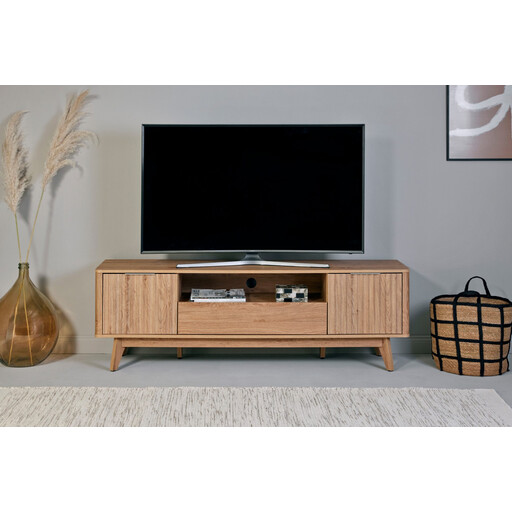
Why This Fits Their Persona: Ideal for users seeking a statement piece of furniture with a distinct design aesthetic. Its approx. 170 cm width and elegant retro design make it a centrepiece in larger living rooms, providing the perfect stage for large televisions.
Its sturdy engineered wood construction and smart design with six feet effectively prevent the top surface from sagging. A cable opening in the back panel allows for basic cable management.
Featuring two doors, a drawer, and an open compartment, it offers a balanced mix of visible and concealed storage. The Montana Oak finish gives the room a warm, premium atmosphere.

Why This Fits Their Persona: Perfect for those who appreciate an understated, modern design and thoughtful features. At 120 cm wide, it fits well in mid-sized rooms and promotes a tidy, serene living environment.
This model directly addresses the cable problem with two dedicated cable management openings in the back, allowing for clean and separate routing of wires from different devices.
Equipped with soft-close hinges and upgraded drawer runners, it ensures quiet and smooth daily use—a detail often missing in models at this price point.

Why This Fits Their Persona: A great choice for new homeowners and apartment dwellers looking for a stylish piece of furniture without breaking the bank. The striking chevron pattern adds a modern touch, while its compact size is ideal for smaller living spaces.
Despite its design focus, the stand offers ample closed storage with two doors and a drawer to keep clutter at bay. The 55 kg maximum load capacity is solid for its size and prevents instability.
The combination of a distinctive design and practical functionality (including a soft-close mechanism) offers excellent value for money. The FSC certification indicates responsible material sourcing.
We've curated a complete, up-to-date list of products that fully meet these strict selection criteria and German safety regulations.
For a balanced look and secure placement, the TV stand should extend about 10 to 20 cm beyond the TV on each side. Measure the total width of your television and add at least 20 cm to determine the minimum width for your new stand.
MDF (Medium-Density Fibreboard) is made by compressing fine wood fibres under high pressure. It is denser, heavier, and more stable than particle board, and has smoother surfaces and edges, which allows for a higher-quality paint or veneer finish. Particle board is made from coarser wood chips. It is lighter and less expensive, but also less resistant to bending and more susceptible to moisture damage. For load-bearing elements like the top shelf, MDF is often the more durable choice.
Start by placing all your devices in their final positions. Bundle the power cables together and run them through one cable opening to the power strip. Use a separate opening for signal and data cables (HDMI, LAN) to minimise interference. Velcro cable ties or cable sleeves can help bundle and tidy the cable runs behind the furniture.