
Lieferung heute & morgen

Qualitätsgarantie

Willkommens-Angebote freischalten: KOSTENLOSE Lieferung | Bis zu 80 % RABATT | Kostenlose 30-Tage-JoyPlus-Testphase
App herunterladen
A TV stand should support your television securely, accommodate media devices and keep cables as discreet as possible. In practice, however, poor purchases are often caused not by the design, but by missing information about load capacity, dimensions and assembly. If you choose based solely on colour or fronts, you may later find that your games console does not fit in the compartment, there is no designated place for the remote control or the furniture looks too bulky in the room.
This guide explains what individuals and families in Germany should consider when buying a TV lowboard, TV cabinet or other TV furniture.
The screen diagonal alone tells you little about whether a TV stand will fit. The actual width of the device, including its feet, is what matters. A 140 cm TV stand, for example, provides 140 cm of usable surface area, but also needs some additional clearance from walls or other furniture.
Before buying, you should check:
A lowboard for televisions should not only be wide enough visually. The surface must also suit the position of the feet and the weight distribution of the device.
TV furniture with doors and drawers can keep accessories out of sight. However, if there are no cable access holes or the compartments are not deep enough, connections can be difficult to reach. Some air circulation is also advisable for games consoles, receivers and streaming devices.
Look out for:
A wooden TV stand may be made from solid wood, MDF, chipboard or a combination of materials. These materials differ in terms of weight, finish, care requirements and construction. A wood-effect finish initially describes only the appearance, not necessarily the material itself.
With MDF or chipboard, the edges, fittings and attachment of the feet are particularly important. Details such as “maximum load capacity” should be clearly stated. If this information is missing, you should not estimate the television’s weight yourself.
For smaller rooms, a TV unit measuring 120 cm wide may be sufficient. Wider models from around 140 cm offer more surface space and storage, but require a suitable wall and floor area. The depth should accommodate your equipment without extending unnecessarily far into the room.
The height affects the viewing angle. When seated, the central area of the screen should be approximately at eye level. The sofa, seat height and personal preferences all play a part. A taller model may be useful in a bedroom or with raised seating.
The load capacity must cover at least the weight of the television and any other items placed on the top surface. For a model with a stated 50 kg maximum load capacity, this limit should not be exceeded. This specification does not automatically apply to every individual compartment or drawer.
Also important:
A TV unit with storage should suit the equipment you actually own. Open compartments are suitable for devices operated by remote control or with visible displays. Enclosed areas are ideal for games, cables, films and accessories. Drawers provide space for smaller items, while sliding doors require less clearance in front of the furniture than hinged doors.
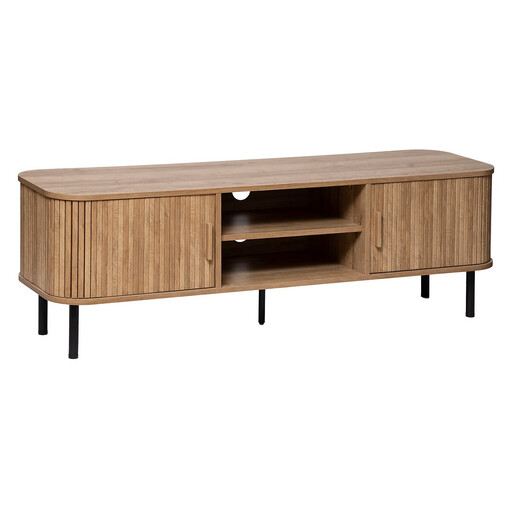
Why this product suits the profile: With a width of 140 cm and a depth of 40 cm, this unit is suitable for a living room where compact TV furniture with enclosed storage is required.
The precise external dimensions make it easier to check whether it will fit your available space. Two sliding doors reduce the clearance needed in front of the unit.
MDF and chipboard with a wood-effect finish; steel frame; 140 × 40 × 53 cm; self-assembly required.

Why this product suits the profile: If quiet opening and tidy cable management matter in everyday use, this unit offers clearly stated features to support both.
Two cable openings at the back address the common issue of inadequate cable management. Soft-close hinges and improved drawer runners are explicitly specified.
Dimensions of 120 × 39 × 48 cm; beige finish; cable management openings; soft-close door hinges.
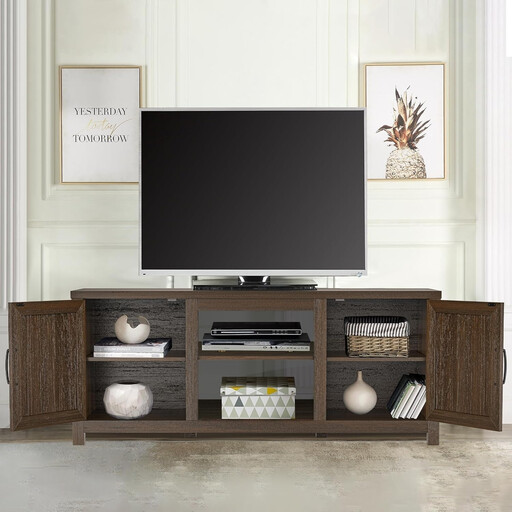
Why this product suits the profile: The combination of open compartments, two doors and a stated suitability for televisions up to 65 inches makes it a good fit for households with several media devices.
The product details specify the external dimensions, maximum load capacity and a suitable TV size. Two open compartments make it easier to access your devices.
147.3 × 40.6 × 61.7 cm; 54 kg maximum load capacity; two open compartments and two doors; adjustable shelves.
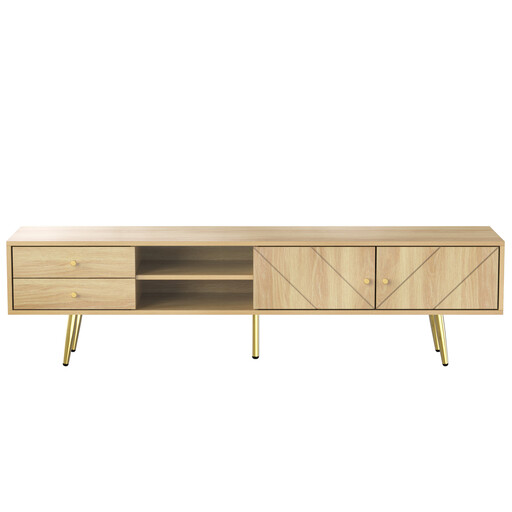
Why this product suits the profile: For users who want extra width and a mix of open and enclosed areas, this TV unit offers several clearly described storage options.
The combination of two drawers, two doors and two open compartments lets you organise accessories, equipment and decorations according to how they are used.
160 × 36 × 42 cm; 50 kg maximum load capacity; two drawers, two doors and two open compartments.
We have put together a complete, regularly updated list of products that fully meet these strict selection criteria and the safety regulations applicable in the EU.
With almost all flat-pack TV furniture, careful assembly is essential. Before putting it together, check that all parts and fittings are included. Larger models are best assembled by two people. The furniture should be fully levelled before any weight is placed on it.
For many coated surfaces, a soft, slightly damp cloth is all that is needed for cleaning. Abrasive cleaning products, standing water and harsh chemicals can damage the surface. Always follow the product-specific care instructions.
First, measure the television’s actual width, including its feet. The TV furniture should be slightly wider, so that the device does not extend beyond the side edge and there is enough space from walls or adjacent furniture.
The right height depends on your seating and position. As a general guide, the centre of the screen should be approximately at eye level when you are seated. A different height may be more suitable in a bedroom, with a low sofa or with raised seating.
Its service life depends on factors including the material, fittings, assembly, load and care. It is not possible to give a reliable general lifespan. The key factors are suitable load capacity, stable positioning, correctly tightened fasteners and protection from moisture.