
Lieferung heute & morgen

Qualitätsgarantie

Willkommens-Angebote freischalten: KOSTENLOSE Lieferung | Bis zu 80 % RABATT | Kostenlose 30-Tage-JoyPlus-Testphase
App herunterladen
A TV stand should safely support your television, keep media devices neatly organised and complement your living room. In practice, however, some common purchasing decisions can lead to unnecessary costs. A piece of furniture may match the screen size but not be deep enough for a receiver and games console. Or its appearance may impress in the product photos, while cable openings and ventilation are missing in everyday use.
This buying guide will help you choose the right TV furniture based on dimensions, storage space, material, colour and assembly requirements.
The description “for TVs up to 65 inches” primarily refers to the intended screen size. It does not automatically mean that every width and type of stand will fit without problems. The key factors are:
For a TV up to 65 inches, the top panel should not merely cover the screen width; it should also provide a little extra room at the sides. Depending on the TV model, mobile TV stands or particularly wide TV consoles may also be suitable for televisions between 50 and 90 inches.
A shallow TV unit may save space, but it can be impractical for larger devices. Check the furniture depth before buying. A TV stand should provide enough room for cable plugs, extension leads and connected devices.
Also look for:
A TV cabinet with closed compartments protects accessories from dust, while open sections make access easier and improve air circulation.
A TV unit with LED lighting can enhance your décor visually. However, lighting does not replace sensible storage planning and should not be the only selection criterion. Check whether the power supply, cable routing and controls are easy to access in practice. With high-gloss surfaces, fingerprints and dust are also usually more noticeable.
Always compare the product dimensions with the intended space. In addition to width, depth and height, skirting boards, radiators and the distance from the wall can also be relevant. For families with young children, a tip-resistant setup is particularly important. The unit should stand on a level surface and, where necessary, be secured with suitable wall fixings.
A maximum load rating is only meaningful if it has been provided by the manufacturer. If this information is missing, check the load limit with the retailer or in the product documentation before buying. Shelves and drawers also have their own load limits.
Commonly used materials include MDF, chipboard, wood fibreboard and metal. The material description alone says little about the unit’s actual stability. More useful indicators include:
TV furniture in black or white often works well with modern interiors. A beige TV unit or one with a wood-effect finish has a more understated appearance and can be combined with many warm colours. Always clean coated surfaces with a soft cloth and avoid abrasive products.
A TV stand with storage should suit the accessories you already own. Measure larger devices such as games consoles, soundbars and receivers, then compare these measurements with the internal dimensions of the compartments.
The following details are relevant to the assembly effort:
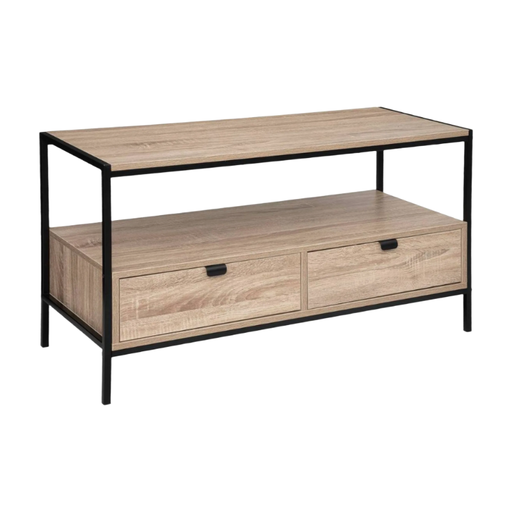
Why this product suits the profile: Measuring 100 × 40 × 54 cm, this TV unit is suitable for smaller living areas and offers a drawer plus an open compartment for everyday accessories.
The clearly stated external dimensions make it easier to check whether the unit will fit. Before buying, however, compare the TV width, distance between the feet and device dimensions.
MDF wood fibreboard, iron legs, a drawer and an open compartment; assembly is required.
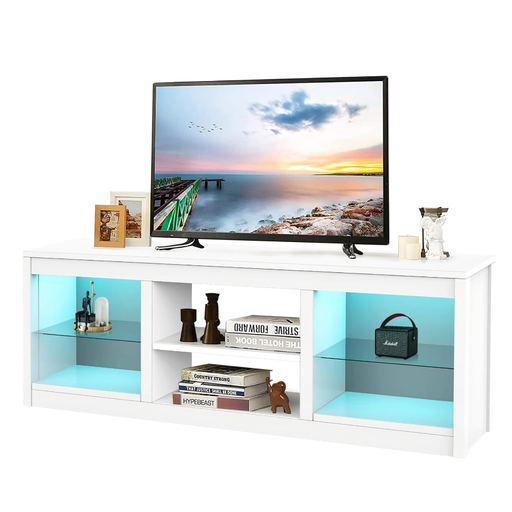
Why this product suits the profile: With a width of 147.3 cm and a height of 61.7 cm, it provides a clearly defined base for TVs up to 65 inches, as well as several storage areas.
Several cabinets and compartments help keep accessories out of sight. Nevertheless, the depth of 40.6 cm should be compared with your devices’ measurements.
White finish, 147.3 cm width, storage compartments and assembly instructions included.
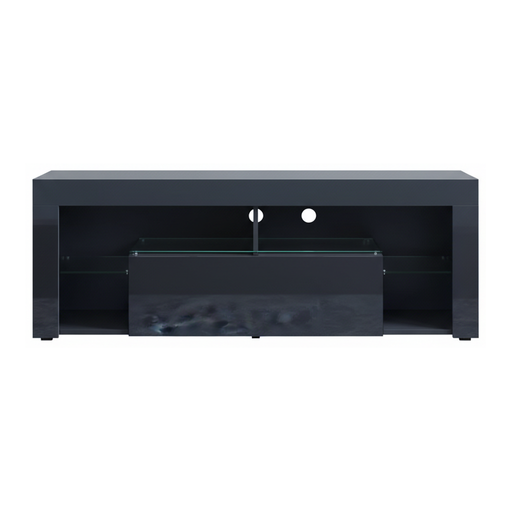
Why this product suits the profile: Measuring 151.1 cm wide, this TV unit combines a glass shelf, a flap door and LED lighting with 12 adjustable colours.
The features are clearly specified: flap door, glass shelf and 12 LED colours. LED components must be kept dry and do not replace a ventilation check.
Black high-gloss finish, 151.1 × 42.1 × 15.6 cm, handleless front and a weight of 28.2 kg.
We have put together a complete, regularly updated list of products that fully meet these strict selection criteria and the safety regulations applicable in the EU.
Before assembly, compare the contents of the package with the parts list. Initially tighten the screws only lightly and align the carcass before fully tightening all the connections. A TV cabinet should stand on a level, stable surface. For taller or heavily loaded furniture, wall fixing may be advisable or required according to the instructions.
Cables should not become trapped between the furniture and the wall. With enclosed compartments, make sure there is sufficient air circulation. The top panel must not be loaded beyond the stated maximum. For the finishes mentioned above, cleaning usually requires no more than a soft, slightly damp or dry cloth; avoid harsh cleaning products.
First measure the TV’s actual width and the distance between its feet. The TV stand should fully support both feet while leaving a little space at the sides. For a television up to 65 inches, many suitable models are around 140 to 170 cm wide, although suitability ultimately depends on the TV itself.
Compare the width, height and depth of each device with the internal dimensions of the compartments. You should also take cable connections and ventilation openings into account. A TV stand with storage is practical when open and closed sections are combined appropriately.
Its lifespan depends on factors including the material, assembly quality, load and care. Stable positioning, correctly tightened fittings and adherence to the stated load limits all help ensure long-term use. Hinges and drawer runners should not be moved abruptly or subjected to loads beyond their intended capacity.