
Lieferung heute & morgen

Qualitätsgarantie

Willkommens-Angebote freischalten: KOSTENLOSE Lieferung | Bis zu 80 % RABATT | Kostenlose 30-Tage-JoyPlus-Testphase
App herunterladen
A new TV stand can transform the entire look of your living room. However, the selection is vast, and a model that looks good at first glance doesn't always prove practical for daily use. Many buyers focus on design and overlook crucial functional aspects, leading to clutter and dissatisfaction. Before you make a decision, it's helpful to know the most common pitfalls to avoid a purchase you'll regret.
This guide focuses on the objective criteria that define a quality TV stand. We'll highlight the three most common mistakes buyers make and explain the key parameters you should consider to find a TV unit that delivers on both aesthetics and functionality.
Choosing the wrong TV unit can quickly lead to frustration. Pay close attention to these three points to find a long-term solution for your home that you'll be happy with.
To avoid these mistakes, you should consider three essential parameters before buying. These will help you narrow down your search and identify a suitable TV unit.
The harmony between the TV, the furniture, and the room is crucial. As a rule of thumb, the TV stand should be at least 10 cm wider than the television on each side.
The material determines not only the look but also the sturdiness and durability. MDF (Medium-Density Fibreboard) is generally denser and more dimensionally stable than basic particleboard.
A well-designed lowboard with storage is the key to a tidy living room. Consider what you need to store.
Based on these criteria, we have selected a few models that are well-suited for different needs and interior styles.
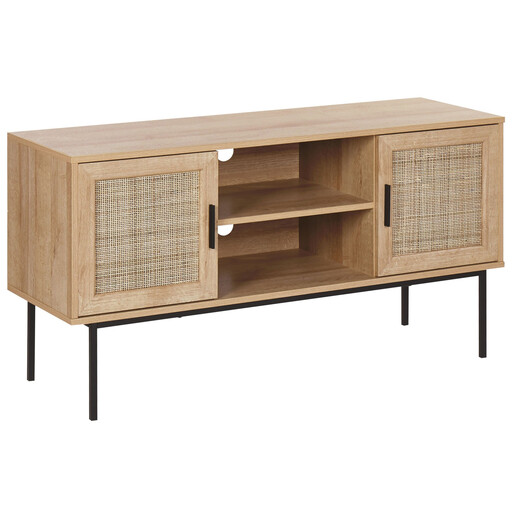
Why it's a great fit: The combination of a light wood effect and doors with a rattan weave embodies the relaxed boho style. At 120 cm wide, it's ideal for mid-sized living rooms and TVs up to 55 inches.
This model includes practical cable management to prevent clutter. The specified maximum load capacity of 30 kg for the top surface provides a clear indication of its stability.
The design with rattan doors offers an aesthetic way to conceal storage while also serving as a decorative element.
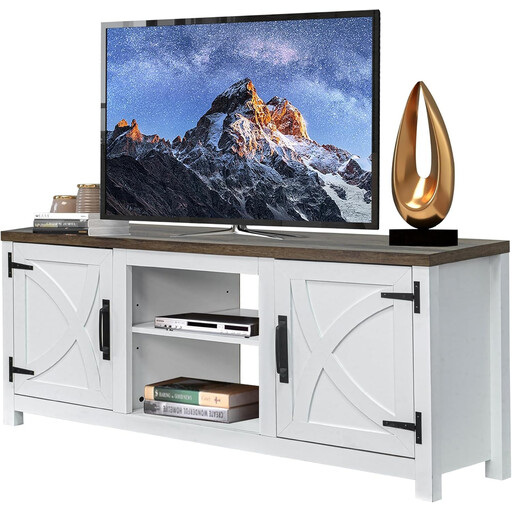
Why it's a great fit: The white finish and sliding barn door design are characteristic of the modern farmhouse style. At nearly 148 cm wide, it's a perfect match for TVs up to 65 inches and offers plenty of storage.
Its generous width ensures the right proportions for large TVs. The combination of open and closed compartments allows for organised storage of devices and accessories.
The sliding door is a space-saving and a visual highlight. Adjustable shelves inside offer flexible storage options.
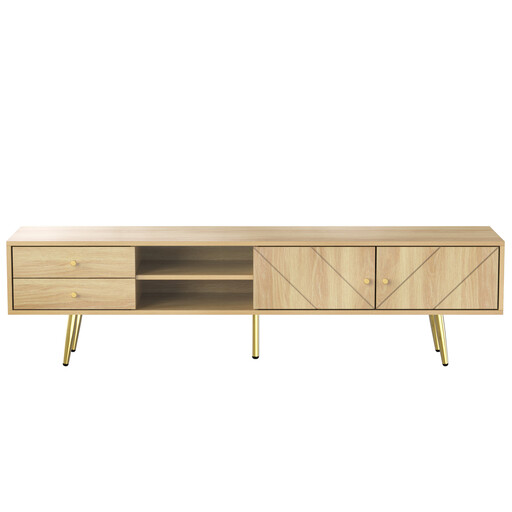
Why it's a great fit: The minimalist design, warm wood effect, and elegant gold feet create a sophisticated, modern look. Its 160 cm width is ideal for large TVs and spacious living rooms.
The MDF and particleboard construction, along with a high maximum load capacity of 50 kg, prevents sagging. The mix of drawers, doors, and open shelves provides a structured storage solution.
The generous width and high load capacity are combined with an elegant design, distinguished by its unique grooved doors and gold accents.
A TV stand with closed compartments is often the best solution for a clutter-free living room. We've curated a selection of models that blend functionality and design.
The optimal height depends on the seat height of your sofa. As a guideline, the centre of the TV screen should be at eye level when you are seated. This typically corresponds to a furniture height of 40 to 60 cm. Measure your seated eye level to determine the right height for you.
A 65-inch TV is approximately 145 cm wide. To create a harmonious look, your TV table should be at least this wide, but ideally a bit wider. A 160cm lowboard provides good visual balance and additional surface space. Always check the manufacturer's specified maximum load capacity to ensure the unit can safely support the TV's weight.
Choose a model with integrated cable management, such as cutouts in the back panel. These allow you to route cables directly down behind the unit. Additionally, you can use cable ties, cable sleeves, or self-adhesive cable clips to bundle the cords and run them discreetly along the back or underside of the TV stand.