
Lieferung heute & morgen

Qualitätsgarantie

Willkommens-Angebote freischalten: KOSTENLOSE Lieferung | Bis zu 80 % RABATT | Kostenlose 30-Tage-JoyPlus-Testphase
App herunterladen
A TV stand should safely support your television, neatly store your devices and fit naturally into your living room or bedroom. In practice, however, some typical purchasing decisions can lead to unnecessary problems: the unit may be too short, connections may be difficult to reach or the stated screen size may be confused with the actual space available on the stand.
A television up to 65 inches will not automatically fit every TV unit advertised for that size. What matters is the actual width of the television, the position of its stand and the usable top surface of the furniture. A centrally mounted stand can require a different amount of space from two feet positioned at the sides.
You should therefore measure:
A low TV stand for televisions up to 65 inches should also not be placed directly beside a busy walkway if the television extends beyond the unit at the sides.
A TV cabinet with doors or sliding doors may look spacious from the outside, while offering very little room inside for a receiver, games console and accessories. Pay attention to the internal dimensions, the position of the shelves and ventilation. Devices that generate heat should not be operated in a fully enclosed compartment without air circulation.
Without cable-routing openings, visible cable loops can quickly build up behind the TV table. Check whether openings are provided in the back panel and whether they are positioned correctly. You should also determine the distance to the socket and to the aerial or network outlet before buying. A modern TV unit without suitable cable management can be less practical in everyday use than a simple model with a well-designed back panel.
The width of the furniture should suit both the width of your television and the room. A 140 cm-wide TV stand often looks well balanced in a compact room, while a 160 to 180 cm-long model provides more display space and storage. The depth must be sufficient for the stand, but should not unnecessarily narrow the walkways.
The height affects your viewing angle. When sitting in front of the television, the centre of the screen should be roughly at eye level. A wall-mounted television can be paired with a lower TV stand; with a television placed on the unit, you will need to take the height of the stand into account.
Many TV units are made from MDF, chipboard or melamine-coated wood-based materials. These materials differ in terms of their surface, edge finishing and care requirements. A steel frame can provide additional stability, but it does not replace checking the maximum load capacity.
Before placing your order, check:
Once assembled, all screws and fittings should be securely tightened. In households with children or pets, suitable wall anchoring to prevent tipping is recommended where provided by the manufacturer.
Sliding doors do not require additional opening space, making them suitable for smaller rooms. Flaps or drawers, on the other hand, provide quicker access to remote controls and accessories. Open compartments make devices easier to operate, but also leave cables and dust more visible.
A TV stand with LED lighting can serve as an attractive design feature. Check whether the lighting can be switched on separately, what type of power supply it requires and whether the cables can be routed neatly. The ability to change colours alone says nothing about the build quality or everyday practicality of the TV unit.
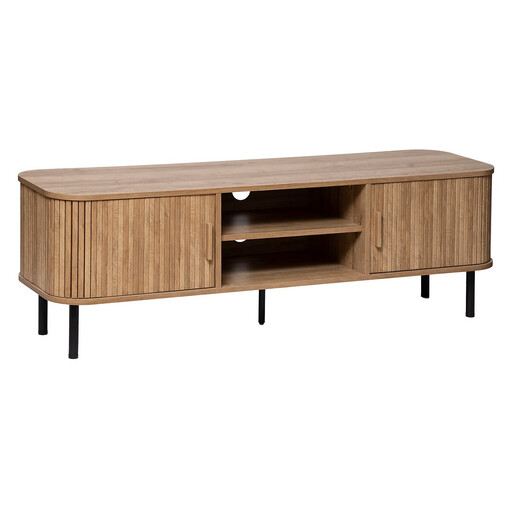
Why this product suits this profile: The compact 140 cm width and two sliding doors make it suitable for smaller living areas and a modest media set-up.
The stated external dimensions make it easier to plan the space required. Before buying, you should also compare the television’s width, stand and load capacity.
MDF and chipboard with a wood-effect finish, steel frame, two sliding doors and a depth of 40 cm.

Why this product suits this profile: This model is aimed at buyers who value convenient operation and tidy cable management at the back of their TV cabinet.
Two cable-management openings help reduce visible cables. The stated specifications do not replace checking the actual dimensions of your devices and cables.
120 × 39 × 48 cm, soft-close door hinges, improved drawer runners and cable openings.
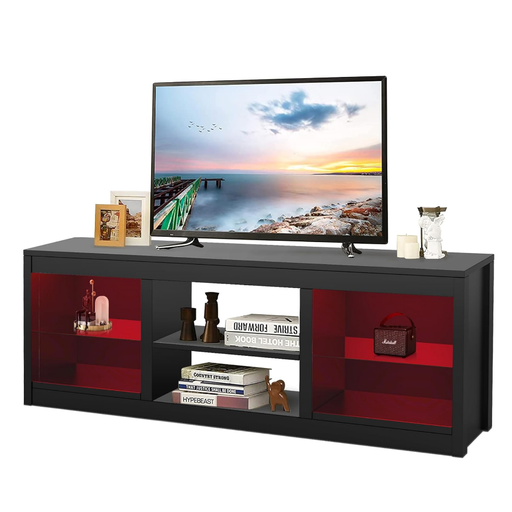
Why this product suits this profile: The 167.6 cm width and multiple compartments appeal to households wanting to store their television, console, receiver and accessories together.
The product description expressly states that it is suitable for televisions up to 65 inches. Even so, you should compare the width, depth and load capacity with your specific television.
167.6 × 41.7 × 55.5 cm, multiple storage compartments and a black wood-effect surface.
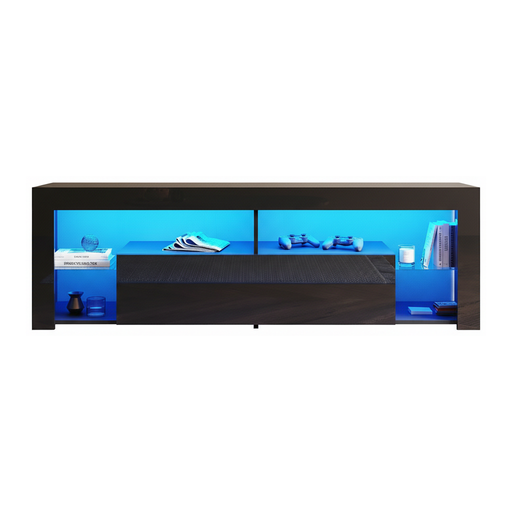
Why this product suits this profile: This TV stand with LED lighting combines a glossy surface with open glass compartments and a closed drawer.
Open compartments make media devices easy to access. Before assembly, you should plan the power supply and cable routing for the lighting.
Glossy black MFC and MDF surfaces, 16-colour LED lighting, drawer and open glass compartments.
We have put together a complete, regularly updated list of products that fully meet these strict selection criteria and the safety regulations applicable in the EU.
A TV stand should be placed on a level, stable surface. Assemble the unit according to the enclosed instructions and tighten the screws and fittings evenly. After a few days, check whether any connections need retightening.
For care, a soft, slightly damp or dry cloth is usually sufficient. Abrasive cleaners, standing moisture and direct heat can damage surfaces. Devices should be positioned so that ventilation openings are not covered. Do not exceed the permitted load for the top surface or compartments.
The right width depends on the television’s actual width and its stand. A 65-inch television is not the same width with every manufacturer. Measure your television and leave a little additional surface space at the sides. A unit around 160 to 180 cm wide often provides more flexibility, but it also requires more room.
This depends on your seating height, screen size and stand. The key point is that, when seated, the centre of the screen should not be significantly above or below your natural line of sight. A lower TV stand may be suitable with a low sofa, while taller seating requires the overall height to be adjusted accordingly.
Its service life is influenced by factors including the material, quality of the fittings, load and assembly. Avoid overloading, moisture and frequent repositioning. Secure wall anchoring and regular checks of the screw connections can help maintain everyday safety. Before buying, check the statutory warranty rights and any guarantee details provided for the specific offer.