
Lieferung heute & morgen

Qualitätsgarantie

Willkommens-Angebote freischalten: KOSTENLOSE Lieferung | Bis zu 80 % RABATT | Kostenlose 30-Tage-JoyPlus-Testphase
App herunterladen
A new TV stand can transform the look of an entire room. But the selection is vast, and marketing promises often outweigh the actual quality. Many buyers only realise after assembly that their new furniture wobbles, the TV barely fits, or the cables create an unsightly mess. Before you make a decision, it's crucial to understand the common pitfalls that lead to disappointment and unnecessary expense.
This guide will help you separate the good from the bad. We'll focus on the objective criteria that define a quality TV stand and show you how to avoid the most frequent purchasing errors.
When searching for the right TV cabinet, several traps are not apparent at first glance. These three issues are the most common sources of dissatisfaction:
To avoid a bad purchase, you should focus on verifiable facts. The following three parameters are crucial for the longevity and functionality of your TV stand.
The most important rule is: The TV stand must match the size and weight of your television.
The material determines not only the look but also the stability and ease of maintenance.
A good TV stand offers more than just a surface. It helps you stay organised.
Here are some models that represent a considered choice for different needs and interior styles, based on objective features.

Why it's a good fit: Ideal for a first apartment or smaller living rooms. The chevron pattern design is modern without being overpowering. At 120 cm wide, it's well-suited for TVs up to 50 inches.
The maximum load capacity of 55 kg is solid for a particle board unit of this size, preventing sagging with proper use. The combination of a drawer and doors offers flexible, enclosed storage.
Features a soft-close mechanism for the drawer. The steel feet provide a stable base and an airy aesthetic.

Why it's a good fit: For those who want to make a bold statement in their living room. This modern TV stand in high-gloss black with integrated LED lighting is an eye-catcher and fits perfectly into contemporary interior styles.
This model combines enclosed storage (a drawer) with open glass shelves. This allows for the placement of devices that require ventilation, thus avoiding the overheating trap.
The LED lighting is adjustable with 16 different colours. The material combination of MDF and coated particle board provides a smooth, low-maintenance, high-gloss finish.
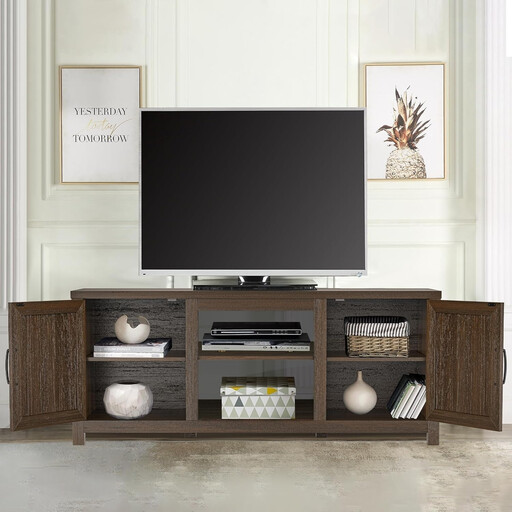
Why it's a good fit: With a width of 147 cm and suitability for TVs up to 65 inches, this model is explicitly designed for large screens. The farmhouse style, featuring a sliding barn door, is also a striking design element.
The MDF construction and the specified maximum load capacity of 54 kg provide the necessary stability for heavy devices. Its proportions are well-suited for large TVs, avoiding the "too small" stand pitfall.
It offers a versatile mix of two open compartments and two enclosed sections. The adjustable shelves allow for flexible customisation of the storage space.
We have compiled a complete, up-to-date list of products that fully meet these strict selection criteria and safety requirements.
The optimal height for a TV stand ensures that the centre of your television screen is at eye level when you are sitting on your sofa or chair. As a general rule, this height is around 90-100 cm from the floor. Since most TV stands are between 40-55 cm high, this provides a good starting point for common TV sizes and seating furniture. Measure your seated eye level to determine the perfect height for you.
For a balanced aesthetic and a secure base, the TV stand should be at least 10-20 cm wider than the television on each side. This means the total width of the stand should exceed your TV's width by at least 20-40 cm. This not only gives the device a stable platform but also creates a visually appealing unit.
A key indicator is the maximum load capacity, which is specified in the product details in kilograms (kg). This value should safely exceed the weight of your TV and all additional devices. Also, pay attention to the material: MDF is generally more robust than simple particle board. For wide stands (over 150 cm), an additional support leg in the centre is a good sign of a well-thought-out and stable design.