
Lieferung heute & morgen

Qualitätsgarantie

Willkommens-Angebote freischalten: KOSTENLOSE Lieferung | Bis zu 80 % RABATT | Kostenlose 30-Tage-JoyPlus-Testphase
App herunterladen
A TV unit should support your television securely, keep your media devices tidy and fit in with your living room or bedroom. In practice, though, the wrong purchase is often down to more than just the design: unsuitable dimensions, unclear weight limits or hard-to-reach connections can all cause problems.
That’s why it’s worth checking the specifications carefully before you buy. A TV unit with an attractive finish won’t necessarily suit every screen size. And while a TV cabinet with doors may provide useful storage, it could restrict ventilation for games consoles or receivers.
The “up to 65 inches” specification usually refers to the recommended screen diagonal. You also need to consider the TV’s actual width and the position of its feet. TVs with the same screen size can vary in width.
So be sure to check:
A TV stand should extend a little beyond the feet on both sides. Wall-mounted TVs have different requirements from those placed on a traditional TV unit.
A TV unit with doors keeps accessories dust-free and gives your room a tidy look. However, receivers, routers and games consoles generate heat when they’re in use. Without ventilation openings or sufficiently large open compartments, heat can build up.
Open compartments or generous cable openings are often more practical for devices that generate more heat. If you’re choosing a TV unit with doors, check the internal dimensions and the position of the back panel.
Many TV units are delivered flat-packed and need to be assembled at home. Clear instructions, labelled components and a stable, level surface all make assembly easier. Taller units may benefit from wall anchoring, or the manufacturer may specify that it’s required.
In homes with children or pets, it’s especially important to choose a TV stand with storage for more than just its appearance. Use the supplied fittings as instructed. If your walls are made from a different material, you’ll need suitable fixings.
A TV unit measuring 140 to 150 cm wide is often suitable for medium to larger TVs. Even so, you should check the width of your particular model. Some of the units featured here are listed as suitable for TVs up to 65 inches. You’ll still need to compare this with your own TV’s dimensions.
As well as the width, consider:
Common materials include MDF, chipboard, metal and coated wood-based panels. The material alone doesn’t tell you whether a unit is suitable. The stated maximum weight capacity, construction and correct assembly are more important.
The Parrot Uncle TV unit has a stated maximum weight capacity of 54 kg. This applies to the top surface or the specified use, and shouldn’t be confused with the weight capacity of individual shelves. For other products, check the manufacturer’s specifications.
Open compartments make devices easy to reach and can improve ventilation. Doors or sliding doors, on the other hand, keep devices and accessories out of sight. For a living room with several media devices, a combination of open and closed storage is often a practical choice.
Look for:
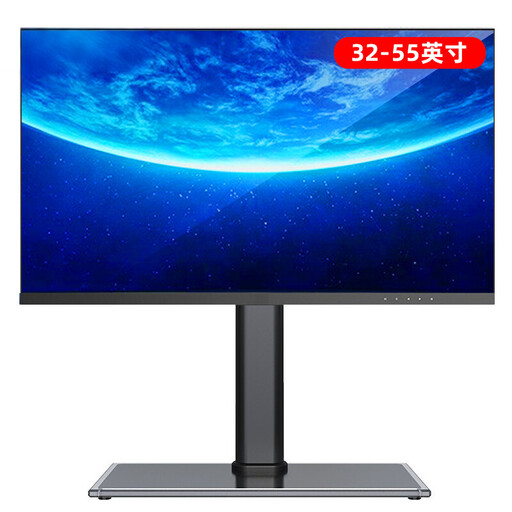
Why it suits this profile: An option for households looking for a base for a 32- to 55-inch TV without needing a large TV unit.
Its stated compatibility with 32- to 55-inch TVs clearly defines what it’s suitable for, helping you avoid choosing it for a larger TV by mistake.
Combines a fixed mount with a stand; specified for 32- to 55-inch TVs.
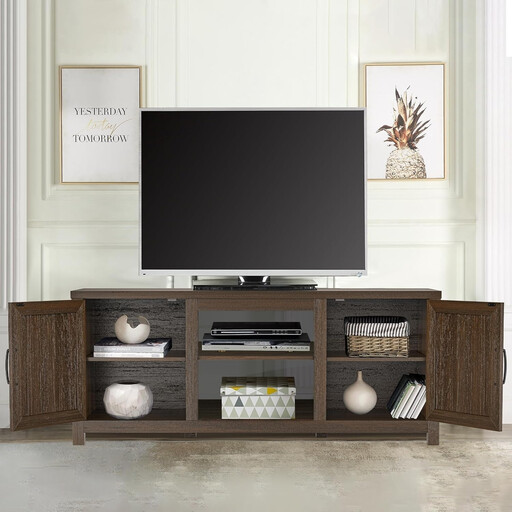
Why it suits this profile: A good fit for a living room where you want to keep a TV up to 65 inches, along with consoles, receivers and accessories.
Its dimensions of 147.3 × 40.6 × 61.7 cm, two open compartments and two doors make it easy to see how the storage is laid out.
Stated weight capacity of 54 kg; 147.3 cm wide; two open compartments and two doors.
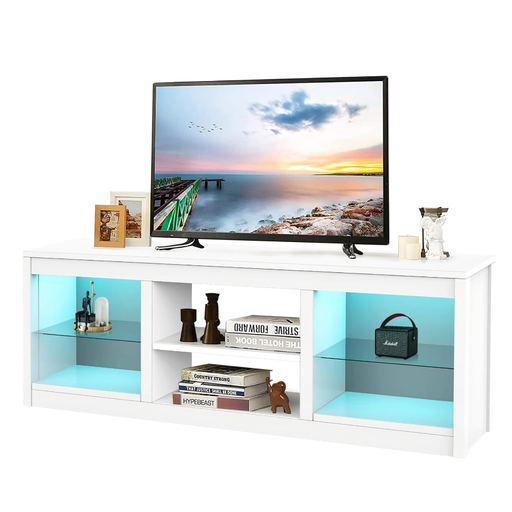
Why it suits this profile: A white TV unit for modern living spaces, with compartments and cupboards to keep several devices and accessories organised.
The product description specifically states that it’s suitable for TVs up to 65 inches, with several compartments and cupboards for media devices.
Measures 147.3 × 40.6 × 61.7 cm; white finish; several storage compartments and cupboards.
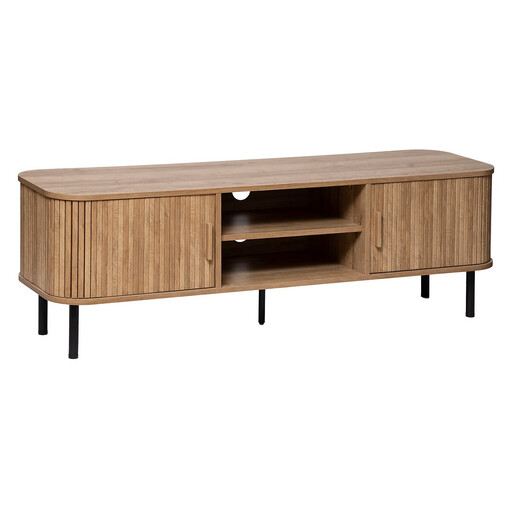
Why it suits this profile: A compact TV unit for a living room or bedroom, with two sliding doors providing enclosed storage.
The exact dimensions of 140 × 40 × 53 cm make it easier to check whether the unit will fit into an alcove or a space with limited room.
Two sliding doors; MDF and chipboard with a steel frame; designed to be assembled on a level, stable surface.
We’ve put together a complete, regularly updated list of products that meet these strict selection criteria and fully comply with the safety regulations in force in the EU.
The width you need depends on more than the screen size. Measure the TV itself and check the distance between its feet. A TV unit should support the feet fully, with a little clearance on either side. It also needs to be deep enough for cables and connections.
Lifespan depends on the materials, the weight it supports, how it’s assembled and how well it’s cared for. Overloaded shelves, moisture, frequent moving and loose joints can all affect stability. Following the assembly instructions, placing the unit on a level surface and staying within the stated weight limits can help it last longer.
The TV unit itself doesn’t use electricity. Ongoing costs only apply if it has built-in electrical components, or for connected devices such as a TV, receiver or games console. Open compartments make ventilation easier; if the doors are closed, follow the manufacturer’s guidance on use and heat build-up.