
Lieferung heute & morgen

Qualitätsgarantie

Willkommens-Angebote freischalten: KOSTENLOSE Lieferung | Bis zu 80 % RABATT | Kostenlose 30-Tage-JoyPlus-Testphase
App herunterladen
A TV wall mount can save space and bring your television closer to where you sit. But your choice shouldn’t be based on screen size alone or simply on finding the lowest price. Problems often arise because the VESA measurement, weight capacity or wall type isn’t suitable for both the television and the mount.
A mount designed for 32 to 65 inches won’t automatically fit every television in that size range. You also need to check the hole pattern on the back, known as the VESA measurement, and the weight of the set. Depending on the model, two 55-inch televisions can have quite different dimensions and mounting points.
The maximum weight capacity usually refers to the weight of the television, not accessories, a soundbar or additional shelves. A TV mount rated for up to 75 kg should only be used if the wall, wall plugs and screws are also suitable for the complete installation. The mount’s weight capacity doesn’t replace a check of the wall.
An ultra-slim TV wall mount is ideal for a fixed, space-saving installation. Once fitted, however, it can’t be adjusted sideways like a swivel TV mount. If you have seats to the side of the screen’s centre or want to mount the TV in a corner, an extending or tilting design may be more suitable.
The VESA measurement is the horizontal and vertical distance between the threaded mounting holes, in millimetres. Examples include 400 × 400 mm and 600 × 400 mm. You’ll often find this information in your television’s instruction manual or on the manufacturer’s website.
Before buying, check these three details:
A universal TV mount supports several VESA measurements, but that doesn’t mean it’s automatically compatible with every television. The position of the connections and the shape of the back of the set can also affect the clearance from the wall.
TV mounts for concrete and brick walls have different requirements from those for plasterboard or lightweight hollow walls. For concrete and solid masonry, use suitable wall plugs and screws. For timber stud walls, the mount must be fixed to the supporting studs.
Fixing directly into a standard plasterboard sheet is generally not enough to support a heavy television. Depending on the wall’s construction, you may need reinforcement or suitable cavity fixings. Always follow the product’s installation instructions and take the type of wall into account.
Before installation, measure the distance between the television, furniture, sockets and any potential obstacles. With an extra-slim design, cables that exit from the side may require additional adaptors or angled plugs.
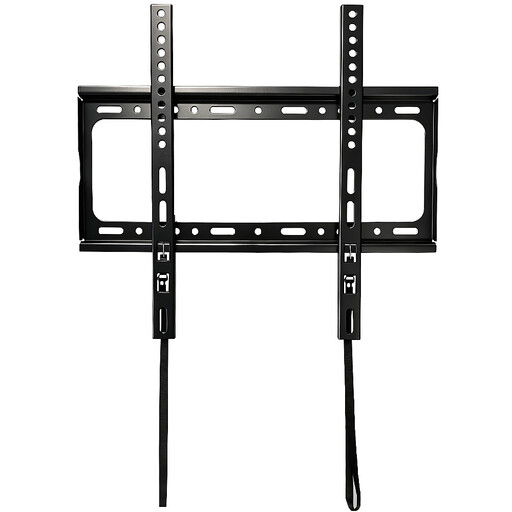
Why this product suits this profile: This fixed mount is ideal for living rooms and bedrooms where you want the television to face forwards and sit close to the wall.
The specifications state 32–65 inches, support for up to 45 kg and a VESA measurement of up to 400 × 400 mm. This makes it easy to check the key details before you order.
Fixed design, compact dimensions of 49.5 × 22.7 × 2.9 cm, and suitable for concrete, brick and timber stud walls.
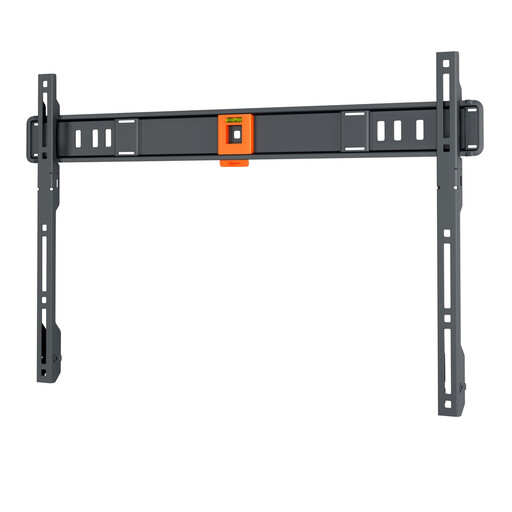
Why this product suits this profile: Designed for large televisions from 40 to 100 inches, this model offers a wide range of technical compatibility and a fixed fit for home cinema set-ups.
Compatibility ranges from VESA 100 × 100 to 600 × 400 mm, and the product specifications state a maximum weight capacity of 75 kg. You’ll still need to check the wall type and the weight of your television separately.
Reinforced steel construction, a ClickLoc safety system with an audible locking confirmation, and help with alignment from the supplied spirit level.
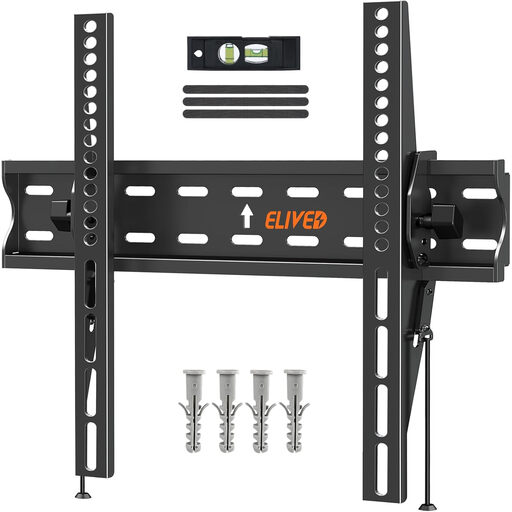
Why this product suits this profile: Designed for 26–60-inch televisions, this mount tilts from 0 to −8 degrees, so you can adjust the viewing angle or account for incoming light.
This isn’t a fixed mount: the tilt joint is clearly specified. However, it’s designed for installation on timber studs or concrete and brick walls only.
VESA 75 × 75 to 400 × 400 mm, supports up to 45 kg and has a stated wall clearance of 38 mm.
Check the screen size, weight and VESA measurement. The mount is generally suitable only if all three details fall within the product specifications. You’ll also need to make sure the wall is suitable for the fixings.
Fixing directly into a standard sheet of plasterboard is usually not enough to support a heavy television. You may need to secure the mount to supporting timber studs, reinforce the wall or use suitable cavity fixings. If you’re unsure, have the mount fitted by a suitably qualified professional.
It depends on the mount, cables and connections. A fixed, slimline mount saves space, but there may not be enough room for plugs that point backwards. Measure the depth of the connections and check the wall clearance stated in the product description.