
Lieferung heute & morgen

Qualitätsgarantie

Willkommens-Angebote freischalten: KOSTENLOSE Lieferung | Bis zu 80 % RABATT | Kostenlose 30-Tage-JoyPlus-Testphase
App herunterladen
A TV wall mount can save space, improve your viewing position and help keep cables organised. However, your choice should not be based solely on screen size or price. Technical details such as the VESA measurement, load capacity, wall material and range of movement are crucial.
If you focus only on terms such as “universal” or “ultra-slim”, you can easily overlook important limitations. The following points will help you choose a suitable TV wall mount for homes, offices, hospitality venues or retail spaces.
The specification “for 32 to 65 inches” initially describes only the supported screen-size range. It does not automatically mean that every TV mount will fit every television. The VESA measurement must also be checked. This refers to the horizontal and vertical distance between the threaded mounting holes on the back of the television, for example 200 × 200 mm or 400 × 400 mm.
A 55-inch television may therefore have a different VESA measurement from a comparable model of the same size. Before buying, check the details in the television’s user manual or on the manufacturer’s website.
A TV mount up to 45 kg should not be used for a television whose weight is close to or exceeds this limit. Extendable and swivelling models also place leverage forces on the wall fixings. For larger televisions, models with greater capacity reserves are advisable, such as a TV mount up to 75 kg or a TV mount up to 100 kg, provided that the VESA measurement and wall construction are also suitable.
The decisive factor is always the television’s actual weight, including accessories, not just its screen size.
Adhesive and hook-based solutions may be designed for lightweight decorations, towels or small objects. As a rule, they are not a suitable way to mount a television. Even a space-saving TV mount requires a secure connection to the wall or ceiling.
Tenants should check whether their landlord’s permission is required before installation. Plasterboard, hollow bricks and drywall require suitable wall plugs, reinforcements or load-bearing substructures. Fixing a heavy screen only to a thin board is not sufficient.
First, note down your television’s VESA measurement. A VESA wall mount should explicitly support the specified hole spacing. With flexible universal models, the range may extend from 75 × 75 mm to 400 × 400 mm or up to 600 × 400 mm, for example.
In addition to the hole spacing, you should check:
A fixed TV mount is a sensible choice when the screen is positioned directly in front of the seating area and should sit as close to the wall as possible. Depending on the model, an ultra-slim TV wall mount may provide only a few centimetres of clearance. This creates a discreet appearance, but leaves less room for cables and plugs.
A tilting TV wall mount can adjust the viewing angle when the television is installed higher up, such as above a sideboard. A swivelling TV mount or extendable mount is more suitable for rooms with several seating areas. The maximum extension should be taken into account, as the load on the fixings increases as the distance from the wall grows.
Concrete and solid brick offer different fixing options from timber studs or drywall. A suitable TV wall mount must be compatible with the wall in question. With a ceiling mount for televisions, you must also check whether a load-bearing beam or sufficiently strong ceiling structure is available. Fixing a heavy television to a plasterboard-only ceiling is not sufficient.
Large televisions should always be installed by two people. Once the television has been mounted, check the locking mechanisms, screws and fixing points. The mount must not be loaded beyond its stated limits.
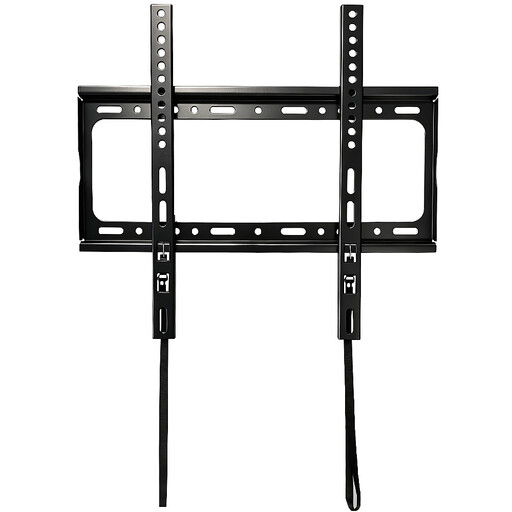
Why this product suits this profile: This fixed mount is aimed at buyers looking for simple, space-saving installation without a swivel function. It supports televisions from 32 to 65 inches and up to 45 kg.
The specified screen-size range, maximum VESA measurement of 400 × 400 mm and load capacity make it easier to check compatibility before buying.
Fixed design, support for concrete, brick and timber studs, plus a space-saving profile.
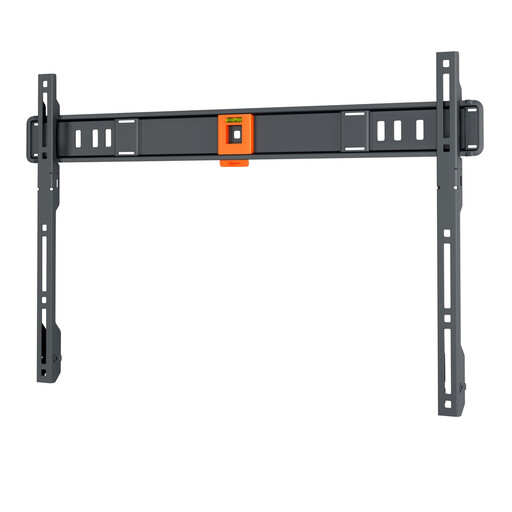
Why this product suits this profile: For large screens from 40 to 100 inches, clearly stated load capacity is particularly important. According to the product details, this model is designed for up to 75 kg and VESA measurements from 100 × 100 to 600 × 400 mm.
The maximum load and broad VESA range are clearly specified. Suitable reinforcement anchors are required for plasterboard or hollow brick.
Fixed construction, VESA support up to 600 × 400 mm and a stated load capacity of up to 75 kg.
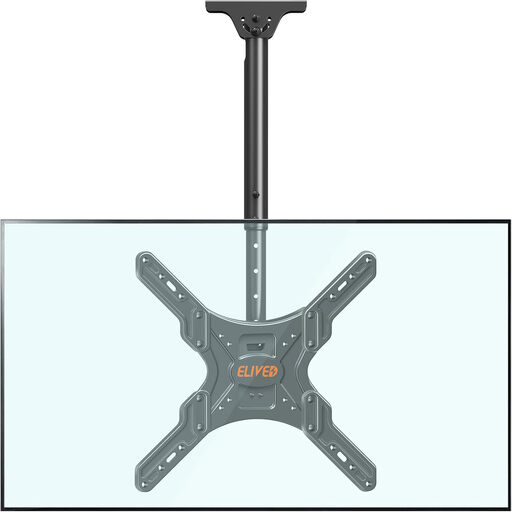
Why this product suits this profile: This ceiling mount for televisions is designed for rooms with limited wall space, as well as offices, retail spaces and hospitality venues. According to the product details, it supports up to 45 kg.
The mount is explicitly designed for load-bearing ceiling elements, not plasterboard-only ceilings. This means the installation location is taken into account in advance.
Six height positions, 360° swivel range, tilt from +5° to −10° and integrated cable management.
We have put together a complete, regularly updated list of products that fully meet these strict selection criteria and the safety regulations applicable in the EU.
Before buying and installing your mount, we recommend following these steps:
If you are unsure about the wall’s load-bearing capacity, installation should be carried out by a qualified person. Particularly with large televisions, the weight and leverage can be significantly greater than with smaller screens.
Check the screen size, weight and VESA measurement. The inch specification alone is not enough. The mount must also be suitable for the wall type in question.
Directly fixing a TV mount solely into plasterboard is not suitable for many models. Depending on the construction, load-bearing studs, reinforcement or suitable cavity anchors may be required. The installation instructions for the specific product are the deciding factor.
A fixed TV mount holds the screen in one position and usually allows for a small gap between the television and the wall. A swivelling TV mount can be adjusted from side to side and may also extend outwards. It requires more space and places greater demands on the fixings and load capacity.