
Lieferung heute & morgen

Qualitätsgarantie

Willkommens-Angebote freischalten: KOSTENLOSE Lieferung | Bis zu 80 % RABATT | Kostenlose 30-Tage-JoyPlus-Testphase
App herunterladen
A two-head LED outdoor floodlight can provide targeted lighting for your driveway, patio, garden, garage or courtyard. In practice, however, poor purchases are often caused not by the light output, but by unclear technical specifications and unsuitable installation.
Before buying, check for these three common pitfalls:
Homeowners, tenants with a suitable outdoor installation and garden owners should therefore check the technical specifications rather than relying solely on product images.
Light output is measured in lumens (lm). When choosing a light, the key consideration is the area you want to illuminate:
Colour temperature is measured in kelvin (K). A 4000K LED floodlight produces neutral white light and is often suitable for practical garden, courtyard or patio lighting. 5000K gives a daylight-white effect and may be a good choice for garages, sheds and areas where you need greater visibility. How the light looks also depends on the beam angle, mounting height and colour of the wall.
Also check whether the two heads can be adjusted separately. Adjustable LED spotlights make it easier to light a front door and path, or a garage and driveway, at the same time.
For an LED outdoor light, the housing, seals and glass cover all matter. The stated IP rating indicates protection against solid objects and water. Requirements vary depending on where the light will be installed:
When comparing products, check that the IP rating is clearly stated and that the light is designed for wall, ceiling or post mounting. A black outdoor floodlight suits many façades, but may get hotter in direct sunlight than a light-coloured one.
A hard-wired outdoor LED wall light will generally need to be connected to a properly prepared electrical installation. Before buying, check:
For Germany, compatibility with the existing 230 V mains supply is particularly important. According to its description, the LUTEC model listed in the product specifications, with a colour temperature of 5000 K, is designed for AC 120 V, 60 Hz. It should not be used with a German home electrical installation without first checking its technical compatibility.
For an outdoor security light with a motion sensor, there are additional factors to consider: detection range, timer delay, dusk sensor and options for reducing false activations caused by pets or passing vehicles. Not all sensors can be adjusted in the same way.
The models below differ in colour temperature, light output, sensor function and stated electrical specifications. Before buying, check the full product page and make sure the light is suitable for your specific installation.
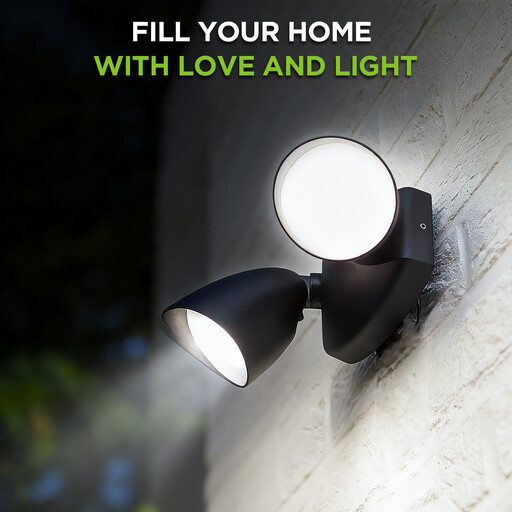
Why it suits this type of user: The stated output of 1800 lumens, 20 watts and 4000 K gives you a clear starting point if you’re looking for a practical twin-head LED light for a courtyard, patio or garden.
The separate heads allow you to direct the light where you need it. Before buying, though, check that a specific IP rating and the correct mains voltage are listed.
1800 lumens, 20 watts, neutral white 4000 K light and a dual-head design, according to the product name.
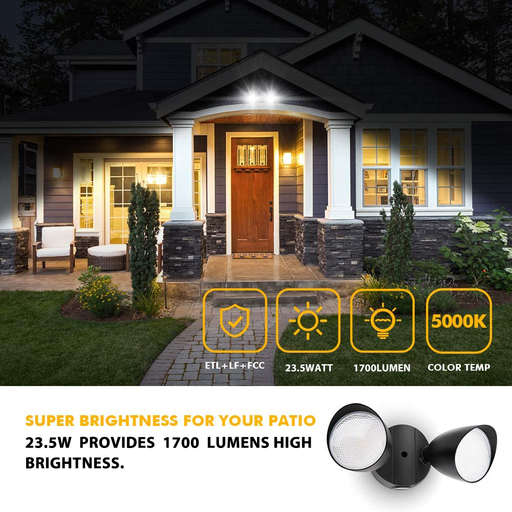
Why it suits this type of user: This model is for anyone who prefers a black metal housing, toughened glass covers and adjustable twin heads for a garage, shed or driveway.
The product description specifies heads that adjust through 180°, as well as materials including aluminium and toughened glass. Most importantly, it lists AC 120 V and 60 Hz; check compatibility with a German electrical installation before buying.
5000 K, two adjustable light heads, a die-cast aluminium housing and toughened glass lenses, according to the product description.
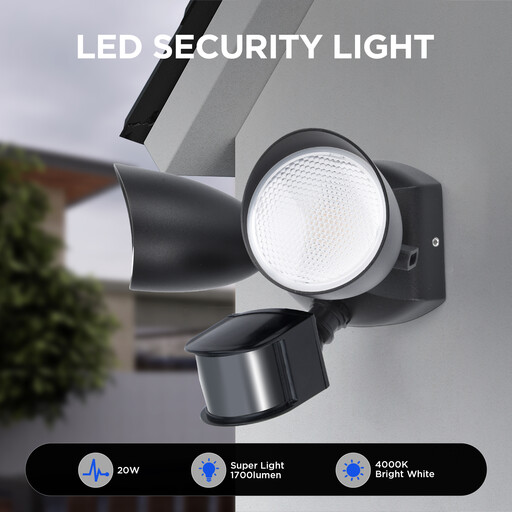
Why it suits this type of user: This model is aimed at anyone considering an LED outdoor light with a motion sensor for an entrance, courtyard, garden or garage.
The sensor can help prevent the light from staying on unnecessarily. Before installation, check the detection range, adjustment options and specific IP rating in the product specifications.
1700 lumens, 20 watts, 4000 K and integrated twin heads with a sensor, according to the product name.
We’ve put together a complete, regularly updated list of products that fully meet these strict selection criteria and the safety regulations in force in the EU.
Running costs depend on the wattage, how long the light is used and your electricity tariff. A 20-watt light used for five hours a day consumes:
20 watts × 5 hours = 100 watt-hours per day, or 0.1 kilowatt-hours. To estimate annual consumption, multiply this figure by the actual number of days the light is used and your current electricity rate.
A motion sensor can reduce the time the light is on if it isn’t needed continuously. Heat dissipation, seals, switching cycles and the quality of the installation also affect its lifespan. Without specific information from the manufacturer, it isn’t possible to give a reliable general estimate of how long a light will last.
4000 K is generally perceived as neutral white and is suitable for paths, patios and general courtyard lighting. 5000 K gives a daylight-white effect and may work well in garages, sheds or areas where you need brighter, more practical lighting. The best choice depends on your personal preference and where the light will be used.
It can be a good choice if you only want the light to come on when it detects movement. Check the detection range, timer delay and possibility of false activations in advance. If your garage is covered, make sure the sensor is positioned appropriately.
No. For hard-wired lights, you need to take the mains voltage, cable routing, earth conductor and installation location into account. Before carrying out electrical work, isolate the circuit at the consumer unit. If you’re unsure, or are installing a new outdoor cable, the work should be carried out by a qualified electrician.