Baking two trays at the same time
If you want to use both trays in one go, look for a heating function specified for multiple levels, suitable trays and ways to check how evenly they are browning.


If you want to bake two trays of peanut butter biscuits at the same time, a built-in oven with explicitly specified multi-level fan cooking is a sensible place to start – provided the housing, connection and two suitable trays are all right. A fan-assisted mini oven may suit smaller batches or baking in succession, but having several shelf positions does not in itself guarantee enough tray space or even browning. Even when multi-level cooking is specified, keep an eye on the biscuits and swap trays only if needed.
If you want to use both trays in one go, look for a heating function specified for multiple levels, suitable trays and ways to check how evenly they are browning.
If you don’t have a suitable built-in space or only need to bake smaller quantities, consider the space it takes up, usable tray dimensions and how easy it is to swap trays.
If you bake often, compare what’s included, how easy the oven is to clean and any clear information on energy consumption, rather than basing your decision on the number of programmes alone.
A good fit if: You can fit two full trays inside at the same time and have a suitable housing and connection. Check the instructions for the exact model to see which heating function and shelf positions are recommended for flat bakes.
Trade-off: Multi-level cooking specifications don’t replace checking the accessories or keeping an eye on browning. Bosch lists a universal pan and a wire rack for the HBA571BB4, while AEG lists a baking tray for the BP3100B.
A good fit if: You don’t have a built-in space or can bake the trays one after the other. Compare the actual tray dimensions and check the instructions before using two levels at the same time.
Trade-off: A high number of shelf positions doesn’t, by itself, tell you how much tray space there is, what’s included or whether two trays will bake evenly.
| Buying priority | What to look for | Who it matters most to |
|---|---|---|
| Baking at the same time | Check for multi-level fan cooking and suitable shelf positions in the instructions for the exact model. | If I want to bake both trays in one go, the recommended heating function matters more than the number of shelf runners. Around 33% of consumers would make simultaneous baking their top priority. |
| Space and batch size | Compare the external dimensions, installation guidance and usable tray space. | If a built-in model won’t fit or smaller batches are enough, the usable space is what matters to me. Around 25% of consumers would prioritise space and batch size. |
| Swapping trays | Check what’s included, whether a second suitable tray is available and how easy the shelves are to handle. | If I want to swap trays or bake one after the other, I need suitable trays and a straightforward routine. Around 25% of consumers would prioritise accessories and swapping trays. |
| Energy use and cleaning | For household ovens with an energy label, check the kWh figure per standard fan-forced cycle; assess cleaning features based on your own needs. | If I bake often, I want to factor energy use and cleaning into my buying decision. Around 17% of consumers would make these points their top priority. |
Several shelf positions don’t mean that two suitable biscuit trays are included. Bosch lists a universal pan and a wire rack for the HBA571BB4, while AEG lists a baking tray for the BP3100B.
Check the accessories supplied with the exact model against your needs, and see whether a second suitable tray is available.
The heating function, shelf position and recipe can all affect the result. AEG recommends baking on multiple levels only when the instructions for the specific model allow it.
Use the settings recommended for flat bakes and keep an eye on your first batch. If one tray is ready sooner, take it out earlier rather than assuming you’ll need to swap trays at fixed intervals.
For biscuits, usable tray space matters. The European Commission lists small ovens as outside the scope of its overview of energy labelling for household ovens; the absence of a corresponding label doesn’t prove that an oven uses little energy.
Compare the actual tray dimensions. For household ovens with an energy label, the kWh figure per standardised fan-forced cycle is useful for comparison, but it doesn’t predict the energy used for your particular batch of biscuits.
Built-in ovens with model-dependent 3D hot air; the HBA571BB4 is a specific example of an oven designed for baking on multiple levels.
Built-in ovens with model-dependent multi-level baking; the BP3100B is relevant if you’re considering baking with multiple trays at once.
Built-in ovens with CircoTherm multi-level fan cooking; suitability depends on the specific model.
Fan-assisted mini ovens; the BGE 1580/E has clearly specified cooking space, shelf positions and tray dimensions.
Mini ovens with fan cooking; the TO 2058 is one example with a specified cooking capacity.
This selection includes countertop appliances with a baking function and built-in ovens with specified multi-level fan cooking. For each model, check the tray dimensions, included accessories and instructions against the way you plan to bake.
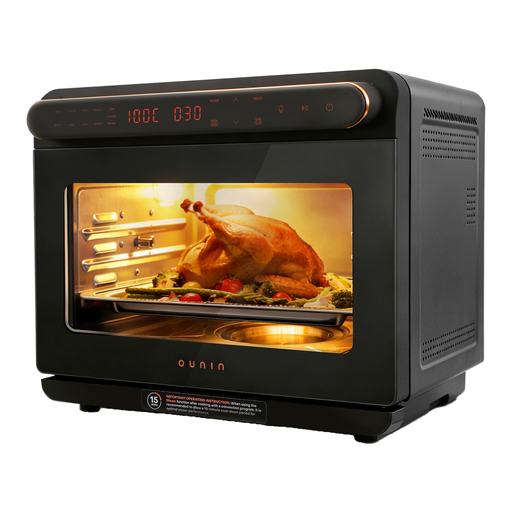 No image available
A baking function is specified for countertop use; check that the pan is the right size for your batches of biscuits.
Joybuy lists a 24 l capacity, a 1-l water tank and a 304 stainless steel interior. The listed accessories include seven items, including a baking pan; two baking trays are not specified.
 No image available
This countertop appliance may suit smaller batches; check in advance whether suitable trays will fit and how the levels are arranged.
Joybuy lists a 23 l capacity and two compartments. The product details say it comes with three trays and three racks; this doesn’t mean they can all be used at the same time for baking biscuits.
 No image available
A baking function is specified for fan cooking; before buying, check that a suitably sized tray will fit inside.
Joybuy lists a 6,5 l capacity, 360° hot air circulation and a viewing window. The description lists a stainless steel basket, an inner pot and a rack.
 No image available
If you want to use two levels at the same time, Bosch specifies 3D hot air for up to three levels on this model; follow the instructions for flat bakes.
Joybuy lists a 71 l capacity. According to Bosch, the accessories include a universal pan and a wire rack, not two trays specifically described as biscuit trays. This built-in appliance requires a suitable housing.
 No image available
For baking on multiple levels at the same time, Joybuy specifies 3D hot air for up to three levels; check the recommended shelf positions in the instructions.
The product details list a 71 l capacity and a width of 60 cm. The accessories include a baking pan and an Air Fry tray, not two trays specifically described as biscuit trays. This built-in appliance requires a suitable housing.
Not necessarily. Start with the settings and shelf positions recommended in the instructions for flat biscuits and small bakes. If the biscuits brown unevenly, AEG recommends taking the tray that’s ready sooner out early or adjusting the temperature; this doesn’t establish a general swapping schedule for peanut butter biscuits.
No. The number of shelf positions alone isn’t enough to confirm that it will work. Check the instructions for the exact model to see whether using multiple levels is allowed, measure suitable trays and make sure there’s enough space for air to circulate.
It depends on the model. Bosch lists a wire rack and a universal pan for the HBA571BB4, AEG lists an enamelled baking tray for the BP3100B, and Rommelsbacher lists a roasting and baking tray for the BGE 1580/E. Check whether two suitable trays are included or whether you’ll need to buy a second accessory.
For household ovens covered by the label, it shows details including the cooking compartment volume and energy use per standardised cycle with conventional heat and fan cooking. The European Commission lists small ovens as outside the scope of its overview of energy labelling for household ovens. The label figure also doesn’t measure the energy used for your particular batch of biscuits on two trays.