With so many technical specifications to consider, choosing the right charging cable for your electric car can be a challenge. An unsuitable cable can not only increase charging times but, in the worst-case scenario, also pose safety risks. This article serves as an objective guide to help you select a safe and compatible Type 2 11kW charging cable. We focus on the facts that are relevant for making an informed purchasing decision.
What to Look for When Buying a Type 2 Charging Cable
To find the right cable for your needs, three criteria are crucial: charging power, cable length, and certified safety.
1. The Right Charging Power: 11 kW or 22 kW?
The maximum charging power is determined by the weakest link in the chain: the charging station, the charging cable, and your vehicle's on-board charger (OBC).
- 11 kW Charging Cable: A 3-phase 11kW charging cable operates with a current of 16 amps (A) per phase. This is the common standard for most battery electric vehicles (BEVs) and plug-in hybrids (PHEVs) on the market and is sufficient for most private wallboxes. Such a cable is also referred to as a Type 2 16A charging cable.
- 22 kW Charging Cable: These cables are designed for 32 A per phase. They will only charge a vehicle at 22 kW if both the charging station and the vehicle's OBC support this power level. If you use a 22 kW cable on a vehicle with an 11 kW OBC, the charging power will automatically be limited to 11 kW.
Pro Tip: Check your vehicle's manual for its maximum AC charging power. For the majority of EVs, an 11 kW cable is the appropriate and most cost-effective choice.
2. The Ideal Cable Length for Maximum Flexibility
The length of the cable has a direct impact on your daily charging convenience.
- 5 Metres: Ideal for a home garage or carport where you always park in the same spot close to the wallbox. The cable is lightweight and easy to handle.
- 7 Metres: A 7m charging cable offers an excellent balance of manageability and flexibility. It is generally sufficient for most public charging stations, where parking directly next to the station isn't always possible.
- 10 Metres: Provides maximum reach for tricky parking situations or when the charging station is awkwardly positioned. The higher weight and increased storage space required should be taken into account.
3. Safety First: Certifications and Material Quality
A charging cable is a high-current product where safety must come first. A Mode 3 charging cable is designed for the connection between an AC charging station (public or private) and the vehicle.
Look for the following features:
- Independent Certification: A T?V-certified charging cable has been tested by an independent body for compliance with relevant safety standards (e.g., IEC 62196). CE and UKCA markings are also important indicators.
- Material and Build Quality: A high-quality cable sheath made of TPU (Thermoplastic Polyurethane) is more resistant to abrasion, chemicals, and extreme temperatures than less expensive PVC cables.
- Ingress Protection (IP) Rating: An IP rating of IP54 or higher ensures that the cable is protected against dust and splashing water, meaning it can be used safely even in the rain.
- Connector Quality: Silver-plated contacts and a robust connector design that can, for example, withstand being run over by a vehicle are features of durable products.
Top Charging Cable Picks
Based on the quality and safety criteria mentioned, we have curated a selection of charging cables.
Recommendations for 11kW Charging Cables
These cables are designed for the vast majority of electric vehicles equipped with an 11 kW on-board charger.
GONEO Type 2 11kW Charging Cable (7 Metres)

- Why it stands out: This cable combines a practical length with high safety standards. The T?V Rheinland certification confirms its compliance with European norms. The construction with ultrasonically welded, silver-plated contacts ensures low heat generation and stable charging performance. Its robust TPU sheath and IP54 rating make it a reliable companion in all weather conditions.
- Advantages:
- Charging Power: 11 kW (3-phase, 16A)
- Length: 7 Metres
- Certification: T?V Rheinland, CE, UKCA
- Material: TPU cable sheath, PA66 connector housing
- Protection Rating: IP54 (dust and splash-proof)
- Who is it for? EV drivers looking for a versatile solution for charging at home and at public stations. The 7-metre length offers a great balance between reach and ease of use.
GONEO Type 2 11kW Charging Cable (10 Metres)
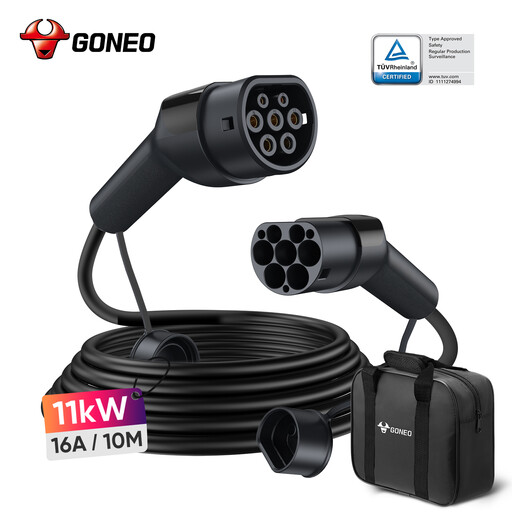
- Why it stands out: Technically identical to the 7-metre version, this model offers maximum flexibility with its extended length. It meets the same high safety and quality standards, including T?V certification and robust materials designed for long-term outdoor use.
- Advantages:
- Charging Power: 11 kW (3-phase, 16A)
- Length: 10 Metres
- Certification: T?V Rheinland, CE, UKCA
- Material: TPU cable sheath
- Special Feature: Maximum reach for difficult parking situations
- Who is it for? Users who frequently charge at hard-to-reach stations or need to cover a long distance between their wallbox and vehicle.
GONEO Type 2 11kW Charging Cable (5 Metres)
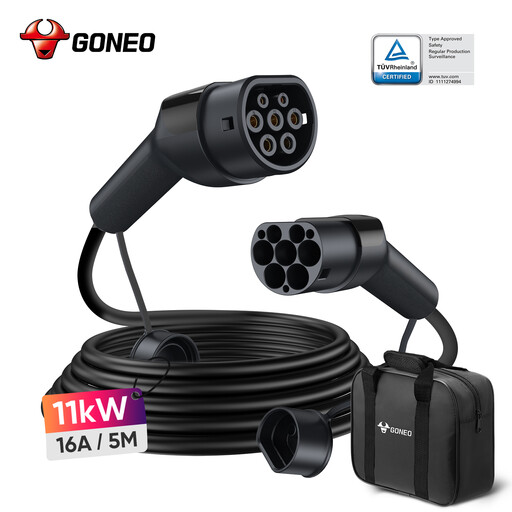
- Why it stands out: This compact version is the ideal choice for home use. It offers the same certified safety features and durable construction as the longer models but is easier to store and handle. As a wallbox charging cable for a dedicated parking space, it is an excellent choice.
- Advantages:
- Charging Power: 11 kW (3-phase, 16A)
- Length: 5 Metres
- Certification: T?V Rheinland, CE, UKCA
- Material: TPU cable sheath
- Special Feature: Compact and easy to handle
- Who is it for? Owners of a private wallbox with a dedicated parking spot right next to it. Ideal for anyone who prefers a tidy and straightforward charging setup.
Option for Higher Charging Power
GONEO Type 2 22kW Charging Cable (10 Metres)

- Why it stands out: This cable is designed for the future or for vehicles with higher charging capabilities. It supports up to 22 kW (32A) while offering the same certified safety and quality features as the 11 kW models, including T?V testing, a TPU sheath, and robust connectors.
- Advantages:
- Charging Power: 22 kW (3-phase, 32A)
- Length: 10 Metres
- Certification: T?V Rheinland, CE, UKCA
- Compatibility: Backward compatible with 11 kW systems
- Who is it for? Owners of vehicles with a 22 kW on-board charger who want to take advantage of the maximum AC charging speed. It is also a future-proof investment for users planning to purchase such a vehicle.
Looking for a Different Cable Length?
The featured lengths of 5, 7, and 10 metres cover most use cases. However, if you need a specific, shorter solution for your garage, you can find a selection of 2m charging cables here.
Frequently Asked Questions (FAQ)
What is the difference between an 11kW and a 22kW charging cable?
The main difference lies in the maximum power they can transfer. An 11 kW cable is designed for 16 amps per phase, while a 22 kW cable can handle 32 amps. However, the actual charging speed depends on your car's on-board charger (OBC). A car with an 11 kW OBC will only charge at 11 kW, even with a 22 kW cable.
Is a Type 2 charging cable compatible with my Tesla?
Yes. All Tesla models delivered in Europe (Model 3, Model Y, Model S, Model X) use the Type 2 connector for AC (alternating current) charging. Therefore, a Type 2 EV charging cable like the models presented here is fully compatible with these vehicles.
How can I identify a safe EV charging cable?
Look for independent test seals like the T?V certificate. Other important features include a CE marking, a high protection rating (at least IP54), a durable cable sheath (preferably TPU), and solidly constructed connectors. Avoid products without clear markings or verifiable certifications.


