
Lieferung heute & morgen

Qualitätsgarantie

Willkommens-Angebote freischalten: KOSTENLOSE Lieferung | Bis zu 80 % RABATT | Kostenlose 30-Tage-JoyPlus-Testphase
App herunterladen
A Type 2 charging cable 11 kW 10 m gives you plenty of reach between the charging point and your vehicle, whether you are charging at public stations or on a private drive. However, the extra length can also have disadvantages: the cable is heavier, takes up more space and needs to be stored carefully after every charging session.
Owners of Tesla, Audi, BMW, Mercedes, Volkswagen, Hyundai and Kia should therefore look beyond terms such as “universal”, “fast” or “waterproof”. The key factors are the connector type, the on-board charger’s charging capacity, build quality and the stated protection rating.
An 11 kW charging cable does not automatically ensure that your vehicle will charge at 11 kW. The following factors are also important:
A 16A 3-phase charging cable is generally suitable for 11 kW, provided that both the vehicle and charging point support this configuration. A plug-in hybrid with a lower charging capacity can still use the cable, but it will not charge any faster as a result.
An EV Type 2 charging cable with a Type 2 plug and Type 2 socket is designed for vehicles and charging stations using the European Type 2 system. For vehicles with a CCS2 connection, the Type 2 section is used for AC charging; the vehicle-side CCS2 connection is backwards-compatible with the Type 2 section.
However, not every electric car uses Type 2. Vehicles with J1772, CCS1 or CHAdeMO require different solutions. Older model variants may also have different connectors or charging capacities. It is therefore worth checking the owner’s manual or the vehicle’s technical specifications before buying.
The IP54 rating indicates protection against limited dust ingress and splashing water. It does not mean that the plugs and cable can be left submerged in water. Even a product advertised as a “waterproof EV charging cable” should therefore be stored in a dry place and never left in puddles.
For an 11 kW electric car charging cable, three phases and up to 16 A per phase are typical specifications. The theoretical calculation is:
230 V × 16 A × 3 phases ≈ 11 kW
In practice, the actual charging capacity may be lower. This depends, among other things, on the vehicle, charging station and mains supply. A 22 kW cable may be capable of handling a higher load, but it cannot turn an 11 kW on-board charger into a 22 kW charger.
A 10 m charging cable for electric cars is useful when:
For a permanent parking space, a shorter cable may be easier to handle. With a 10 m cable, you should plan for a carry bag, dry storage and suitable cable management. The cable should not be left in tight loops or placed under the vehicle’s tyres while charging.
A TPU cable sheath can be designed to withstand frequent bending and changing temperatures. Specifications such as a temperature range of -40 °C to +50 °C should always be understood as manufacturer’s claims and checked against the product documentation.
The precise wording of safety information is important. According to the product specifications, the GONEO cable mentioned below carries references to TÜV Rheinland, CE, UKCA, RoHS, ISO and IEC. Even a TÜV-certified charging cable should be checked against a verifiable certificate or test number and the manufacturer’s information. A test mark does not replace checking the plugs, cable sheath and contacts before every use.

Why this product suits this profile: This cable combines a 10 m length with 11 kW, 16 A and three-phase charging. It is designed for Type 2 and CCS2 vehicles, making it suitable for many popular electric cars and plug-in hybrids with a compatible AC connection.
The product specifications state the precise combination of 11 kW, 16 A and 3 phases. They also list IP54, a TPU sheath and a temperature range of -40 °C to +50 °C. IP54 should be understood as protection against splashing water, not as permission for submersion.
According to the product description, TÜV Rheinland as well as CE, UKCA, RoHS, ISO and IEC; a carry bag is also included.
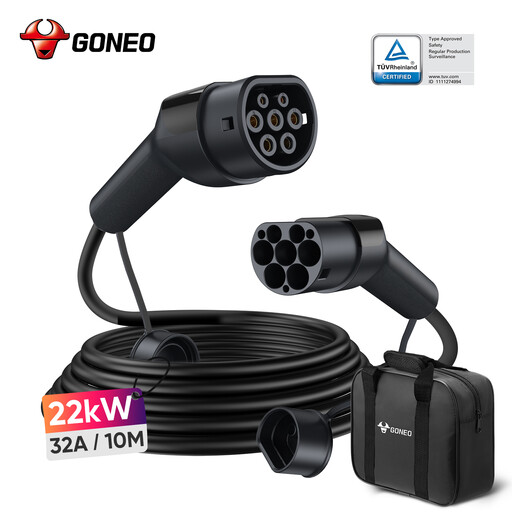
Why this product suits this profile: The 10 m cable is aimed at drivers of vehicles with a 22 kW on-board charger, as well as users who want to allow for higher AC charging capacity when choosing a future vehicle.
The cable’s higher rating does not automatically prevent confusion between cable capacity and vehicle output: the on-board charger must be checked before buying. This cable is not essential for a vehicle with an 11 kW charger.
According to the product specifications, 32 A, 22 kW, three-phase design, IP54 and a carry bag; the technical specifications must match the charging infrastructure.
Why this product suits this profile: The length is ideal for changing parking conditions at public charging stations. A carry bag makes it easier to transport in the boot when the cable is not permanently connected to a wallbox.
The 10 m length is not treated as an indication of output alone. Before use, the cable should be fully unwound, the plugs checked for dirt and the connection protected from moisture.
TPU cable sheath, silver-plated contacts and, according to the product description, a design tested for more than 20,000 bends.
We have put together a complete, regularly updated list of products that fully meet these strict selection criteria and the safety regulations applicable in the EU.
Yes, provided that the wallbox or charging station has a suitable Type 2 socket and the cable can be positioned without sharp bends or crushing. For a permanent parking space, however, 10 m may take up more room than necessary.
Its lifespan depends on bending, dirt, moisture, tensile strain and storage conditions. Product claims such as “over 20,000 bends” are manufacturer-specific statements, not a guarantee for every usage situation. Damaged cable sheaths, loose plugs or discoloured contacts are all reasons to stop using the cable.
The cable length can increase electrical resistance slightly. With a suitable cable designed to the relevant standards, however, the difference during normal operation is not the key cost factor. More important are the vehicle’s charging losses, the efficiency of the charging station and the power actually transferred.