
Lieferung heute & morgen

Qualitätsgarantie

Willkommens-Angebote freischalten: KOSTENLOSE Lieferung | Bis zu 80 % RABATT | Kostenlose 30-Tage-JoyPlus-Testphase
App herunterladen
Choosing the right charging cable is a crucial step for any electric vehicle owner. With various power levels, lengths, and safety standards, the decision can seem complex. This guide is designed to provide clarity and help you find a Type 2 charging cable that is perfectly matched to your vehicle, wallbox, and daily needs. We will focus on the objective criteria that are essential for reliable and safe charging.
Before you make a decision, three main technical features should be considered. These determine not only the charging speed but also the practicality in daily use.
The charging power, measured in kilowatts (kW), is a central factor. The most common variants for AC charging (alternating current) at a wallbox or public charging station are 11kW charging cables and 22kW charging cables.
Check your vehicle's technical specifications to determine the maximum supported AC charging power.
The length of the cable directly impacts the convenience of the charging process. Measure the distance from your wallbox or the typical parking spot at a public station to your car's charging port.
An EV charging cable is a high-performance product where safety must be the top priority. Look for independent certification marks and high-quality materials.
Based on the criteria above, we have compiled a few models that stand out for their technical specifications and safety features.
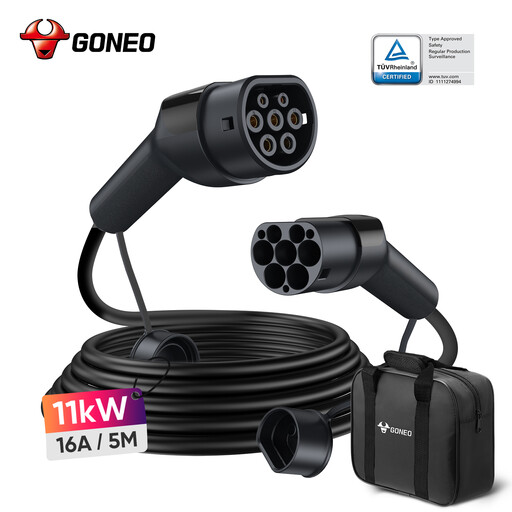
Why It Stands Out: This cable combines a charging power of 11 kW, suitable for many EVs and plug-in hybrids, with a compact length. The certification by T?V Rheinland underscores its focus on safety. According to the manufacturer, ultrasonically welded and silver-plated contacts ensure optimised conductivity and reduced heat generation.
Advantages:
Who It's For: Ideal for drivers of electric cars with an 11 kW on-board charger who primarily charge at their home wallbox or at easily accessible charging stations. The 5-metre length is designed for standard parking situations.

Why It Stands Out: This model offers the maximum AC charging power of 22 kW and an exceptional reach of 10 metres. It is designed for demanding charging scenarios and, thanks to its backward compatibility, provides a future-proof solution for vehicles with lower charging capacities. Its robust construction is confirmed by the T?V certification.
Advantages:
Who It's For: Perfect for drivers who frequently charge at public stations with unpredictable parking situations. The long length bridges greater distances and makes charging straightforward, even if the charging spot is partially blocked.
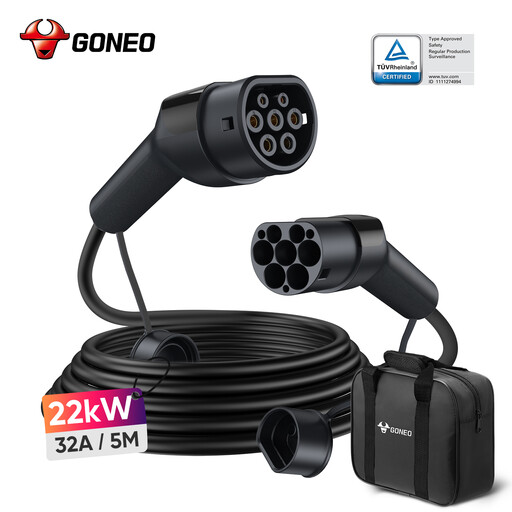
Why It Stands Out: This version is the solution for anyone who needs future-proof 22 kW power in a compact and manageable form. It combines high performance with the practicality of a 5-metre cable for daily use at home. Here too, T?V certification and high-quality materials are key features.
Advantages:
Who It's For: A great choice for owners of vehicles with a 22 kW OBC who primarily charge at home and prefer an easy-to-handle cable. It is also a smart purchase for drivers of 11 kW vehicles who want to be prepared for the future.
If the models presented here do not exactly meet your requirements or if you are looking for suitable accessories, you can find more products in our range.
? Discover our selection of Cable Organizer Bags and other accessories.
1. Can I use a 22kW charging cable for a car that only supports 11kW? Yes, that is perfectly fine. The EV charging cable and the charging station communicate with the vehicle. The car's on-board charger regulates the power draw and will only pull its maximum possible power, in this case, 11 kW. The 22 kW cable simply acts as a high-capacity conductor without overloading the vehicle.
2. Why is T?V certification important for a charging cable? A product marked as T?V certified has been tested by an independent inspection organisation for compliance with strict safety and quality standards. This includes electrical safety (e.g., protection against overheating), mechanical durability (e.g., resistance to kinking and breaking), and material resilience. It is an important indicator of a long-lasting and safe product.