
Lieferung heute & morgen

Qualitätsgarantie

Willkommens-Angebote freischalten: KOSTENLOSE Lieferung | Bis zu 80 % RABATT | Kostenlose 30-Tage-JoyPlus-Testphase
App herunterladen
Purchasing an electric car is a major step, but choosing the right accessories is what determines your day-to-day convenience and safety. A crucial element here is the charging cable. An incompatible Type 2 charging cable can not only slow down the charging process but also pose a safety risk or be simply impractical. Before you make a decision, you should be aware of the most common pitfalls that lead to unnecessary expense and frustration.
The selection of charging cables is vast, but not every model is suitable for every need. Many buyers focus on price or marketing promises instead of paying attention to the crucial technical specifications.
To avoid a costly mistake, you should focus on three core aspects. These determine whether a charging cable is the right fit for your vehicle and your usage patterns.
The maximum charging speed is determined not by the cable, but by your vehicle's On-Board Charger (OBC).
When dealing with high currents, safety is non-negotiable. Look for the following features:
The right length and type of charging cable depend on your charging location.
Based on these criteria, we have put together a selection of charging solutions tailored to specific needs.
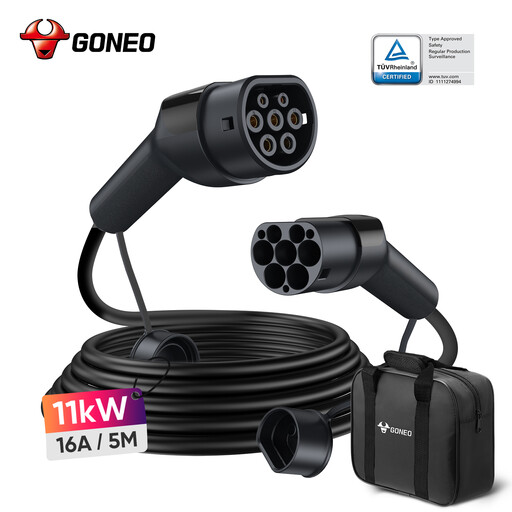
Why This Fits Their Persona: Ideal for drivers who need a reliable and safe standard solution for daily charging at a home wallbox or a dedicated workplace charging point. The 5-metre length is optimised for predictable parking scenarios.
With 11 kW, its power is perfectly matched to the most common EVs, avoiding unnecessary extra costs. The T?V certification prioritises safety.
T?V Rheinland certified and compliant with CE and IEC standards. A robust TPU cable sheath ensures durability.

Why This Fits Their Persona: Perfect for drivers of high-performance EVs with a 22 kW OBC or for those who want to make a future-proof investment. The 10-metre length offers maximum flexibility at public charging stations and in tricky parking situations.
The generous 10-metre length prevents the frustration of a cable that's too short. The 22 kW capacity is a deliberate choice for maximum charging speed with compatible vehicles.
Maximum reach with a 10-metre cable length. T?V-certified and designed for an operating temperature range of -40°C to +50°C.
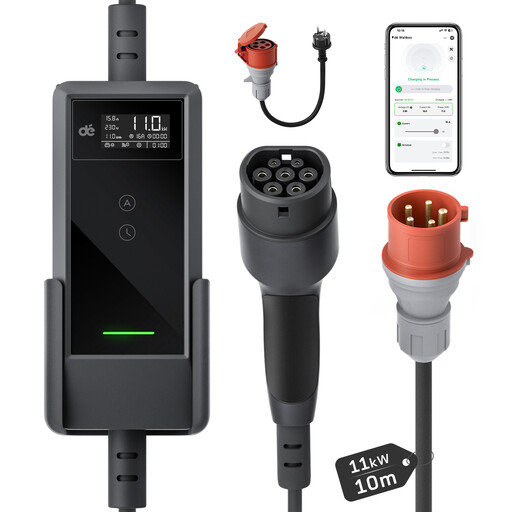
Why This Fits Their Persona: A smart and portable alternative to a fixed wallbox. Ideal for homeowners who value flexibility and want to control and schedule charging sessions via an app, for instance, to take advantage of off-peak electricity rates.
This device is more than just a cable. It offers smart features that create real value, rather than just advertising high power. The adjustable charging current protects the home's electrical system.
App control for scheduling charging times and adjusting the charging power (6–16A). Connects to a CEE 16A industrial socket for 11 kW charging performance.
We've compiled a complete, up-to-date list of products that fully meet these strict selection criteria and safety standards.
1. Which charging capacity (11 kW or 22 kW) is right for my EV? The right charging capacity depends on your vehicle's On-Board Charger (OBC). Most current EVs and plug-in hybrids are designed for an 11 kW charging capacity. A 22 kW cable will not provide any speed advantage for these vehicles. Check your car's technical specifications in the owner's manual to determine its maximum AC charging power and select the appropriate cable.
2. How important is a T?V certification for a charging cable? A T?V certification is extremely important. It confirms that the product has been tested by an independent body for electrical safety, mechanical durability, and compliance with applicable standards. Especially with the high power levels involved in charging an EV, a tested and certified product is essential for preventing damage to the vehicle's battery and charging infrastructure, as well as mitigating fire hazards.
3. Can I use a Type 2 charging cable with a regular household socket? No, a standard Type 2 charging cable is designed for connection to a wallbox or a public charging station. It cannot be plugged directly into a domestic household socket. For that purpose, there are special mobile chargers (Mode 2 charging cables) that have a domestic plug on one end and a Type 2 connector on the other. However, these limit the charging power to a maximum of 3.7 kW and are intended more as an emergency or temporary solution.