
Lieferung heute & morgen

Qualitätsgarantie

Willkommens-Angebote freischalten: KOSTENLOSE Lieferung | Bis zu 80 % RABATT | Kostenlose 30-Tage-JoyPlus-Testphase
App herunterladen
As an electric car or plug-in hybrid driver, you know how crucial a reliable charging solution is. A Type 2 mobile charging cable becomes an indispensable companion, especially when a permanently installed wallbox isn't available—for instance, in a rental apartment or while traveling. However, the market is confusing, and not every product delivers on its promises. Making the wrong choice can lead not only to frustration but also to potential safety hazards.
This guide highlights the crucial criteria for selecting the right charging cable and helps you avoid common pitfalls, ensuring you can charge your EV from a standard socket—safely and efficiently.
Many buyers focus solely on price or marketing claims, overlooking critical technical details. You should absolutely avoid these three mistakes:
To make an informed decision, you should focus on the following technical features. These define the performance, safety, and practical utility of your mobile charging cable.
The maximum charging power for single-phase charging at a Schuko socket is typically 3.6 kW (kilowatts), which corresponds to an amperage of 16A (amperes) at 230V. A 3.6 kW mobile wallbox like this is ideal for overnight charging or topping up during a workday. However, the ability to adjust the amperage is crucial. This allows you to use the charger even with sockets whose circuit protection you are unsure of, without overloading the system.
A high-quality Schuko to Type 2 charging cable is more than just a cable; it's an intelligent protective device between your vehicle and the power grid. Look for the following non-negotiable safety features:
Beyond the core functions, some features significantly enhance convenience. A Type 2 charging cable with a timer allows you to schedule the charging process to take advantage of cheaper off-peak electricity rates, for example. A clear LED display showing real-time information such as voltage, amperage, and energy delivered provides transparency and control over the charging process.
Based on the criteria above, we have identified a few products suitable for different user groups.

Why This Fits Their Persona: Ideal for daily use in a home garage or at an assigned company parking spot. The 8-meter length offers enough flexibility for most parking situations without having to manage excess cable.
Features an integrated RCD (30mA AC + 6mA DC) and adjustable amperage, bypassing the most common safety and compatibility traps.
A comprehensive safety package (CE/CB/RoHS certified) and a memory function for the last-used amperage ensure simple and secure operation.
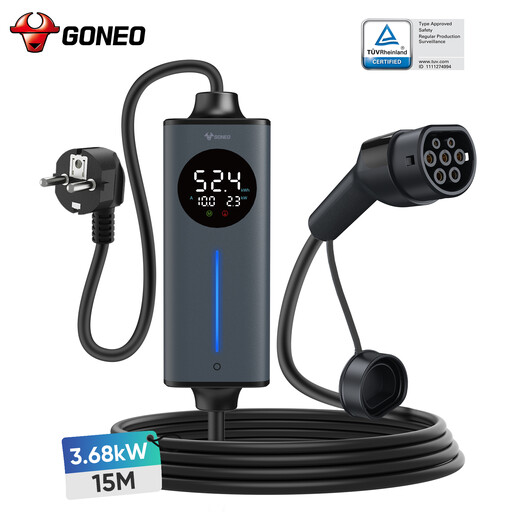
Why This Fits Their Persona: Perfect for users who depend on unpredictable charging situations—whether in the underground garage of a rental apartment, at a vacation home, or at a friend's house. The generous 15-meter length bridges even greater distances to the nearest socket.
The long cable length solves the problem of inaccessible sockets, while the full suite of safety features and adjustable amperage ensure safe operation under all conditions.
Maximum flexibility thanks to its long reach. The integrated timer function (0-8 hours) also enables cost-effective charging during off-peak hours.
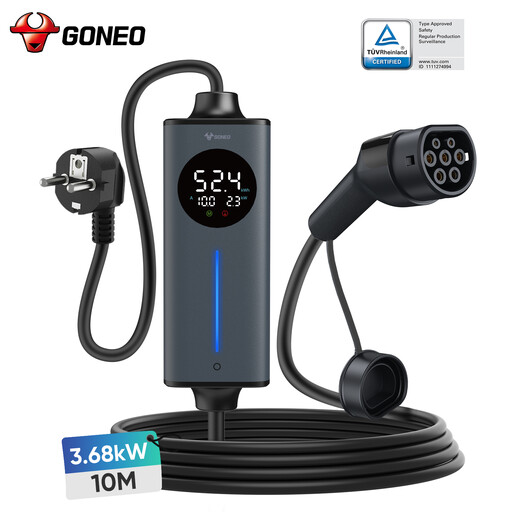
Why This Fits Their Persona: For users who refuse to compromise on safety and want full control. The 10-meter version is an excellent compromise between reach and manageability for a wide variety of use cases.
Directly addresses the most critical pitfall: the device offers a complete safety system, from ground detection and RCD protection to temperature monitoring.
The LED display provides transparent, real-time data on voltage, current, temperature, and charging time. This gives the user full control and peace of mind at all times.
A mobile charging cable is an essential travel companion for EV drivers. To reliably power your other electronic devices on the go, choosing the right accessories is just as crucial.
We've compiled a complete, real-time list of products that meet strict selection criteria and German safety regulations.
In principle, yes, as long as it is a professionally installed and certified Schuko socket. However, caution is advised with older home installations, as they are not always designed for a continuous load of 16A. It is recommended to start the charging process at a lower amperage (e.g., 10A) and check if the socket becomes warm. A charger with adjustable amperage is ideal for this.
The charging time depends on your vehicle's battery capacity. A 3.6 kW charger adds about 3.6 kilowatt-hours (kWh) of energy per hour. To charge a 60 kWh battery from 0 to 100%, it would theoretically take about 16.7 hours. In practice, this charging speed is optimal for fully charging the vehicle overnight or significantly increasing its range during a multi-hour stop.
Yes, such protection is an indispensable safety feature. Conventional RCDs (Type A) in home installations detect AC fault currents but not pure DC fault currents. Such DC fault currents can occur when charging electric vehicles and can render the home's RCD "blind," preventing it from tripping in the event of a fault. An RCD integrated into the cable that also detects DC fault currents (e.g., RCD Type A-EV or Type A + 6mA DC) ensures protection against dangerous electric shocks.