
Lieferung heute & morgen

Qualitätsgarantie

Willkommens-Angebote freischalten: KOSTENLOSE Lieferung | Bis zu 80 % RABATT | Kostenlose 30-Tage-JoyPlus-Testphase
App herunterladen
Purchasing an electric car is a significant step, but choosing the right accessories is just as crucial for a seamless charging experience. A high-quality Type 2 charging cable is essential for charging at public stations or a home wallbox. However, the market is flooded with products whose quality and safety claims often don't live up to their promises. Misleading specifications on charging power or the use of subpar materials can lead not only to frustration but also to significant safety hazards. This guide will help you identify the key features and avoid common purchasing pitfalls.
Before you make a decision, you should be aware of the typical pitfalls that often lead to unnecessary expenses or safety concerns.
To find the perfect Type 2 EV charging cable, focus on three core technical aspects that are decisive for safety, compatibility, and convenience.
The charging power determines how quickly your vehicle's battery is charged. Most public AC charging stations and wallboxes in Europe offer 11 kW or 22 kW.
Therefore, always check your vehicle's maximum AC charging power in the manual before you decide. The cable used is a so-called Mode 3 charging cable, the European standard for the connection between the charging station and the vehicle.
The right cable length depends entirely on your parking habits.
A longer cable offers more convenience but is also heavier and more cumbersome. A supplied charging cable with a bag is a handy accessory for neat and tidy storage in the boot.
Safety is non-negotiable. Look for the following features:
Here are some recommendations tailored to specific user profiles and their requirements.

Why This Fits Their Persona: Perfect for drivers of the most common EVs with 11kW charging capabilities. The 7-metre length offers excellent everyday usability for charging at home and at public stations without being unnecessarily cumbersome.
Avoids the cost trap of an over-spec'd 22kW cable. The T?V certification and robust TPU sheathing directly address the safety and durability risks of cheaper alternatives.
T?V Rheinland certified safety; flexible and durable TPU cable sheathing; includes a carrying case.
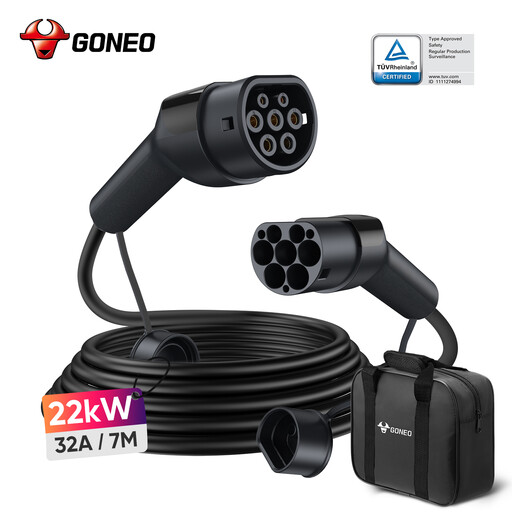
Why This Fits Their Persona: Designed for owners of EVs with a 22kW on-board charger who don't want to compromise on charging speed. This cable enables the fastest possible AC charging.
Ensures the vehicle's full potential is utilised, preventing a charging bottleneck caused by an underpowered cable. High-quality components like silver-plated contacts minimise power loss.
Maximum 22 kW charging power; silver-plated contacts for lower heat generation; T?V certified and IP54 rated.

Why This Fits Their Persona: The solution for anyone who regularly faces inconveniently placed charging stations. The 10-metre length bridges even greater distances and offers maximum freedom when parking.
Solves the often-overlooked problem of a cable being too short, which can make charging impossible. The robust TPU quality is especially important at this length, as the cable is subjected to more stress.
Maximum reach with 10 metres; high durability and weather resistance; 22kW power for future-proofing.
We've compiled a complete, up-to-date list of products that fully meet these strict selection criteria and European safety standards.
The Type 2 connector is the European standard for AC charging and is compatible with almost all modern electric cars and plug-in hybrids sold in Europe. This includes models from Volkswagen, BMW, Mercedes, Audi, Hyundai, Kia, as well as the European models of Tesla (Model 3, Model Y, S, X). Exceptions include some older models or vehicles imported from other regions (e.g., with a J1772 connector from North America). For DC fast charging, other connectors like CCS2 or CHAdeMO are used.
Yes, this is technically possible and completely safe. The charging system is designed so that the vehicle (via its on-board charger) requests the maximum power it can handle, and the station and cable supply it. If your car can only accept 11 kW, it will only draw 11 kW, even with a 22kW cable. You won't gain any speed, but the cable is future-proof in case your next vehicle supports 22 kW. However, an 11kW cable is often lighter and more cost-effective.
Proper handling will significantly extend the life of your charging cable. Always keep the connector contacts clean and dry, and always use the supplied protective caps after charging. Avoid kinking the cable sharply or driving over it, even if high-quality cables can withstand it. Store the cable loosely coiled, ideally in its dedicated charging cable with a bag, to protect it from dirt and mechanical stress.