
Lieferung heute & morgen

Qualitätsgarantie

Willkommens-Angebote freischalten: KOSTENLOSE Lieferung | Bis zu 80 % RABATT | Kostenlose 30-Tage-JoyPlus-Testphase
App herunterladen
An 11 kW Type 2 EV charger is suitable for many electric cars and plug-in hybrids with a three-phase connection. In practice, however, the stated charging capacity is not the only factor that determines whether a charger is suitable. The vehicle’s onboard charger, household connection, socket, cable length and safety features all need to work together.
Many products advertise Wi-Fi app control, IP66 protection or ‘fast charging’. Important limitations are often mentioned only in the small print. The following points will help you avoid common purchasing mistakes.
An 11 kW charger usually requires a three-phase connection with 16 A per phase. If the electric car only supports single-phase charging, or if the onboard charger is limited to a lower output, the charging capacity will be reduced accordingly.
A 22 kW charger will not automatically charge faster than an 11 kW model, either. The vehicle, electrical installation and configured current set the practical limit.
A CEE plug for 16 A three-phase operation is better suited to continuous loads than a standard household socket. Before use, the socket, cable, fuse protection and earthing must be professionally checked. A permanently installed wallbox should be fitted by a qualified electrical contractor. Depending on the network operator, additional notification or coordination requirements may apply.
An adapter without the appropriate technical approval can cause heat build-up and malfunctions. The 16 A electric car charger should therefore always be used with the intended connection and suitable fuse protection.
Wi-Fi, Bluetooth, charging schedules and remote control are useful additional features. On their own, however, they say nothing about electrical safety. Buyers should look for protective functions such as overcurrent, overvoltage, overheating, earthing and residual-current protection.
Ratings such as IP65 or IP66 describe protection against dust and water under the relevant testing conditions. They do not mean that a charger may be left permanently in puddles or operated completely unprotected without suitable installation.
An 11 kW 3-phase charger typically operates at 3 × 16 A with a three-phase supply. The following points are crucial when choosing a product:
Models offering 8, 10, 13 and 16 A provide greater flexibility, for example when the power supply is temporarily limited. The setting should always be compatible with the electrical installation.
The IEC 62196-2 connection is the standard AC charging format used by many electric cars in Europe. Even so, you should check the vehicle model and charging connection before buying. A permanently attached Type 2 charging cable is convenient, while a Type 2 socket offers greater flexibility when choosing a cable.
For garages and carports, 5 m is often sufficient. If the parking space is further away, 7 or 10 m may be more practical, although they increase the weight and storage requirements.
Some models specify integrated protection with AC 30 mA and DC 6 mA. According to the relevant product descriptions, this function is integrated into several feyree devices. An electrician must determine which additional protective equipment the household installation requires, based on the specific system.
A dynamic load balancer measures the power available in the household and can adjust the charging current when the cooker, heat pump or other appliances are running at the same time. It is important to check whether the function is actually included in the selected model and which components are required for measuring the load.
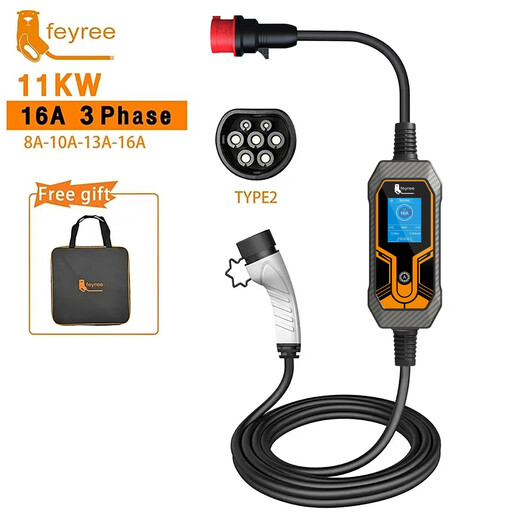
Why this product suits this profile: This portable EV charger is suitable for users who have a CEE connection and want to take the device between the garage, parking space and holiday destination. According to the product description, it features an LCD display and adjustable charging current.
The stated 11 kW output is linked to a suitable CEE 16 A connection and 16 A rated current. Even so, you must check the vehicle and installation before buying.
CEE plug, LCD display, protective functions according to the supplier’s specifications and adjustable charging current.
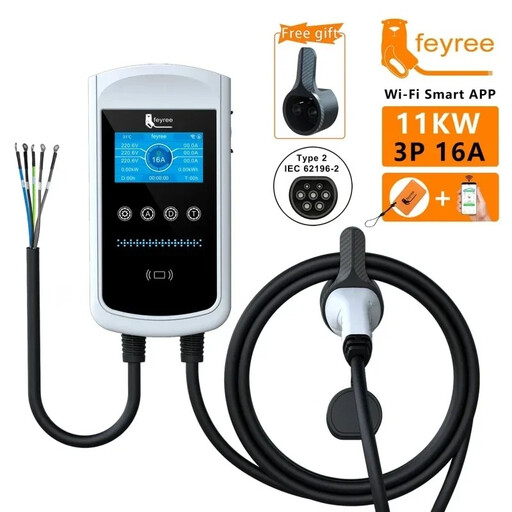
Why this product suits this profile: This device is designed for users who want to manage charging information directly on the display and via an app. The product description mentions charging records, scheduling and current adjustment from 8 to 16 A.
The stated output is supplemented by specific current settings and three-phase operation. Protective and certification details should be checked against the documents supplied with the product before installation.
4.3-inch display, Wi-Fi app, charging and fault records, plus scheduled charging according to the product description.
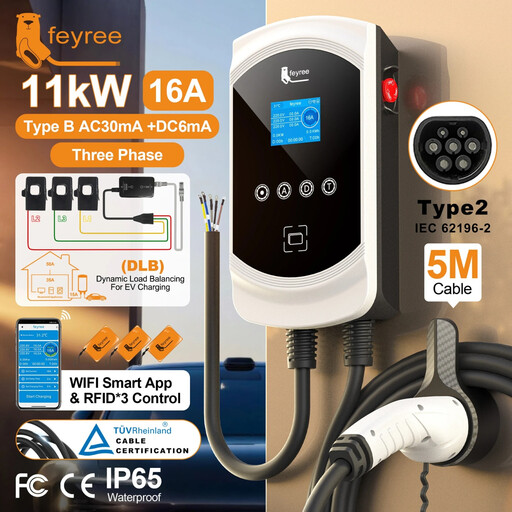
Why this product suits this profile: This EVSE charger is designed for households where several high-consumption appliances operate at the same time. According to the product description, the DLB function monitors household consumption and adjusts the charging current.
The listing explicitly mentions dynamic load balancing instead of making only general claims about ‘smart charging’. The required measurement and installation setup should be clarified in advance.
DLB function, Tuya app, current adjustment, scheduling and IP65 rating according to the product description.
We have put together a complete, regularly updated list of products that fully meet these strict selection criteria and the safety regulations applicable in the EU.
The charging time depends on the usable battery capacity, state of charge and the output of the onboard charger. A 55 kWh battery can theoretically be charged in around five hours; charging losses and the charging curve may make the actual time longer.
A three-phase 11 kW charger is normally designed for a suitable CEE connection or a professionally installed wallbox. A standard household socket is not designed for this purpose. For occasional lower-power charging, a separate single-phase charger designed for that application may be more suitable.
The running costs are based on electricity consumption, including charging losses, and the applicable price per kilowatt-hour. A Wi-Fi app with scheduling can help move charging sessions to cheaper tariff periods. It does not automatically reduce the electricity price, however.