
Lieferung heute & morgen

Qualitätsgarantie
App herunterladen
Kategorien
Choosing the right charger for an electric vehicle (EV) or plug-in hybrid (PHEV) is a technical decision that depends on your home setup, vehicle model, and personal usage habits. The Type 2 connector (IEC 62196-2) has been established as the European standard, ensuring broad compatibility. This article analyses the key parameters to consider when selecting a Type 2 EV charger and presents a selection of models with different technical specifications.
The decision for a charger should be based on an objective analysis of charging power, installation type, safety features, and additional functions.
The charging power, measured in kilowatts (kW), determines the charging speed. It is the product of voltage (Volts), current (Amps), and the number of phases used.
A crucial safety feature is the integrated Residual Current Device (RCD). For charging electric vehicles, protection against DC fault currents is essential. Chargers should therefore have a Type B RCD (sensitive to all current types) or a combination of a Type A RCD and DC fault current detection (≥ 6 mA). This protects against potentially hazardous fault currents that can arise during the conversion of AC to DC in the vehicle.
Modern charging stations often offer smart features that optimise the charging process.
Based on the technical criteria mentioned, we present three different charging solutions.
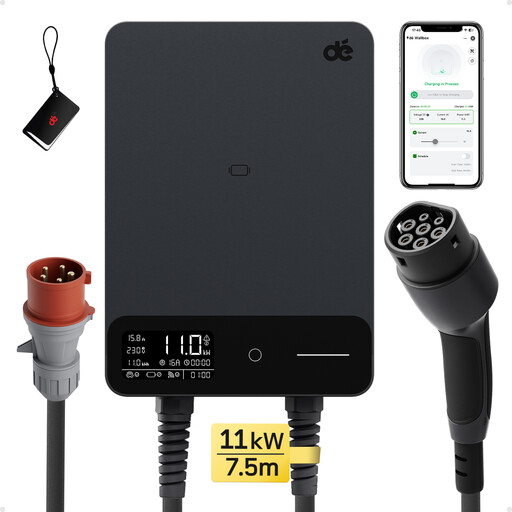
Product Specification Analysis This model is designed as a fixed 11 kW wallbox for home use. It combines the 11 kW charging power (3-phase, 16A), which simplifies the notification process in Germany, with modern control options. The integration of a Type B RCD (AC 30mA + DC 6mA) ensures a high level of safety without the need for an expensive external RCD of this type. Control via the Tuya Smart app allows for efficient charge scheduling and monitoring.
Advantages:
Best suited for: Homeowners looking for a fully-featured, safe, and smart wallbox for daily use who value a straightforward installation.
View Product: dé Wallbox Type 2 11kW
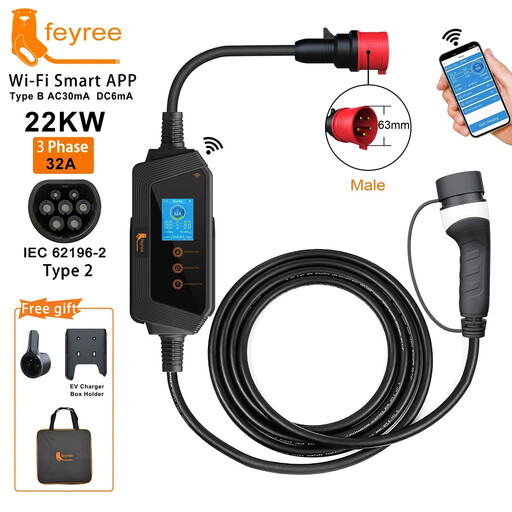
Product Specification Analysis This portable EV charger offers a maximum charging power of 22 kW (3-phase, 32A), combining high speed with flexibility. It can be operated portably from a CEE high-power socket or mounted as a stationary wallbox using the included bracket. The IP66 protection rating and integrated fault current protection (Type B AC 30mA + DC 6mA) enable safe operation even outdoors. Control via a Wi-Fi app allows for scheduling charging sessions and adjusting the charging current.
Advantages:
Best suited for: Users with access to a 32A high-power connection who want maximum charging power and appreciate the flexibility between stationary and portable use.
View Product: feyree 22KW Portable EV Charger
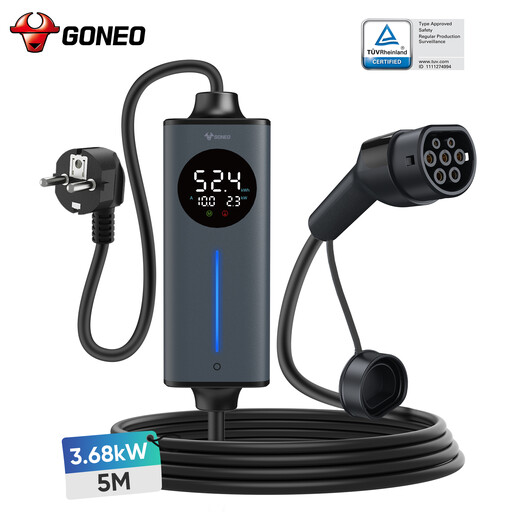
Product Specification Analysis This Type 2 to Schuko charging cable is designed for direct connection to a standard household socket (230V). With a maximum power of 3.68 kW (adjustable up to 16A), it provides a straightforward plug-and-play solution. Despite its simplicity, the device features comprehensive safety functions, including an RCD with 30mA AC + 6mA DC protection, overheat protection, and automatic ground detection. An integrated timer allows for delayed charging to take advantage of off-peak electricity rates.
Advantages:
Best suited for: Renters without a high-power connection, drivers of PHEVs, or as a secondary charger for maximum flexibility and independence from public charging infrastructure.
View Product: GONEO Portable Type 2 EV Charger
If the models presented here do not exactly meet your requirements or if you are looking for other accessories for your vehicle, you can find a wider selection of products in our Hybrid Cars category.
1. What is the difference between a Type 1 and a Type 2 charger? The Type 2 connector is the European standard for AC charging and is used by almost all electric cars and plug-in hybrids sold in Europe. It supports both single-phase and three-phase charging. The Type 1 connector is predominantly found in North American and Asian markets and only supports single-phase charging.
2. Do I need a permit for an 11 kW wallbox? No, in Germany, a wallbox with a charging capacity of up to 11 kW only needs to be registered with the responsible grid operator. Formal approval is not required. However, charging stations with more than 11 kW (e.g., 22 kW) do require approval. In all cases, the installation should be carried out by a qualified electrician.