
Lieferung heute & morgen

Qualitätsgarantie

Willkommens-Angebote freischalten: KOSTENLOSE Lieferung | Bis zu 80 % RABATT | Kostenlose 30-Tage-JoyPlus-Testphase
App herunterladen
A mobile Type 2 EV charger with Schuko plug gives electric car and plug-in hybrid owners a flexible way to charge their vehicle at home, at a holiday destination or while travelling. This solution is particularly useful when no permanently installed wallbox is available, or when you do not want to rely exclusively on public charging points.
However, not every portable electric car charger is suitable for regular use with a domestic socket. Some products advertise high output without adequately explaining the requirements of the socket. Others mention important safety features only in the product description, without clearly stating the adjustable current or cable length.
An EV charger 16A can theoretically deliver up to 3.68 kW at 230 volts. However, this does not automatically mean that every vehicle will charge continuously at this output. Other important factors include:
For older sockets, multi-way adaptors or unfamiliar circuits, a lower setting may be more suitable. A Schuko connection should not be treated as equivalent to a permanently installed wallbox.
A Type 2 charging cable initially describes the vehicle side, or the connection in accordance with IEC 62196-2. When charging via Schuko, additional protection and monitoring functions are also important. Buyers should check whether the device specifies residual-current protection, overheating protection, earth monitoring and overcurrent protection.
A description such as “Plug & Play” does not replace an inspection of the electrical installation. The socket should be professionally installed, correctly earthed and suitable for the intended continuous load.
When charging an electric car at home, the distance between the socket and vehicle may be greater than expected. Sufficient cable length is also important when using the charger while travelling or at a parking space. At the same time, the cable should not be unnecessarily coiled up or subjected to mechanical strain.
An adjustable charging output and a timer charging function are also useful. These allow the charging process to be moved to a cheaper electricity tariff period, for example. This does not guarantee automatic savings, as these depend on your individual electricity tariff and charging time.
A Schuko charger for electric cars should display the current clearly and ideally offer several settings. A model with a maximum of 16 A can provide up to 3.68 kW electric car charger output. For continuous use with a domestic socket, a reduced setting may be more suitable, depending on the installation.
A lower charging output is often sufficient for a plug-in hybrid, particularly because its battery is usually smaller than that of a fully electric vehicle.
An integrated 30 mA RCD protection system monitors AC residual currents. In addition, 6 mA DC residual-current protection is relevant because DC residual currents can affect the operation of an upstream residual-current device. The exact design and protection architecture should be clearly described in the relevant product’s user manual.
Additional safety features such as overcurrent, overvoltage, undervoltage, short-circuit and overheating protection can monitor the device during operation. However, they do not replace a safe socket or correct use.
Charging over several hours generates heat. A device with temperature monitoring can reduce the current if the temperature rises or interrupt the charging process. According to the product specifications, the GONEO model automatically reduces the charging current at 65 °C; charging is intended to stop at 70 °C.
The charger should be positioned in a clear, unobstructed area during operation and should not be covered with blankets or other objects. Plugs, cables and the housing should be protected from moisture, pressure points and visible damage.

Why this product suits this profile: This mobile Type 2 EV charger with Schuko plug is designed for charging at home and while travelling. According to the product specifications, it supports BEVs and PHEVs with a Type 2 connection.
The current can be adjusted up to 16 A. This allows the charging output to be matched to the existing installation rather than always charging at maximum output.
Up to 3.68 kW, a timer from 0 to 8 hours, LED display, plus 30 mA AC and 6 mA DC RCD protection according to the manufacturer’s specifications.
Why this product suits this profile: The available 8 m version may be suitable for parking spaces where the socket is not directly next to the vehicle.
Earth monitoring and NTC temperature control address two points that are often overlooked when charging via Schuko. The cable length should nevertheless be chosen to suit the parking space.
Flame-retardant housing, display of voltage, current, temperature and timer, plus several stated safety features.
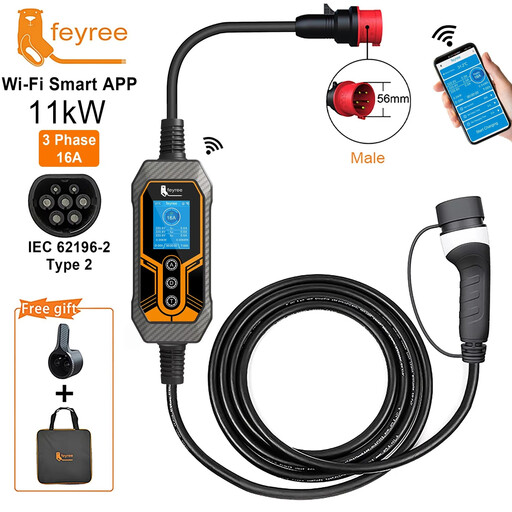
Why this product suits this profile: This model is not a Schuko solution; it is designed for a three-phase CEE connection. It is suitable for users with the necessary infrastructure and higher charging requirements.
The clear CEE design prevents confusion with a Schuko charger. Before buying, the connection, vehicle and electrical protection must all be compatible.
Adjustable current from 8 to 16 A, app and Bluetooth functions, plus up to 11 kW with a three-phase supply according to the product specifications.
We have put together a complete, regularly updated list of products that fully meet these strict selection criteria and the safety regulations applicable in the EU.
Before using the charger for the first time, users should check the following:
Charging time depends on the battery capacity, state of charge and the vehicle’s on-board charger. As a rough guide, a 30 kWh battery may take more than eight hours under idealised conditions. Charging losses and a reduced current will extend the charging time.
A vehicle with a Type 2 connection is generally designed for compatible AC chargers. Whether the specific mobile Type 2 EV charger with Schuko plug is compatible should be checked against the vehicle documentation and the specifications under IEC 62196-2. Different charging outputs may be suitable for BEVs and PHEVs.
A timer function can be helpful if you want the vehicle to charge at specific times, for example with a variable electricity tariff. It does not automatically reduce electricity consumption, but it can make it easier to control when charging takes place.