
Lieferung heute & morgen

Qualitätsgarantie

Willkommens-Angebote freischalten: KOSTENLOSE Lieferung | Bis zu 80 % RABATT | Kostenlose 30-Tage-JoyPlus-Testphase
App herunterladen
A Type 2 EV charging cable 11 kW 10 m gives you plenty of reach between your vehicle and the charging point when charging at public AC charging stations or at home. The additional cable length can be useful if the charging socket is not directly next to the wallbox or the vehicle is parked awkwardly in relation to the charging station. However, it also means extra weight, takes up more storage space and may create additional trip hazards.
Before buying, electric car and plug-in hybrid owners should therefore look beyond the “11 kW” rating. Important factors include the vehicle connection, the output of the on-board charger, the current rating, protection against environmental conditions and evidence of product safety.
An 11 kW electric car charging cable does not automatically ensure that the vehicle will actually charge at 11 kW. The available charging capacity is limited by several factors:
A vehicle with a 7.4 kW or 3.7 kW on-board charger will only charge within its own technical limit, even when connected to an 11 kW charging point. Plug-in hybrids often have a lower AC charging capacity than fully electric vehicles.
An EV Type 2 charging cable for AC charging generally connects a Type 2 charging station to the vehicle’s Type 2 charging socket. On a vehicle with a CCS2 socket, the upper Type 2 section is used for AC charging. However, this does not make the cable a DC fast-charging cable.
Cables with other connector systems, such as J1772, CCS1 or CHAdeMO, are not compatible. There may also be exceptions with older vehicle models. You should therefore check the vehicle manual or manufacturer’s specifications before buying.
A rating such as IP54 describes protection against limited dust ingress and splashing water from various directions. It does not mean that the cable can be immersed in water or stored outdoors without protection for extended periods.
If a product is marketed as a TÜV-certified EV charging cable, it should also be clear which certification body is named and which version of the product the certification applies to. Details such as CE, RoHS, UKCA, ISO or IEC may provide additional indications of conformity or standards, but they do not replace checking the specific product documentation.
An 11 kW electric vehicle charging cable is typically designed for 16 A three-phase charging. Three phases, 16 A and a mains voltage of around 400 V produce approximately 11 kW in theory. The cable must be suitable for this operating mode and approved for its intended use.
Before placing your order, we recommend checking the following:
A longer cable offers greater flexibility, but it should be coiled neatly after every charging session and stored so that it does not create a traffic or trip hazard.
For a charging cable that is used frequently, the mechanical design and materials are important. The GONEO cable’s product specifications include a TPU cable sheath, PA66 components, ultrasonic welding and silver-plated contacts. These details can be assessed as technical product features, but they do not constitute a general promise of performance or durability for every type of use.
Other practical features include:
A charging cable with a bag can be stored separately from other items in the boot. Before putting it away, make sure it is dry and free from coarse dirt.
An IP54 charging cable may be suitable for normal use at public charging points, provided this is specified in the product instructions. Plugs and contacts should not be left in puddles. Damaged cables, cracks in the sheath or discoloured contacts are reasons to stop using the cable.
The cable should not be trapped underneath the vehicle or routed over sharp edges. An additional household extension lead is not intended for connection to a charging station and may create safety risks.
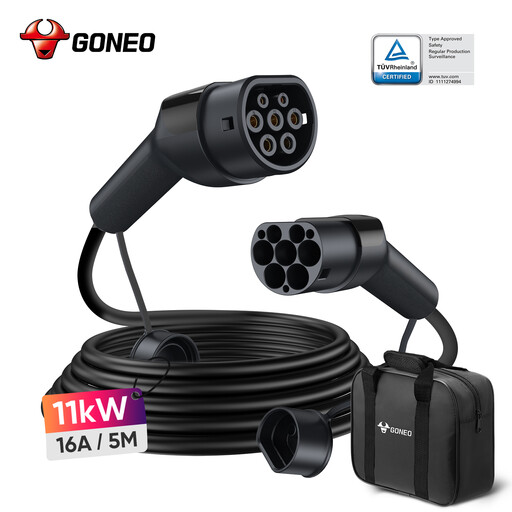
Why this product suits this profile: The 5 m version is suitable for parking spaces directly next to wallboxes or public charging points where there is no need to cover a significant distance.
The product specifications state 11 kW, 16 A, three phases, TÜV Rheinland and IP54. This makes it possible to compare the key selection criteria before buying.
5 m length; TPU sheath, protective cap and carry bag according to the product description.

Why this product suits this profile: The 10 m version is designed for more complex parking situations, for example when the charging point and vehicle socket are on opposite sides.
According to the specifications, this version is designed for 11 kW and 16 A, and references TÜV Rheinland, CE, UKCA, RoHS, ISO and IEC.
10 m length; IP54, TPU sheath, carry bag and silver-plated contacts according to the product description.
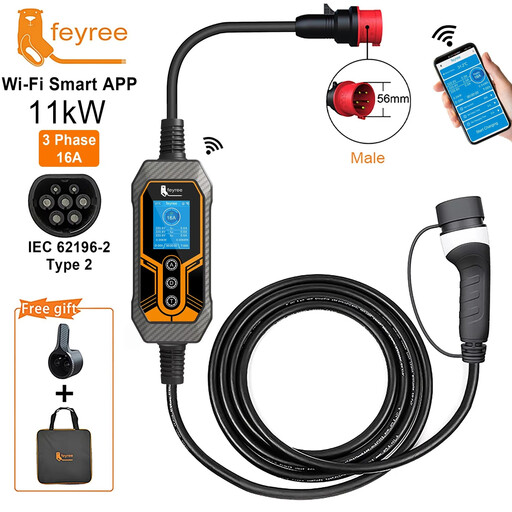
Why this product suits this profile: This portable charger is aimed at users who need a charging option with a CEE plug and adjustable functions in addition to their vehicle cable.
The product description states an adjustable range of 8 to 16 A and includes protective functions. However, this is not a simple Type 2-to-Type 2 cable, but a portable EVSE charger.
CEE connection, LCD display and control via app and Bluetooth, according to the supplier’s specifications.
We have put together a complete, regularly updated list of products that fully meet these strict selection criteria and the safety regulations applicable in the EU.
No. The vehicle must have a compatible Type 2 connection or, in the case of CCS2 vehicles, the corresponding AC connection. The on-board charger also determines the charging capacity that can actually be achieved. An 11 kW cable can also be used with a vehicle that has a lower AC charging capacity, provided the plugs and vehicle are approved for this use.
That depends on the parking space. For a wallbox positioned directly next to the charging socket, 5 m is often sufficient. At public charging stations, with sockets positioned to the side or in changing parking situations, a Type 2 EV charging cable 11 kW 10 m can offer greater flexibility. You should factor in the cable’s additional weight and the extra space it will take up in the boot.
Electricity costs are generally determined by the amount of energy used and the price of the electricity, not by the cable length alone. However, a suitable, undamaged and correctly rated cable is essential for a proper charging process. The vehicle, charging point and state of charge are the main factors affecting the exact charging time and energy consumption.