
Lieferung heute & morgen

Qualitätsgarantie

Willkommens-Angebote freischalten: KOSTENLOSE Lieferung | Bis zu 80 % RABATT | Kostenlose 30-Tage-JoyPlus-Testphase
App herunterladen
If you want to buy a Type 2 EV charging cable, you will quickly come across offers featuring 11 kW, 22 kW, Wi-Fi, app control and TÜV certification. However, these specifications are only useful if they match your vehicle, power source and intended use. A cable that is too short can be impractical at public charging stations, while a higher charging capacity does not automatically mean shorter charging times.
This buying guide from the Joybuy Product Recommendation Officer will help you understand the technical specifications and avoid common purchasing mistakes.
A 22 kW Type 2 charging cable may technically be designed for the corresponding charging capacity. However, the vehicle will only charge at the rate supported by its integrated charger, known as the on-board charger. For example, if an electric car only has an 11 kW charger, a 22 kW cable will not provide any additional speed when AC charging.
The charging station must also be suitable for the desired capacity. A three-phase power source is relevant for a 3-phase EV charging cable; different capacity limits apply to a single-phase supply.
Type 2 is widely used at many AC charging stations in Germany and Europe. CCS2 vehicles also have two DC contacts below the Type 2 section. For AC charging, a Type 2-to-Type 2 cable is generally used. J1772, CCS1 and CHAdeMO are different standards and are not compatible with every Type 2 cable.
You should therefore check the vehicle documentation and the connection on the vehicle before buying. Plug-in hybrids also often support a lower AC charging capacity.
A 5 m charging cable is often easier to handle and is sufficient if the vehicle’s charging port is close to the wallbox or charging point. A 7 m charging cable offers more flexibility in public parking spaces. A 10 m charging cable can be useful when the charging port is in an awkward position, but it takes up more storage space and is generally heavier.
The required length should therefore be chosen based on your typical parking spaces. A cable that is too long is not automatically more practical, while a cable that is too short offers very little flexibility.
The designations 16A EV charging cable and 32A EV charging cable describe the permitted current. Typical specifications include:
The actual charging capacity also depends on the vehicle, charging station, mains installation and selected current. A portable electric car charger with a Schuko plug usually operates at a lower capacity than a version with a CEE connection. When using a household socket, the installation, protective devices and continuous load must be taken into account. A qualified electrician can assess whether the intended connection is suitable.
Flexible cable jackets made from TPU or comparable materials are practical for everyday use. They are easier to coil and can be designed to withstand mechanical stress during regular use. Specifications such as IP54 refer to protection against dust and splashing water under the stated conditions. They do not mean that plugs or cables may be immersed in water.
According to GONEO product information, the cables on offer feature a TPU jacket, IP54 protection and a specified temperature range of -40 °C to +50 °C. Such specifications should always be checked against the actual place of use. Even a robust cable should not be pulled over sharp edges, sharply bent or left permanently underneath vehicle tyres.
Look for clearly stated standards, an EU-based responsible supplier and verifiable product information. According to GONEO product information, the relevant version is TÜV Rheinland certified and associated with CE, UKCA, RoHS, ISO and IEC. These details are based on the supplier’s product description and should be checked in the current product details before purchase.
A portable EV charger should also include safety functions such as overcurrent, overheating, overvoltage and residual-current protection. According to Feyree product information, the corresponding device includes several such safety functions. These protective features do not replace a correctly designed domestic electrical installation.
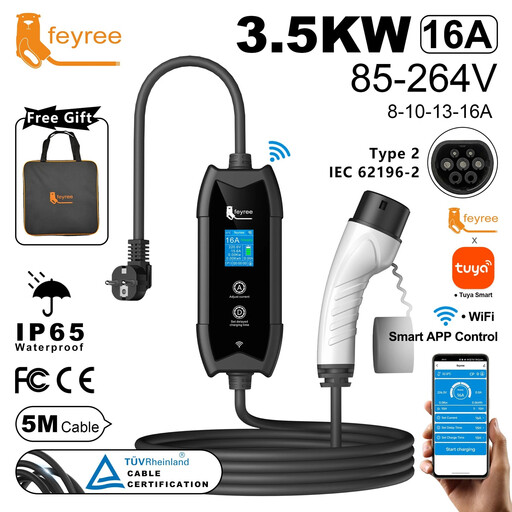
Why this product suits this profile: This portable EV charger is suitable for users who want to charge at a moderate rate at home or on the go. According to Feyree product information, the charging current can be adjusted between 8 A and 16 A; Wi-Fi app control and charge scheduling are also included.
The 3.5 kW specification and Schuko plug make the intended use clearer than a general promise of high charging speeds.
5 m cable, LCD display, adjustable current and delayed charging start according to the product information.
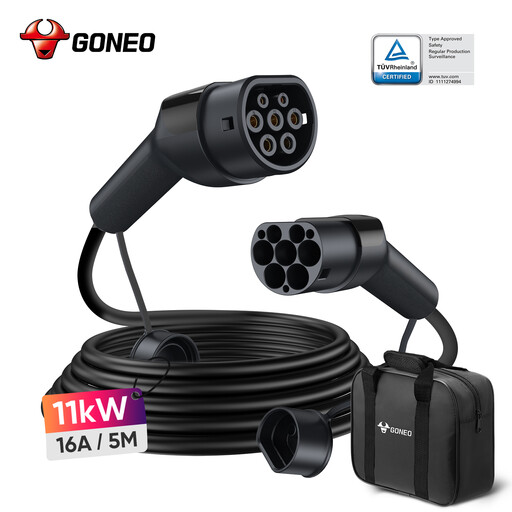
Why this product suits this profile: This 3-phase EV charging cable with 11 kW and 16 A is intended for vehicles with a compatible on-board charger, as well as regular AC charging at wallboxes and public charging stations.
The specific 11 kW and 16 A design reduces the risk of choosing an unnecessary 22 kW version.
According to GONEO product information: TÜV Rheinland certification, IP54, TPU cable jacket and 5 m length.

Why this product suits this profile: The 10 m version is suitable for complex parking situations and frequently changing charging points, provided that the vehicle and infrastructure support 22 kW or 32 A.
This selection focuses not only on capacity, but also specifies the required vehicle capacity and available cable length.
According to GONEO product information: 22 kW, 32 A, three-phase design, IP54, carry bag and TPU jacket.
A cable should be checked for cracks, kinks, damaged contacts and unusual heat before every charging session. Fully unwind a portable electric car charger and any extension leads. An ordinary Schuko extension lead is not a substitute for a suitable EV charging cable; particularly under continuous load, the conductor cross-section, connections and heat generation can become critical.
Only use a Type 2 cable with the connections intended for it. After charging, protective caps and dry, loose storage help protect the contacts from dirt and moisture.
We have put together a complete, regularly updated list of products that fully meet these strict selection criteria and the safety regulations applicable in the EU.
Check the AC charging connection and the maximum charging capacity of the on-board charger. For many vehicles with 11 kW, a 3-phase 16 A cable is suitable. A 22 kW or 32 A cable only makes sense if both the vehicle and charging point support this capacity.
Not necessarily. Charging speed is determined by the weakest link among the vehicle, charging station, mains connection and cable. If the vehicle only supports 11 kW, it will generally not charge any faster with a 22 kW cable.
Service life depends on usage, storage, temperature and mechanical stress. Regular visual checks, loose coiling, dry storage and protection from being driven over or sharply bent can help extend its usable life. The cable should not be used further if it shows visible damage.