
Lieferung heute & morgen

Qualitätsgarantie

Willkommens-Angebote freischalten: KOSTENLOSE Lieferung | Bis zu 80 % RABATT | Kostenlose 30-Tage-JoyPlus-Testphase
App herunterladen
A Type 2 EV charging cable is part of the basic equipment for many owners of a Tesla, Audi, BMW, Mercedes-Benz, Volkswagen, Hyundai, Kia, Volvo or Renault. Yet choosing the right cable often leads to costly mistakes: a cable is bought based on its maximum kilowatt rating, even though the vehicle cannot accept that level of power. Or the length does not suit the parking situation, while the ingress protection rating and safety features receive too little attention.
This buying guide explains which specifications really matter and which charging solution is suitable for use at home, on the road or at a public charging station.
An 11 kW EV charging cable can technically be designed for high three-phase charging rates. However, the vehicle, charging station and on-board charger together determine how quickly charging actually takes place. If the car supports only 11 kW, a 22 kW cable will not provide any additional charging current.
With plug-in hybrids, AC charging power is often considerably lower. You should therefore check the vehicle specifications or owner’s manual before buying.
In Europe, the Type 2 connector in accordance with IEC 62196-2 is widely used for many EVs and plug-in hybrids. A Type 2-to-Type 2 cable is intended for AC charging stations and wallboxes. It is not automatically a CCS2 DC charging cable: with the CCS2 system, the upper Type 2 section is supplemented by additional DC contacts, while the permanently installed cable is often located directly on the rapid charging station.
Cables designed for J1772, CCS1 or CHAdeMO connectors are not suitable. The connector should also be checked before ordering for older or imported vehicles.
A 5 m Type 2 charging cable is often sufficient when the charging station is directly in front of the vehicle. 7 m provides more flexibility at public charging points. A 10 m Type 2 charging cable can be useful for offset charging bays or awkward parking situations, but it is heavier to transport and takes up more storage space.
The extra length should therefore offer a specific practical benefit.
The specification 11 kW / 16 A / three-phase describes a common AC charging configuration for many electric vehicles. A 22 kW cable with 32 A is intended for vehicles with a suitable on-board charger. The electrical installation must also support this level of power.
Important:
For outdoor charging, a stated ingress protection rating is important. IP54 on an EV charging cable indicates protection against dust in quantities that could cause harm and against water splashes. Nevertheless, the cable should not be left in puddles or exposed to heavy rain for extended periods. An IP66-certified wallbox offers greater protection against dust and water during operation, but it does not replace proper professional installation.
TPU cable sheathing is practical for mobile use where flexibility and resistance to mechanical stress are important. Protective caps help keep the contacts clean and dry during storage. Specifications such as a certain number of bending cycles or a temperature range should be understood as manufacturer claims and not treated as a general durability guarantee.
A portable EV charger with a Schuko plug can be useful for travelling, rented properties or as an additional charging option. Its output is typically limited to a maximum of 3.68 kW and 16 A when connected to a suitable 230-volt socket. A portable wallbox with adjustable current can adapt the load to the existing electrical installation.
For regular home charging, a permanently installed wallbox offers greater convenience. Models with app control, scheduling and dynamic load management can distribute the available household electricity between the vehicle and other appliances. A wallbox should be installed by a qualified electrician.
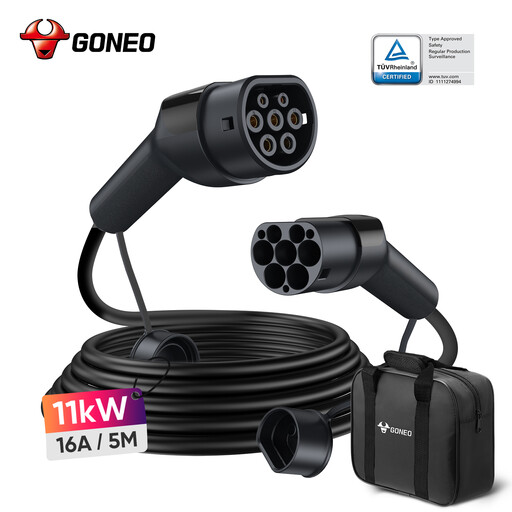
Why this product suits this profile: The 5-metre version is suitable for parking spaces directly in front of a wallbox or public charging station. Its 11 kW rating is suitable for vehicles with a compatible on-board charger.
The stated current and number of phases make it easier to check compatibility with the vehicle. Type 2 compatibility rules out unsuitable J1772, CCS1 and CHAdeMO connectors.
According to the product information: 11 kW, 16 A, three-phase, IP54 and TÜV Rheinland certification.
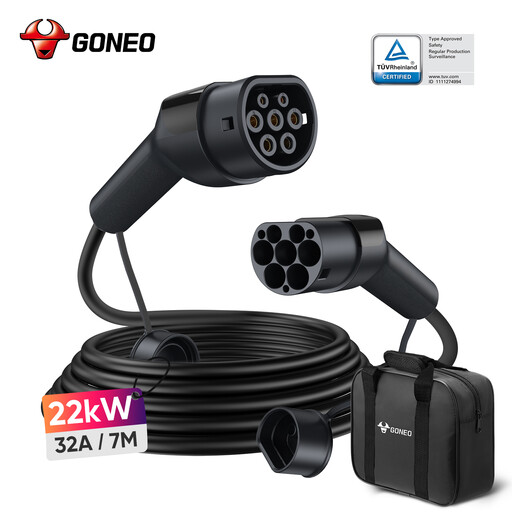
Why this product suits this profile: The 7-metre length offers extra flexibility at many public charging points. Its 22 kW rating is intended for vehicles whose on-board charger supports this level of power.
The product information explicitly states the required vehicle capacity. This helps prevent you from buying a 32 A cable for a vehicle that can accept only 11 kW.
According to the product information: 32 A, 22 kW, three-phase, TPU sheathing, IP54 and silver-plated contacts.
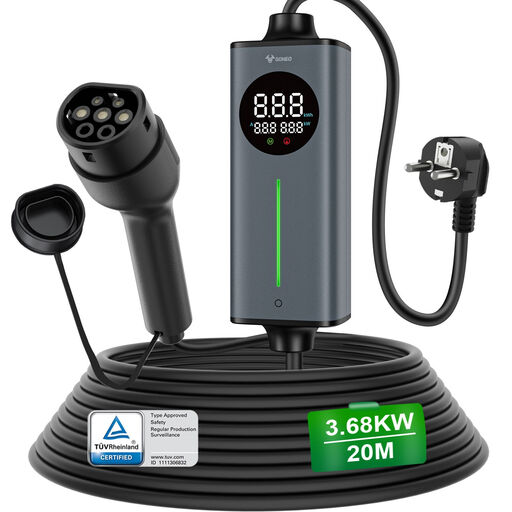
Why this product suits this profile: As a portable Schuko Type 2 charger, the long version is suitable for travelling, changing parking spaces and situations without a permanently installed wallbox.
Power is limited to a standard 230-volt domestic supply and a maximum of 3.68 kW. According to the product information, RCD protection, temperature monitoring and earth detection are integrated.
Adjustable current up to 16 A, timer function, LCD display and AC and DC residual-current protection according to the product description.
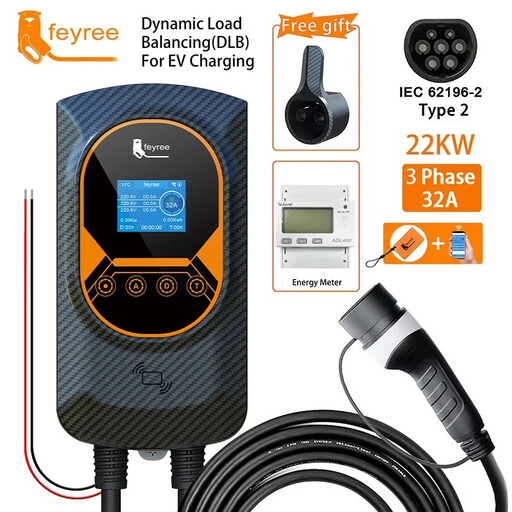
Why this product suits this profile: This wallbox is designed for households that want to schedule charging times via an app and monitor their energy consumption.
According to the product description, dynamic load management takes other household appliances into account. The installation and electrical design must still be carried out professionally.
According to the product information: 22 kW, 32 A, three-phase, IP66, app control, LCD display and adjustable current.
We have put together a complete, regularly updated list of products that fully meet these strict selection criteria and the safety regulations applicable in the EU.
Its service life depends on bending, storage, moisture, tensile stress and frequency of use. The cable should not be pulled over sharp edges, driven over or stored under constant tension for extended periods. After charging, dry storage with the protective cap fitted is recommended.
A 22 kW cable can be used at many Type 2 charging points, provided that the vehicle and charging station are compatible. However, the actual charging power is limited by the on-board charger, power supply and charging station. For a vehicle with an 11 kW charger, an 11 kW charging cable is generally sufficient.
The ongoing cost depends on the amount of energy charged and the electricity tariff. A Schuko charger delivers lower power and may be designed for longer charging times. When using a 16 A charging cable, the socket, wiring and protection must be suitable for the selected current.