
Lieferung heute & morgen

Qualitätsgarantie

Willkommens-Angebote freischalten: KOSTENLOSE Lieferung | Bis zu 80 % RABATT | Kostenlose 30-Tage-JoyPlus-Testphase
App herunterladen
A suitable tyre pressure monitoring system for your motorhome or trailer displays pressure and temperature readings while you’re on the move. This is especially important on long journeys, with heavy loads or multiple axles. Choosing the right system can be tricky, however, as models differ in their measurement ranges, number of sensors and wireless options.
A TPMS with 4 sensors suits many cars, SUVs and compact vehicles. However, a motorhome with twin wheels, a caravan or an articulated lorry will often need more monitoring points. If you only count the wheels on the towing vehicle, you could overlook the trailer’s tyres.
Before you buy, make sure you know:
For larger combinations, consider a TPMS with 6 sensors, a TPMS with 8 sensors or a TPMS with 10 sensors.
A system for cars and SUVs won’t necessarily be suitable for lorry or trailer tyres. A limited range of, for example, 0 to 8 bar or 116 PSI may be enough for many smaller vehicles. For motorhomes, vans or heavy trailers, a wider range such as 0 to 14 bar or 203 PSI is much more relevant.
The key factor is the operating pressure specified by the tyre and vehicle manufacturers. A TPMS doesn’t replace checking your tyres with a calibrated pressure gauge or checking the vehicle’s recommended pressures.
A solar tyre pressure monitoring system can use daylight to help power the monitor. Depending on the model, however, the monitor may also have a rechargeable battery. External sensors need batteries too, such as CR2032 or CR1632 cells. Before buying, check the battery type, expected lifespan and whether the batteries can be replaced.
It’s also worth remembering that a solar-powered display won’t solve signal problems. For long vehicles, the key question is whether a repeater for long vehicles is included or can be added later.
Tyre pressure and temperature monitoring measures two separate readings. Pressure can change with the load, outside temperature and driving conditions. The temperature reading provides extra information about the tyre’s condition, but it isn’t a diagnosis in itself.
Check the following:
According to the product information, the GUTA models featured here have a pressure range of 0 to 14 bar and a measurement tolerance of less than 2 PSI. The Tymate models are designed for 0 to 8 bar, according to the manufacturer.
A useful tyre pressure warning system should do more than display readings: it should clearly flag any changes. Common alerts include:
Some systems automatically calibrate the current pressure as a reference. The product information for the GUTA and Tymate models mentioned here gives alarm thresholds of minus 15 per cent for low pressure and plus 25 per cent for high pressure. Check these thresholds against your vehicle’s recommended pressures before your first journey.
With a caravan or trailer, the distance between the sensors and monitor is greater than in a car. Metal parts, the vehicle body and the overall length can all affect signal transmission. A repeater for long vehicles can help maintain communication between the sensors and monitor.
External sensors screw onto the valves. GUTA recommends fitting its systems to metal valves, according to the product information. Before installation, check that the valve, sensor weight and design are suitable for the wheel. Once fitted, check the sensors for leaks and make sure their positions are shown correctly on the display.
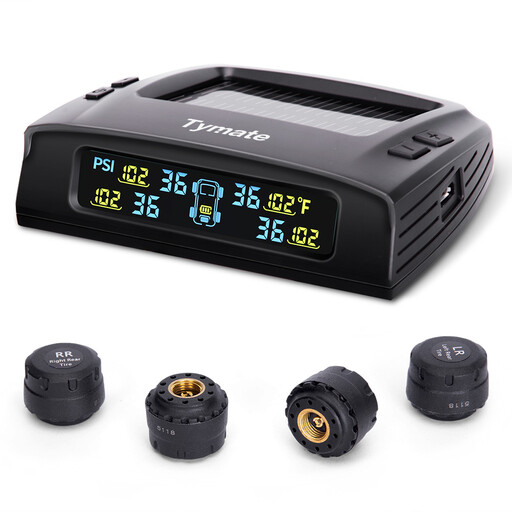
Why it suits this type of buyer: With a range of 0–8 bar and a colour LCD tyre pressure monitor, this model is a good fit for a car, SUV or compact motorhome with four tyres to monitor.
The number of sensors and pressure range are clearly suited to smaller vehicles, making it less likely you’ll buy a system that isn’t suitable for high-pressure tyres.
Four external sensors, 433.92-MHz wireless connection, sleep mode and automatic activation, according to the manufacturer.
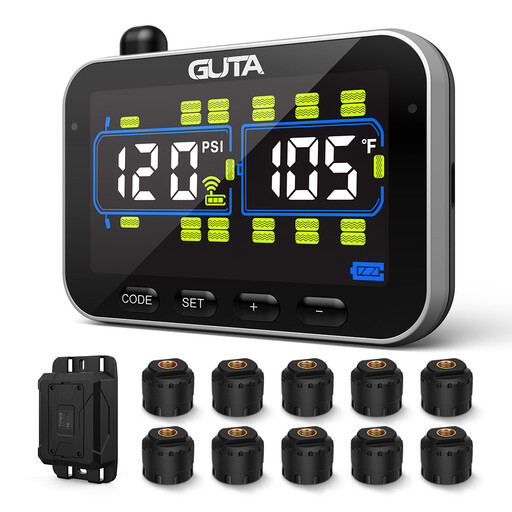
Why it suits this type of buyer: This set is designed for owners of motorhomes, trailers or articulated lorries who want to monitor multiple tyres on a single display.
The ten sensors reduce the risk of having too few monitoring points for a multi-part vehicle combination. A repeater is included in the set.
0–14 bar pressure range, temperature monitoring from -40 to 105 °C, six types of alarm and a 78 × 44.5 mm colour display, according to the product information.
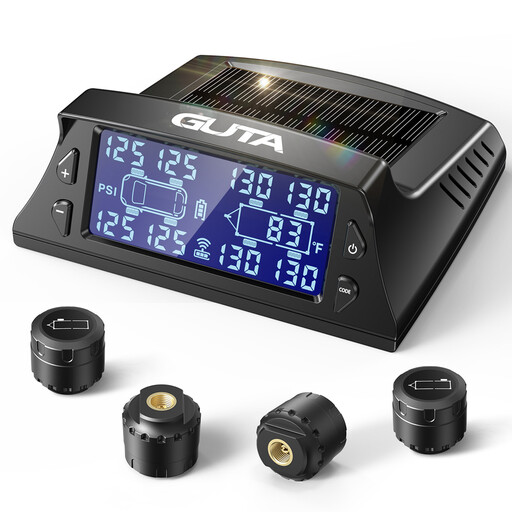
Why it suits this type of buyer: This model combines a 0–13-bar range and four sensors with solar assistance for the monitor.
The product information specifically recommends a repeater for vehicles over 20 feet long. This helps you avoid mistaking solar power for sufficient wireless range.
Solar assistance, automatic calibration, sleep mode and CR2032 sensor batteries with a potential lifespan of around four years, according to the manufacturer.
We’ve put together a complete, regularly updated list of products that meet these strict selection criteria and fully comply with the safety regulations in force in the EU.
External sensors are usually screwed onto the valves. You’ll then need to check the sensor positions and set the reference values. For long vehicles, position the repeater between the sensors and monitor, following the instructions. Before setting off, it’s a good idea to check for leaks and make sure the system is working properly.
Battery life depends on the sensor, battery, temperature and usage. The product information gives an approximate lifespan of four years for GUTA sensors with a CR2032 battery and around two years for Tymate sensors with a CR1632 battery. These are manufacturer estimates, so actual performance may vary.
In addition to the purchase price, the main ongoing cost is replacing the sensor batteries. A TPMS with 10 sensors will need more batteries than a system with four sensors. You should also check the condition of the valves and sensor fittings whenever you change a tyre. A monitor with a rechargeable battery can reduce the need for additional chargers or batteries, but it doesn’t replace maintenance of the external sensors.