
Lieferung heute & morgen

Qualitätsgarantie

Willkommens-Angebote freischalten: KOSTENLOSE Lieferung | Bis zu 80 % RABATT | Kostenlose 30-Tage-JoyPlus-Testphase
App herunterladen
Whether it's a broken mug, a loose shoe sole, or a precision component for model making, there's a solution for almost every bonding challenge. The difficulty often lies in selecting the right UHU adhesive from the vast array of available products. The wrong choice can result in a weak bond, unsightly residue, or even damage to the material itself.
This guide is designed to provide you with clear direction. We'll highlight the key differences between adhesive types and present a selection of UHU products for specific use cases, enabling you to make an informed decision for your next project or repair.
The choice of the right adhesive depends on three key factors: the material, the required strength, and the application conditions.
The nature of the surface to be bonded is crucial.
For special applications, such as bonding certain plastics or metals, a specially formulated glue for plastic or glue for metal is required to ensure a permanent bond.
The technology behind the adhesive determines its properties and applications.
The viscosity of the adhesive significantly affects its handling.
Based on different requirements, we have compiled a selection of UHU adhesives for various scenarios. If you're looking to buy UHU products, you'll find specific options here.
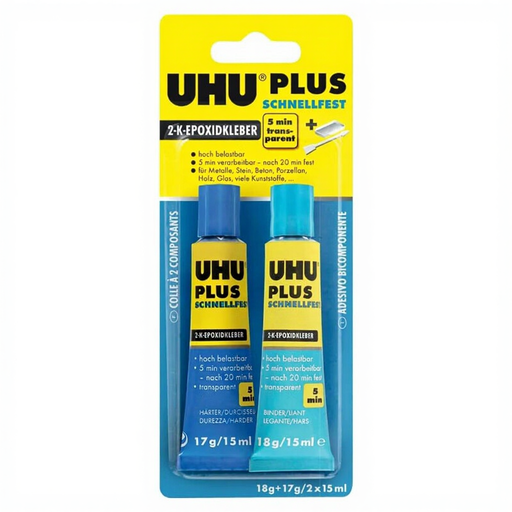
Why This Product Stands Out This epoxy-based 2-component adhesive is designed for fast, high-strength bonds. After mixing the two components, the adhesive cures quickly into a transparent, extremely durable bond. Its resistance to water, chemicals, and temperature fluctuations makes it a reliable solution for demanding repairs.
Advantages
Who Is It For? For DIY enthusiasts and crafters who need a permanent, high-strength bond for materials like metal, stone, concrete, porcelain, or rigid plastics. Perfect for repairs that will be exposed to mechanical stress or moisture.
View Product: UHU Plus Rapid 2-Component Adhesive
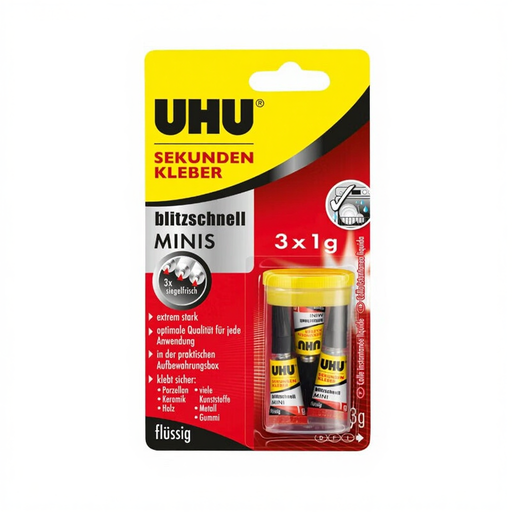
Why This Product Stands Out The main problem with super glues is that the tip dries out quickly after opening. UHU's solution is three separate 1g mini-tubes, ensuring you always have a fresh, sealed tube on hand. The liquid consistency is ideal for penetrating fine cracks via capillary action to create a nearly invisible bond.
Advantages
Who Is It For? For anyone performing quick, precise repairs around the house or for crafts on smooth, non-porous materials like plastic, metal, rubber, or porcelain. Ideal for snug-fitting bonds where the adhesive needs to remain invisible.
View Product: UHU Super Glue Mini, Liquid
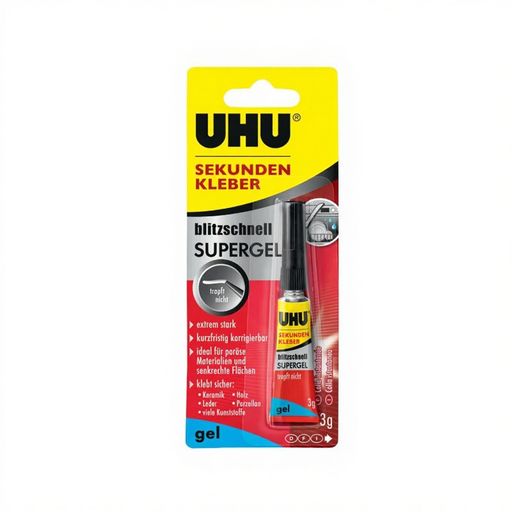
Why This Product Stands Out This Super Glue Gel solves a classic problem: dripping. Its gel consistency prevents it from running on vertical surfaces or overhead. Furthermore, the formula is designed to absorb vibrations and impacts better than conventional, brittle super glues. The solvent-free and low-odour composition is another bonus for indoor applications.
Advantages
Who Is It For? Ideal for model builders, crafters, and for household repairs where the adhesive must not run. Perfect for porous materials (e.g., wood, ceramic) and for bonding on vertical objects.
View Product: UHU Super Glue Gel
The selection presented here covers many, but not all, use cases. For special materials like flexible PVC, textiles, or for large-area bonding, UHU offers other specialised products. If you need a different type of adhesive, you can find more options in our broader category.
Discover the Full Range of Glues & Adhesives
The main difference lies in their consistency and application. Liquid Super Glue is very thin and ideal for smooth, tight-fitting breaks, as it penetrates the finest cracks. Super Glue Gel is thick, does not drip, and is therefore better suited for porous materials, uneven surfaces, and work on vertical areas.
The curing time varies depending on the product and ambient temperature. The UHU Plus Rapid often reaches handling strength in just a few minutes and final strength after a few hours. You will always find precise details on working and curing times in the manufacturer's product instructions. A full chemical cure can take up to 24 hours.
No, not every adhesive is suitable for every type of plastic. Bonding is particularly difficult with low-surface-energy plastics like polyethylene (PE) and polypropylene (PP), which are often used for containers or packaging. For such cases, there are special plastic adhesives that often include a "primer" for surface pre-treatment. Always check the material specifications on the adhesive's packaging.