
Lieferung heute & morgen

Qualitätsgarantie

Willkommens-Angebote freischalten: KOSTENLOSE Lieferung | Bis zu 80 % RABATT | Kostenlose 30-Tage-JoyPlus-Testphase
App herunterladen
A broken handle on a favorite mug, a loose shoe sole, or a craft project that requires stability—the search for the right adhesive is often critical to the success of a repair or project. The UHU range of adhesives is diverse, designed for different materials and requirements. Choosing the right product can be the difference between a short-lived patch-up job and a durable, reliable bond.
This guide is designed to give you a clear overview of different UHU adhesive types. We will introduce specific products and explain their ideal applications, so you can make an informed decision for your next project.
Before you decide on a glue, several fundamental properties should be considered. These will help you narrow down the selection to the product that best suits your needs.
The viscosity of the adhesive is a key criterion.
Not every bond needs to withstand extreme forces. For high-stress connections, especially when bonding metal or parts exposed to vibrations or impacts, a simple super glue is often not enough.
For items that regularly come into contact with water, such as dishes or bathroom accessories, water resistance is crucial.
Here is a selection of UHU products developed for typical needs in the home and workshop.
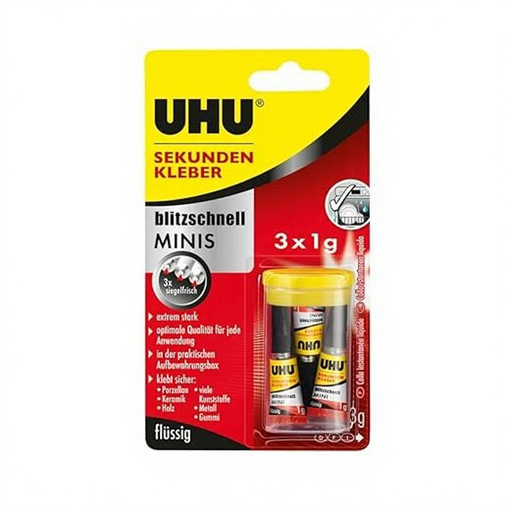
Why It Stands Out: The gel formula of this adhesive is a key advantage for precision work. It prevents dripping on vertical surfaces and gives the user more control. The manufacturer's claim of being dishwasher-safe makes it a practical option for repairing kitchen utensils or ceramic dishes. The set of three small 1g tubes is particularly convenient, as super glue tends to harden over time after being opened. This ensures you always have fresh, ready-to-use adhesive on hand.
Pros:
Who It's For: Users who need a controlled, drip-free application, for example, when repairing ceramic figurines, attaching handles, or working on craft projects on vertical objects.
View Product: UHU Super Glue Gel Ultra Fast Minis
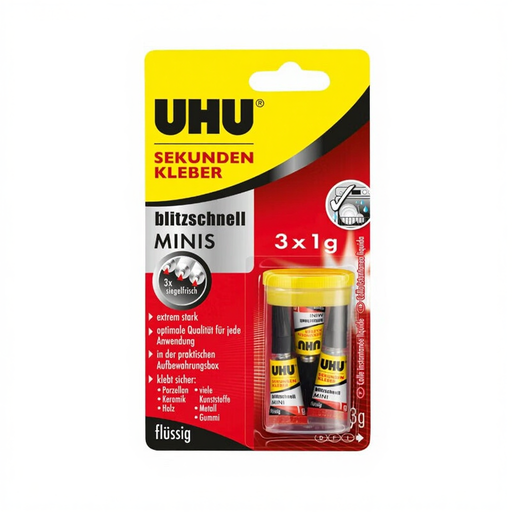
Why It Stands Out: This liquid super glue uses capillary action to penetrate the finest cracks and joints. This makes it the first choice for repairs where the break line should remain virtually invisible. Here too, the division into three 1g tubes ensures that larger quantities don't dry out. The included storage case helps keep the small tubes organized and within reach. According to the manufacturer, the bond is water-resistant and even dishwasher-safe, which expands its range of uses.
Pros:
Who It's For: Individuals looking to glue precisely fitting parts with very fine break lines, such as on broken hard plastic toys or delicate porcelain pieces where the bond line should be invisible.
View Product: UHU Super Glue Mini Liquid
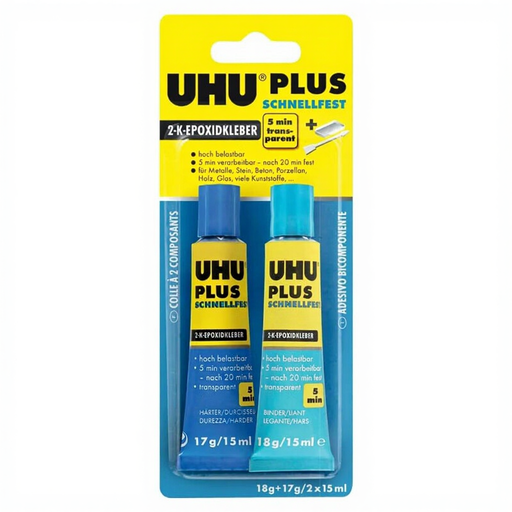
Why It Stands Out: As a 2-component adhesive based on epoxy resin, this product offers extremely high final strength. It is the solution for demanding bonds that must withstand mechanical stress, moisture, and chemicals. Its transparent cure also makes it suitable for visible repairs. It is excellent for bonding metal, as well as stone, concrete, porcelain, and many plastics. The rapid curing time allows for quick work without sacrificing maximum stability.
Pros:
Who It's For: DIY enthusiasts and users who need to perform a structural, permanent repair. Ideal for bonding metal parts, repairing stone slabs, or for connections exposed to extreme conditions.
View Product: UHU Plus Rapid 2-Component Adhesive
The products presented here cover many, but not all, applications. If you need a special adhesive for a specific material like flexible PVC, Styrofoam, or textiles, it's worth taking a look at the extended range.
Discover our full selection of original glue to find the right solution for your specific project.
Several UHU adhesives offer water resistance. The UHU Plus Rapid 2-Component Adhesive is completely water- and chemical-resistant after curing. The super glues UHU Super Glue Gel and UHU Super Glue Liquid are also described by the manufacturer as water-resistant and even dishwasher-safe, although durability heavily depends on the bonded material and correct application.
The main difference lies in the curing mechanism and the resulting load-bearing capacity. Super glue (cyanoacrylate) cures in seconds by reacting with air moisture. It is ideal for quick, precise bonds but has poor gap-filling properties. A 2-component adhesive (e.g., epoxy) cures through a chemical reaction between two components (resin and hardener). This process takes longer but results in a structurally stronger, often gap-filling, and more resilient bond.
If super glue gets on your skin, do not forcibly pull the skin apart. Soak the affected area in warm, soapy water and try to gently peel or roll the glue off. Alternatively, a cotton pad soaked in acetone (found in most nail polish removers) can help dissolve the glue. Proceed with caution and wash the skin thoroughly afterward.