
Lieferung heute & morgen

Qualitätsgarantie

Willkommens-Angebote freischalten: KOSTENLOSE Lieferung | Bis zu 80 % RABATT | Kostenlose 30-Tage-JoyPlus-Testphase
App herunterladen
By the Joybuy Product Recommendation Officer, Published on July 28, 2026
When repairing a cherished item or tackling a delicate craft project, choosing the wrong adhesive can do more harm than good. Many users simply grab any super glue off the shelf, only to face one of three common disappointments: the liquid glue runs uncontrollably and ruins the surface, the tube glues itself shut after the first use, or the bond breaks apart under the slightest stress.
These problems often stem from an unsuitable viscosity or a brittle cure. A conventional, low-viscosity glue is particularly ill-suited for vertical surfaces or porous materials. A UHU Super Glue Gel often provides a more reliable solution thanks to its specific properties. This guide explains the critical factors you should consider before buying to achieve a clean, stable, and long-lasting bond.
To avoid making the wrong purchase, it's essential to understand an adhesive's technical properties. Instead of being swayed by marketing promises, you should evaluate three specific criteria.
The consistency of the adhesive is crucial for a clean application. There are two basic types:
The term "universal" is often misleading. An adhesive's chemical composition determines on which materials it will develop a strong bond. A strong glue for plastic and ceramic must have different properties than an adhesive for flexible materials like rubber or leather.
Before purchasing, check the manufacturer's specifications on material suitability. Cyanoacrylate adhesives, the basis for most super glues, work well on many plastics, metals, ceramics, and rubbers. However, for certain plastics like polyethylene (PE) or polypropylene (PP), a special primer is often required.
A fast curing time alone does not guarantee a lasting repair. Standard super glues often cure to a very brittle state. This means the bond can easily break again when subjected to impacts, vibrations, or slight flexing.
For items that are moved or stressed in daily use—such as shoe soles, tool handles, or toys—a shock-resistant glue is essential. Products with flexible or impact-tough formulas can absorb these stresses, ensuring a significantly more durable bond.
Based on these criteria, we have identified products suited for specific user requirements.
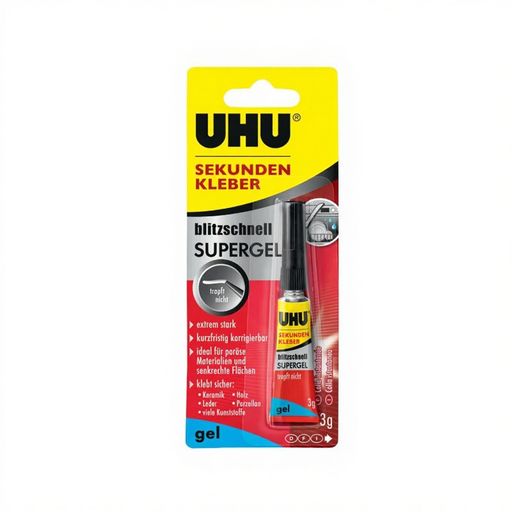
Why It's a Match: Ideal for demanding household repairs that require precision and a clean application. Perfect for reattaching a broken ceramic tile on a wall or fixing a mug handle without any drips.
The gel formula is drip-free, solving the problem of uncontrolled running. Its shock-resistant formulation also prevents the bond from becoming brittle and breaking under stress.
Controlled application on vertical surfaces. Vibration and shock-resistant bond. Solvent-free, according to the manufacturer.
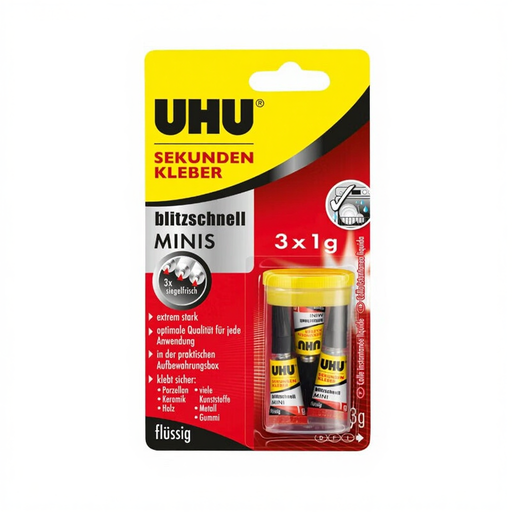
Why It's a Match: For delicate model-making tasks where the adhesive must penetrate the tiniest joints and gaps. The liquid consistency uses capillary action to create a discreet and strong bond.
The packaging into three separate 1g tubes solves the problem of the glue drying out. Instead of wasting a large tube, a fresh, sealed unit is opened for each project.
Liquid formula for tight fits. Practical single-use portions prevent drying out. Includes a storage case.
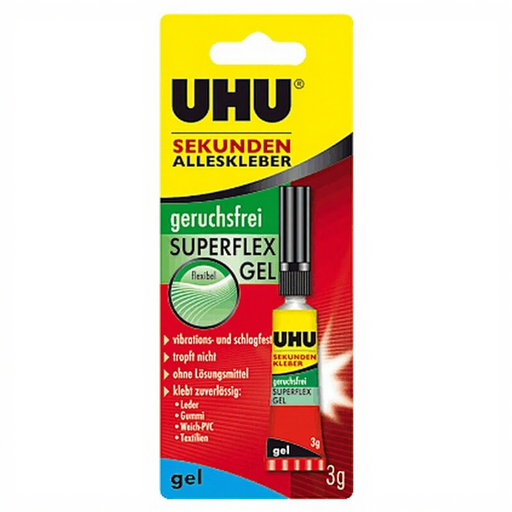
Why It's a Match: A versatile all-rounder for various household repairs, especially when the break lines aren't perfectly smooth. The flexible formula is ideal for items subject to light movement or impact.
The "Superflex" property makes this glue shock-resistant, preventing the bond from becoming brittle and breaking. According to the manufacturer, it is also suitable for materials with minor surface imperfections.
Odorless and solvent-free formula. Fills minor gaps. Drip-free gel consistency.
We have compiled a complete, up-to-date list of products that fully meet these strict selection criteria and safety regulations.
The required pressing time depends heavily on the materials and ambient temperature. According to the manufacturer, parts should be joined immediately after applying the glue and pressed together firmly for 10 to 60 seconds, depending on the material. Final bond strength is typically achieved after several hours.
Yes, cyanoacrylate gels like UHU's are very effective for bonding many common plastics (e.g., ABS, PVC, polystyrene) as well as porous materials like ceramic, porcelain, and wood. The gel formula prevents the adhesive from soaking into the material too quickly, which allows for a stronger surface bond. However, always check the manufacturer's material guidelines, as some plastics (PE, PP, Teflon) will not bond without a special primer.
To maximize its shelf life, the tip of the tube should be wiped clean with a dry cloth immediately after use and the cap screwed on tightly. Store the tube upright in a cool, dry, and dark place. Storing it in the refrigerator (not the freezer) can also extend its lifespan, but be sure to keep the glue out of the reach of children.