
Lieferung heute & morgen

Qualitätsgarantie

Willkommens-Angebote freischalten: KOSTENLOSE Lieferung | Bis zu 80 % RABATT | Kostenlose 30-Tage-JoyPlus-Testphase
App herunterladen
A broken handle on your favourite mug, a loose seal, or a delicate component in a model kit—many small repairs and craft projects require a fast and reliable bonding solution. Reaching for UHU Super Glue is often a natural choice, but the range of options can be overwhelming. The decision between a super glue gel and a liquid super glue depends heavily on your specific application.
This guide will help you understand the properties of different UHU super glues and find the perfect product for your project. We will highlight the differences in consistency, application, and the materials for which each adhesive is best suited.
Choosing the right adhesive can be the difference between a permanent fix and a recurring frustration. Consider the following points to make an informed decision.
The viscosity of the glue is one of its most important distinguishing features.
Not every super glue adheres equally well to all surfaces. UHU super glues are designed for a wide variety of materials, including porcelain, ceramic, wood, metal, and many plastics.
Super glue cures by reacting with ambient moisture. An opened tube can therefore quickly clog at the tip or dry out.
Based on different requirements, we have compiled a selection of UHU super glues that are well-suited for various projects.
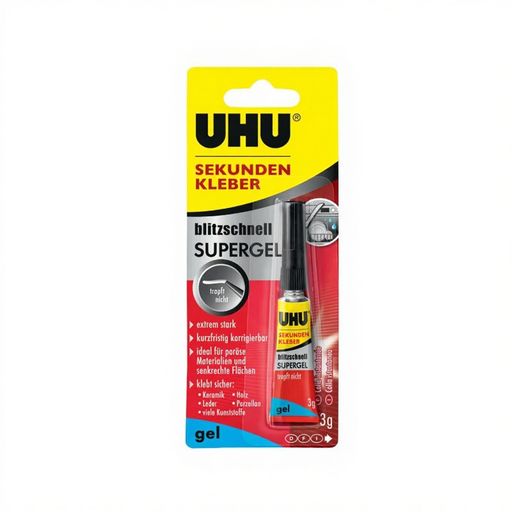
Why this product stands out: The gel formula makes this glue the top choice for applications where precision and control are essential. Since it doesn't run, it is perfect for working on vertical surfaces or for delicate bonding tasks where the adhesive must stay exactly where it is applied.
Advantages:
Who is it for?: For DIY enthusiasts and crafters who need a controlled, drip-free application, such as when repairing furniture, attaching decorative elements to walls, or in demanding model-making.
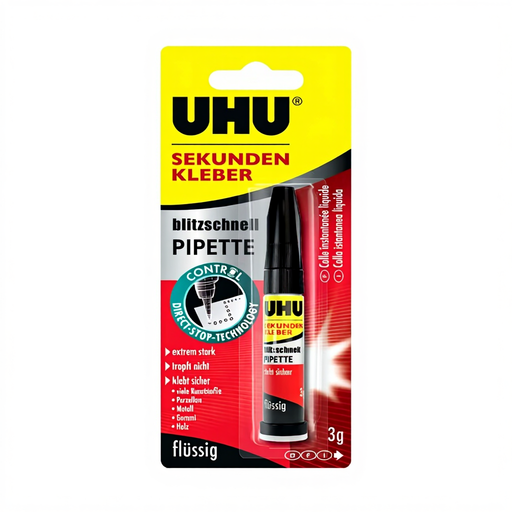
Why this product stands out: This liquid super glue combines extremely fast and strong bonding power with a highly precise application method. The fine-dosing tip and "Direct Stop" technology enable a clean, pinpoint application without any uncontrolled glue flow.
Advantages:
Who is it for?: A universal strong adhesive for the home and workshop. Ideal for quick repairs on smooth, tight-fitting breaks in ceramic, porcelain, metal, and many plastics.
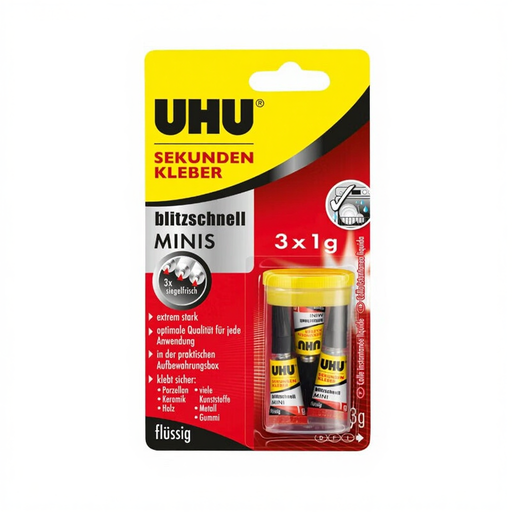
Why this product stands out: The problem of dried-out tubes is solved here by dividing the product into three separate 1-gram portions. This ensures you have fresh, fully effective adhesive for every application. The liquid consistency penetrates deep into fine cracks.
Advantages:
Who is it for?: Perfect for people who only occasionally need a strong adhesive and want to avoid waste. This option is also a great choice for crafters working on projects with very fine, tight-fitting parts.
The products featured here cover many common use cases. However, if you are looking for an adhesive for a very specific material or a special requirement, it's worth taking a look at other specialised products.
If you're looking for a solution for flexible materials, large surfaces, or other special requirements, you may find the right product in our wider selection of synthetic adhesives.
1. How do you remove UHU Super Glue from skin? If super glue gets on your skin, patience is key. Soak the affected area in warm, soapy water and try to gently roll or peel the glue off. Never pull forcefully on the skin. Alternatively, a cotton pad soaked in acetone (found in most nail polish removers) can help dissolve the glue. Proceed with caution.
2. Is UHU Super Glue waterproof? Some UHU Super Glue variants are labelled as "waterproof" or even "dishwasher-safe." This will be noted on the packaging. However, water resistance also depends heavily on the materials being bonded and correct application. For continuous underwater use, special epoxy adhesives are generally more suitable.
3. How should UHU Super Glue be stored to extend its shelf life? Always store super glue tightly sealed, upright, and in a cool, dry place. Some users report a longer shelf life when stored in the refrigerator (not the freezer). It is important to let the tube return to room temperature before the next use to prevent condensation from forming inside.