For long lessons with multiple audio tracks, an ultrawide monitor gives you more room on the timeline. If you want to check 4K image detail and small on-screen graphics, a 4K display is a better fit. Choose colour modes and, if needed, calibration to suit your output format, and check the connections, charging power and desk space available. A monitor won’t synchronise separately recorded audio for you: that’s done in your editing software, for example using the relevant features in Adobe Premiere.
Who these monitors are for
Editing with multiple audio tracks
When you’re editing longer lessons, a clear timeline can help you keep both the footage and separately recorded speech in view. Adobe explains how to synchronise video and audio, as well as display audio waveforms in Premiere.
Checking 4K and colour
If you’re assessing image detail or colour for a particular output format, check the native resolution and available colour modes. BenQ, ASUS and EIZO list different colour mode or calibration features for specific models.
Editing on a laptop
If your monitor will be used with a laptop, make sure the video connection, potential power delivery and desk space work for both your computer and your setup. Manufacturer information on USB-C and charging power applies to the specific model.
What to look for when choosing
First, decide whether the timeline or preview matters more for your editing. Then check your colour workflow and connection requirements.
| What matters |
What to check before buying |
Who it matters most to |
| Timeline and audio tracks |
Aspect ratio, resolution and how clearly your planned track and window layout will display. |
If I want to keep long lessons and separate audio tracks in view at the same time, timeline space is especially important. Around 36% of consumers put this need first. |
| Colour checking |
Output format, available colour modes and whether a calibration process is planned. |
If the colours need to look right for my planned video output, I check for a suitable mode and consider my workflow, rather than focusing on just one colour specification. Around 29% of consumers put colour checking first. |
| 4K detail and on-screen graphics |
Resolution of the footage, as well as preview and scaling settings. |
If I want to assess small graphics or 4K image detail, native vertical resolution matters more to me than extra timeline width. Around 21% of consumers prioritise this level of detail checking. |
| Laptop and editing setup |
Video output, required charging power, a suitable cable and the space needed for the monitor and stand. |
If the monitor needs to work with my laptop and fit on my desk, I check the connections, power supply and space requirements first. Around 14% of consumers see how well it fits their workspace as their top priority. |
Common buying misconceptions
-
Assuming a wide screen gives you a native 4K preview
An ultrawide format can give you more horizontal room for your timeline and windows, without matching the native vertical resolution of a 4K display. For example, the LG 34BA75QE-B has a resolution of 3440 × 1440 pixels, while the BenQ PD2706U has 3840 × 2160 pixels.
Decide whether extra timeline width or native vertical resolution matters more for your editing.
-
Assuming colour gamut figures guarantee accurate colours
Manufacturer information about colour modes or colour gamut coverage alone doesn’t tell you how accurately your configured editing setup will reproduce colour.
Choose your output format, then check whether the monitor offers a suitable mode and whether your workflow includes calibration.
-
Assuming a USB-C port guarantees video and enough charging power
USB-C features and charging power vary by model. A power delivery specification doesn’t automatically mean your laptop, connection and cable will all work together.
Check your computer’s video output, its charging requirements and whether the cable is suitable. Depending on your laptop, you may still need its power adapter or a compatible connection cable.
Brands and models to consider
BenQ
The PD2706U is a documented 27-inch 4K option for editing setups where a selectable colour mode and USB-C are useful.
- BenQ lists a resolution of 3840 × 2160 pixels, a Rec.709 mode and USB-C with 90 W power delivery.
- The colour and connection specifications apply to this model; they don’t confirm the accuracy of your configured workspace or compatibility with a particular laptop.
LG
The 34BA75QE-B is a wide 21:9 option for a spacious timeline, while the 27UP850K-W is a separate 27-inch 4K model.
- LG lists a resolution of 3440 × 1440 pixels for the 34BA75QE-B and 3840 × 2160 pixels for the 27UP850K-W.
- The ultrawide model doesn’t have the native vertical resolution of the 4K model mentioned here; their features aren’t interchangeable.
ASUS
The ProArt PA279CRV is a 27-inch 4K option with selectable colour modes and USB-C.
- ASUS lists Rec.709 and sRGB modes, among others, as well as USB-C with 96 W Power Delivery.
- Manufacturer claims about colour accuracy aren’t measurements of the specific unit you’ve bought and set up.
EIZO
The ColorEdge CS2740 is designed for workflows that include regular colour checking and calibration.
- EIZO describes hardware calibration with ColorNavigator for the CS2740.
- Calibration doesn’t automatically give you more room for a wide timeline, and it requires a properly set up colour workflow.
Dell
The UltraSharp U2725QE is a 27-inch 4K monitor with a hub, for setups where connectivity matters.
- Dell lists a built-in hub and a resolution of 3840 × 2160 pixels for this model.
- According to Dell, the model doesn’t have a built-in speaker; hub features won’t synchronise separately recorded audio tracks.
Joybuy monitors for wide timelines
These Joybuy monitors are designed around wide 21:9 workspaces for timelines and multiple editing windows. Resolution varies by model, so choose one that suits your needs for previewing detail.
 No image available
INNOCN 40C1U, 40-inch, 5120 × 2160
The 21:9 format gives you a wide workspace for timelines and multiple editing windows, while the stated resolution also provides 2160 vertical pixels for viewing detail.
IPS display; 100 Hz; USB-C with 65 W Power Delivery; height-adjustable stand.
View at Joybuy
 No image available
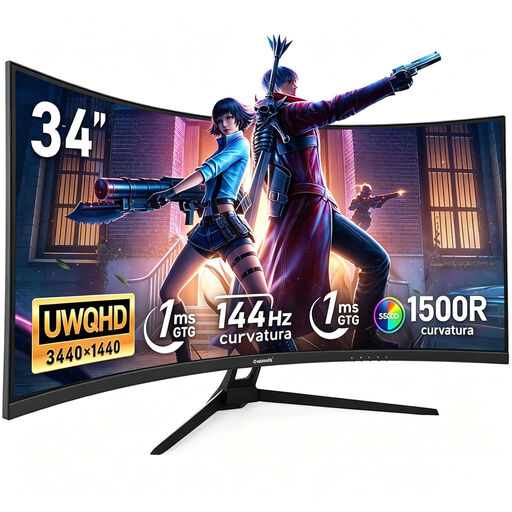
Gawfolk 34-inch curved, UWQHD 3440 × 1440
The 21:9 format can give you room for a wide timeline and multiple windows. Its resolution of 3440 × 1440 pixels doesn’t match the native 4K vertical resolution of 2160 pixels.
144 Hz; 1500R curvature; 100% sRGB according to the product listing; no speakers.
View at Joybuy
Frequently asked questions
Will a larger monitor automatically synchronise separately recorded voice files?
No. Synchronising separately recorded video and audio clips is a feature of editing software, not the monitor. Adobe explains this feature and how to display audio waveforms in Premiere. Choose a monitor based on the space you need and the level of image checking you want to do.
What should I check when connecting a laptop for editing?
Check whether your laptop’s port can output a video signal over the intended USB-C connection, how much charging power it needs and whether the cable is suitable. BenQ lists DisplayPort Alt Mode and 90 W Power Delivery for the PD2706U; this doesn’t automatically confirm compatibility with a particular laptop.
What should I consider for colour checking and extended use?
Set up the preview, timeline and text scaling so they’re easy to read at your workstation. If you regularly assess colour, plan a colour workflow that suits your output format and consider calibration; EIZO describes hardware calibration with ColorNavigator for the CS2740.
What rights apply when buying a monitor online from a business seller?
For goods purchased under a relevant distance selling contract, the EU consumer portal generally explains that you have 14 days from delivery to withdraw from the contract. For faulty goods, a minimum two-year legal guarantee applies against the business seller within the scope of the relevant legislation; this is separate from any additional manufacturer’s guarantee. Check the terms and applicable exceptions for your specific purchase.
Do monitors have an EU energy label?
The European Commission generally classifies computer monitors as electronic displays with an A to G energy label; exceptions apply to certain display types. Check the product information for the specific model rather than assuming its efficiency rating based on screen size or brand.


