For album double-page spreads at a standing desk, a 34-inch ultrawide with 3,440 × 1,440 pixels is a sensible starting point if you want to see your layout and tools side by side. Before you buy, check that the preview is easy to read at your preferred scaling and that the monitor and stand will fit on your desk. For print checks, you’ll also need the right monitor profile, calibration and print profile.
Who is an ultrawide monitor for?
Album designers working with lots of panels
If you want to see your double-page spread, image selection and tools at the same time, usable resolution and window layout are important factors to consider. ASUS and BenQ list features on their respective ultrawide models that are designed for a wide workspace.
Designers approving print work
If you need to check print colours as well as your layout, your colour-management workflow and the right output profile are key. EIZO identifies calibration and print colour spaces as important aspects of colour control.
Standing desk users
If you change your working position or have limited desk space, check the monitor’s width and depth, including the stand, as well as its height adjustment. ASUS lists these measurements for individual models; the BAuA recommends adjusting screen position to suit individual needs.
Which buying considerations matter most?
First check how easy your album spread is to read, then consider your colour workflow and setup, and finally make sure the connections are compatible with your computer.
| What matters |
What to look for when buying |
Who should pay particular attention? |
| Easy-to-read double-page spread |
View the spread in your software at your preferred scaling and allow room for control panels. 3,440 × 1,440 pixels provide a wide workspace, but the preview you can actually see also depends on your window layout and scaling. |
I want to see the double-page spread and tools clearly at the same time; around 36% of consumers put a clear overview of the layout first. |
| Print colours and soft proofing |
Check that your monitor profile and calibration options work with the output profile. EIZO points out that common CMYK colour spaces can extend beyond sRGB, so sRGB, DCI-P3 and Adobe RGB are not interchangeable. |
If I want to check album colours before approving a print, I need a suitable colour workflow, not just a wide screen; around 29% of consumers prioritise print colour checking. |
| Setup and viewing position |
Compare your desk space with the monitor’s dimensions, including the stand, and check the height range for your working positions. ASUS lists the PA348CGV as 81.76 cm wide and 24.50 cm deep with its stand, with 0–115 mm of height adjustment. |
The monitor and stand need to fit on my standing desk and adjust to suit my working position; around 21% of consumers put a suitable setup first. |
| Laptop connection |
Check video output through the specific port on your laptop and make sure the charging power is sufficient. ASUS lists 90 W for the PA348CGV, while AOC specifies up to 65 W USB-C Power Delivery for the CU34P3CV. |
If I want to connect my laptop with as few cables as possible, the video output and charging requirements need to match; around 14% of consumers prioritise easy laptop connectivity. |
Common buying misconceptions
-
Assuming a colour gamut percentage guarantees print accuracy
sRGB, DCI-P3 and Adobe RGB refer to different colour spaces. A manufacturer’s stated specification alone can’t predict how your album will look in print.
Choose your output workflow first, then check the colour modes and profiling options of the specific monitor. For soft proofing, the monitor and print profiles need to suit the workflow you intend to use.
-
Comparing screen size alone, rather than the preview and desk space
Control panels and scaling can affect the album preview you can actually see; the stand also takes up desk space.
Try your window layout and measure the available width and depth. Only consider an alternative mount if it’s compatible with your desk and its fittings.
-
Assuming USB-C always means a universal one-cable setup
A USB-C port doesn’t guarantee that your laptop can output video through it or receive enough power to charge. ASUS lists 90 W for the PA348CGV; AOC specifies up to 65 W for the CU34P3CV.
Check video output and charging requirements against your specific laptop before prioritising docking features.
If the video output or charging power isn’t suitable, you may need extra connections or a separate power supply.
A guide to relevant brands
ASUS
The ProArt PA348CGV is a flat 34-inch ultrawide designed to provide a spacious creative workspace.
- ASUS lists an IPS panel, 3,440 × 1,440 pixels, 100% sRGB, 98% DCI-P3, USB-C with 90 W and 0–115 mm of height adjustment for this model.
- These specifications don’t confirm Adobe RGB coverage or that the monitor is suitable on its own for approving print work.
BenQ
The DesignVue PD3420Q is an ultrawide for creative workspaces; the PhotoVue SW272Q is a separate 27-inch model for more colour-focused checks.
- BenQ lists USB-C, a USB hub and KVM for the PD3420Q. For the SW272Q, BenQ specifies 99% Adobe RGB.
- The SW272Q’s colour gamut specification can’t be applied to the PD3420Q.
Dell
The curved UltraSharp U3425WE is a 34.1-inch ultrawide with a hub for a laptop workstation.
- Dell lists 3,440 × 1,440 pixels, an IPS Black panel, height adjustment and 90 W power delivery.
- The model specifications don’t confirm that the monitor will suit your individual ergonomic setup or provide a calibrated print workflow.
LG
The UltraWide 34U650A-B is a curved IPS monitor for wide layouts and everyday viewing.
- LG lists 3,440 × 1,440 pixels, typical 99% sRGB and factory calibration.
- These specifications don’t confirm Adobe RGB coverage or a match with a particular album print.
AOC
The Pro-Line CU34P3CV is a curved VA ultrawide with USB-C docking.
- AOC lists 3,440 × 1,440 pixels and USB-C with up to 65 W.
- The charging power needs to suit your laptop; the model specifications don’t confirm particular suitability for colour-critical print approval.
Joybuy products for album double-page spreads
The Joybuy products below are ultrawide monitors for viewing wide layouts. Check that each model’s resolution, stand and connections suit your workspace.
 No image available
CRUA 49-inch DQHD ultrawide monitor, 5120 × 1440, 165 Hz
The 49-inch screen and 32:9 format are an option if you want plenty of horizontal space for viewing your layout; check that the preview is easy to read at your chosen scaling.
The title lists 5120 × 1440 pixels, 165 Hz, a curved 1500R display and a height-adjustable stand.
Connections listed include HDMI 2.1 and DisplayPort 1.4.
View at Joybuy
 No image available
INNOCN E34A1R 34-inch UWQHD monitor, 3440 × 1440
At 34 inches and 21:9, this model is an option for viewing a double-page spread alongside control panels; check beforehand that it remains easy to read at your chosen scaling.
The title lists 3440 × 1440 pixels, a VA panel, 200 Hz and a height-adjustable stand.
PIP and PBP, as well as connections for a laptop, HDMI and DisplayPort, are also listed.
View at Joybuy
 No image available
INNOCN 40C1U 40-inch ultrawide monitor, 5120 × 2160
The 40-inch screen and 5120 × 2160 pixels are an option if you want to view a wide album preview with more vertical pixels than on a 3,440 × 1,440 display.
The title lists a flat IPS panel, a 21:9 format and 100 Hz.
USB-C Power Delivery with 65 W, PIP/PBP and a height-adjustable stand are also listed.
View at Joybuy
 No image available
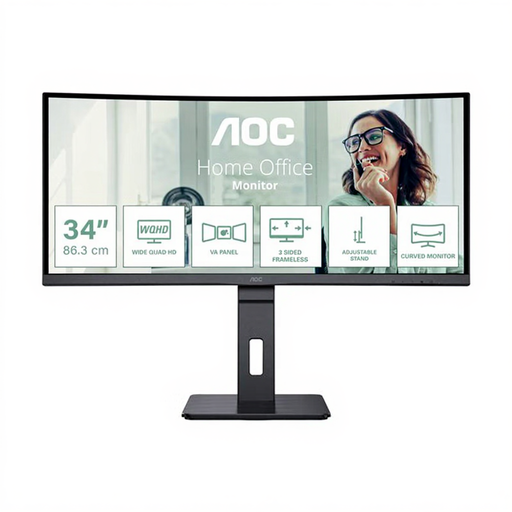
AOC Pro-Line CU34P3CV 34-inch ultrawide monitor
At 34 inches and 3440 × 1440 pixels, this is an option for wide layouts; check that the double-page spread and control panels are both easy to read at your preferred scaling.
The title lists a curved VA panel, 100 Hz and USB-C with 65 W.
KVM, RJ45, HDMI, DisplayPort and a stand with 150 mm of height adjustment are also listed.
View at Joybuy
 No image available
Philips 345B1C 34-inch ultrawide monitor, 3440 × 1440
At 34 inches and 3440 × 1440 pixels, this is an option for a wide album preview; check that your window layout is easy to read in your intended workspace.
The title lists a curved VA panel with 100 Hz and 1500R.
A USB hub and a height-adjustable stand are also listed.
View at Joybuy
Frequently asked questions
Is a wide monitor enough to check the album’s print colours?
No. For colour-critical checks, you need a suitable, profiled monitor and a soft proof using the right output profile. A wide colour gamut alone doesn’t guarantee a match with the printed result.
How do I check the setup at a standing desk?
Measure the usable desk space, compare it with the monitor’s dimensions including the stand, and check the adjustment range in your actual working positions. The Federal Institute for Occupational Safety and Health recommends adjusting screen position to suit individual needs.
What ongoing costs and rights should I consider?
Check the EU energy label for the specific monitor. The European Commission also outlines product-specific energy labelling and ecodesign requirements for electronic displays. For a consumer purchase in Germany, statutory rights for faulty goods are distinct from a voluntary manufacturer’s guarantee. The Verbraucherzentrale explains the difference on 28 September 2026; online purchases generally come with a 14-day right to cancel, as the Verbraucherzentrale explains on 13 August 2026.
Are there special monitor regulations for using a standing desk at home?
The ASR A6 rules on screen-based work set out requirements within their scope of application to workplaces and don’t apply universally to private use. Product-specific ecodesign and energy labelling rules apply to electronic displays on the EU market, as explained by the European Commission.
How should I dispose of an old monitor?
Take it to a separate electrical and electronic equipment collection point, such as a local council recycling centre, and don’t put it in household waste. The German Environment Agency advises disposing of electrical appliances separately; check locally which take-back options are available from retailers in your case.


