Designers making colour decisions
If you judge reference colours for designs, you need suitable colour modes and a display you can control. The requirements are more demanding than simply viewing images.


If you judge colours against reference artwork, colour gamut and colour controls should matter more than screen width alone. If you simply want to view artwork alongside work windows, usable resolution and positioning are the main considerations. At a shared workstation, suitable laptop connections and easy adjustment also matter. Manufacturers’ claims about colour gamuts do not prove that two workstations will display the same colours.
If you judge reference colours for designs, you need suitable colour modes and a display you can control. The requirements are more demanding than simply viewing images.
If you want to view artwork and work windows at the same time, look for a suitable resolution and a setup that works for your space.
When several people share the same desk and monitor, individual settings, thoughtful positioning and an easy way to switch devices become important.
| Buying priority | What to check | Who is it important to? |
|---|---|---|
| Judging colours | Check the monitor’s colour gamut and colour modes against your reference material, and look at its calibration information. | If I make colour decisions based on reference images, I need a suitable colour mode, not just a large screen. Around 33% of consumers put colour judgement first. |
| Viewing reference material alongside work windows | Check the resolution, window layout, and the width of the screen and stand against your workspace. | If I want to keep reference material and applications open at the same time, everything needs to remain legible at my viewing distance. Around 27% of consumers prioritise viewing things side by side. |
| Setting up a shared workstation | Consider the adjustment options, screen finish, desk space and reflections from the intended seating positions. | If different people use the monitor in different lighting conditions, I need a setup that can be adjusted to suit each person’s position. Around 20% of consumers prioritise an ergonomic setup. |
| Switching between devices | Check USB-C video support and charging requirements for each laptop, along with KVM and USB connections. | If I connect different laptops at a shared workstation, I want video and power to work with the devices actually being used. Around 20% of consumers prioritise easy device switching. |
Manufacturers’ claims about colour gamuts and calibration do not, on their own, tell you how consistent the display will be at your particular workstation or whether it will match a print.
Before you buy, decide whether you will simply view reference material or make critical colour decisions based on it. Then check that the colour mode and controls suit your workflow.
The monitors listed offer different levels of USB-C charging power, and each laptop must also support the video output you need.
Check the video signal and required charging power for every laptop that will be used at the shared workstation.
An anti-glare finish will not automatically eliminate reflections caused by poor lighting or unsuitable positioning. With several users, seating positions and adjustment needs will also vary.
Assess the location and intended seating positions before you buy. For workplace display screen equipment, involve the person responsible for workstation design.
The ProArt PA348CGV is a 34-inch example designed for creative work, with an IPS panel and 3440 × 1440 pixels.
The Creative Pro PD3420Q is designed to support several reference colour spaces and image editing.
The FlexScan EV3451X is positioned as an office monitor with a wide workspace and docking features.
The UltraSharp U3425WE is a 34-inch model with an IPS Black panel and a hub for shared workstations.
The UltraWide 34U650A-B is a 34-inch example for viewing reference material and office applications.
This selection includes ultrawide monitors for viewing reference images alongside work windows, as well as for shared office workstations. If colour decisions matter, product information about colour reproduction is no substitute for checking your own workflow.
 No image available
The 21:9 aspect ratio and stated resolution are relevant if you want to view reference images alongside work windows; PIP/PBP is listed for viewing two sources.
34 inches, 3440 × 1440, VA, 200 Hz, 1500R, PIP/PBP, height-adjustable, HDMI and DisplayPort.
Consider the view from your intended seating positions when assessing the 1500R curvature.
 No image available
If you want to view reference artwork and work windows side by side on a large screen, consider the 40-inch format and stated resolution.
40 inches, 5120 × 2160, IPS, 100 Hz, USB-C with 65 W Power Delivery, PIP/PBP and height-adjustable. DeltaE <2 is stated in the product title; this figure alone does not prove colour matching with other workstations or print results.
 No image available
The 21:9 aspect ratio and 3440 × 1440 pixels are listed for a wide workspace. Check that the curved display works for your intended seating positions.
34 inches, UWQHD, VA, 180 Hz, 1500R, HDMI, DisplayPort and USB.
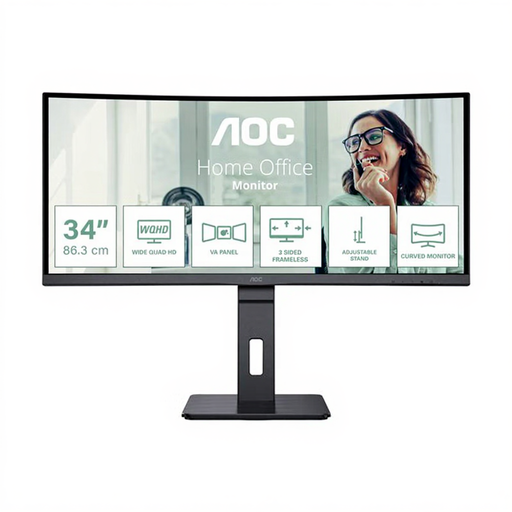 No image available
If people switch between laptops at a shared workstation, the listed USB-C and KVM features are relevant. Check compatibility with the devices you use.
34 inches, 3440 × 1440, 100 Hz, VA, USB-C with 65 W, KVM, RJ45, HDMI and DisplayPort.
Assess the 1500R curvature from the intended seating positions. USB-C video and charging power must be suitable for the laptops.
 No image available
The 21:9 aspect ratio and stated resolution are relevant for viewing reference material and applications side by side; MultiView PIP/PBP is listed for two sources.
34 inches, 3440 × 1440, 100 Hz, VA, 1500R, USB hub and height-adjustable.
Consider the view from your intended seating positions when assessing the 1500R curvature.
Not simply because the screen is wide. If you judge colours, match the colour mode to your reference material and check your colour workflow. If you only want to view images alongside applications, usable resolution is the first thing to consider; colour gamut and calibration figures remain manufacturer claims relating to specific models.
Check the available space, the view from the intended seating positions, potential reflections, and whether the height and tilt can be adjusted. For workplace display screen equipment, ASR A6 from the Federal Institute for Occupational Safety and Health sets out requirements within its scope; an anti-glare finish is no substitute for suitable positioning.
No. Check that the monitor supports the video signal and charging requirements of the specific laptop. BenQ Europe lists 65 W over USB-C for the PD3420Q, while EIZO Germany lists 94 W for the EV3451X; both figures apply to the respective models.
Compare the EU energy label and model information in EPREL on a like-for-like basis. The European Commission describes the label as a scale from A to G, with information on energy consumption and, where applicable, HDR performance. Also check the specific warranty terms: EIZO lists seven years for the EV3451X, not as a blanket warranty for every model included here.
The workplace rules cited do not impose a general ban or a special approval requirement solely because a monitor is ultrawide. Workstations within the scope of the Workplace Ordinance must meet the relevant requirements; ASR A6 sets these out for its area of application. The EU energy label concerns the labelling of monitors when placed on the market, not permission for employees to use them.